
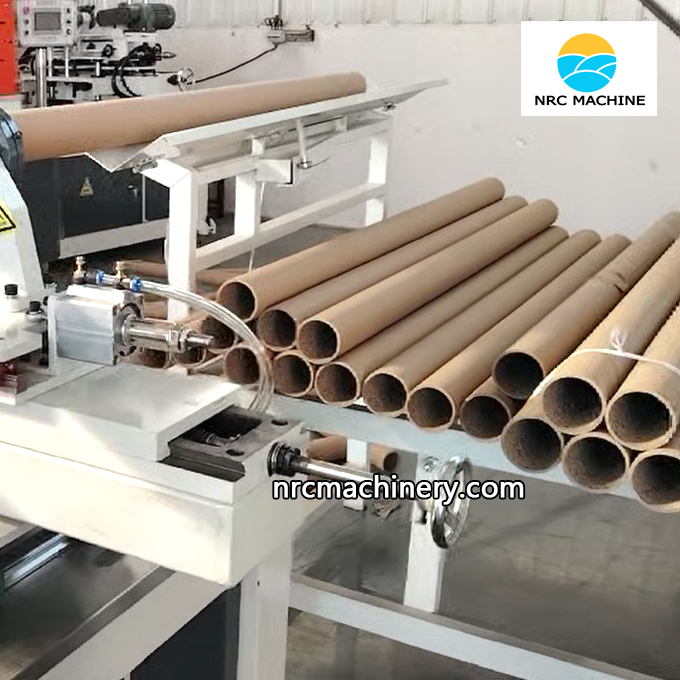


What is a Spiral Paper Tube Making Machine?
It is an industrial machine that manufactures hollow, cylindrical tubes or cores by spirally winding multiple plies (layers) of paper, board, or other flexible materials onto a mandrel, using a continuous helical wind. This is distinct from parallel winding (where the paper edges are straight and parallel to the tube axis).
The spiral method allows for the production of very long tubes that can be cut to any desired length and is excellent for creating strong,
durable tubes with consistent wall thickness.
Working Principle (Step-by-Step)
Unwinding: Rolls of paper (kraft paper, laminated paper, specialty boards, etc.) called "parent rolls" are mounted on unwind stands. Multiple rolls (2-8 typically) are used to create multiple plies for strength.
Gluing: Each paper web passes through a glue application system (e.g., roller glue applicator). A precise amount of adhesive (PVAc, hot melt, etc.) is applied to one side of each ply.
Spiral Winding & Forming: This is the core of the machine. The glued paper strips are fed at a specific, fixed angle onto a rotating, heated steel mandrel. The angle of feed combined with the mandrel's rotation creates the spiral helix. The paper is wound tightly around the mandrel, with the edges of each strip overlapping the previous layer's edge, building up the wall thickness.
Heating & Curing: The heated mandrel and sometimes external heaters quickly cure the adhesive, setting the tube's shape and ensuring a
strong bond between plies.
Drawing & Cutting: As the tube is formed, it is continuously pulled off the mandrel by a set of powered traction belts or rollers. It then
passes through a traveling cut-off saw (often a circular or band saw) that cuts it to pre-set lengths.
Ejection & Stacking: The cut tubes are ejected, often automatically counted and stacked, ready for packaging or further processing (like
printing, plugging, or capping).
Key Machine Components
Unwind Stands: Hold the parent paper rolls, often with tension control and automatic splicing for non-stop operation.
Gluing System: Precision tanks, pumps, and rollers to apply adhesive uniformly.
Forming Mandrel: The heart of the machine. A long, tapered, polished, and heated steel shaft that determines the tube's inner diameter (ID). Length determines maximum tube length before cutting.
Forming Head/Base: The assembly that guides the paper strips onto the mandrel at the precise angle.
Traction/Pulling Unit: A system of synchronized belts or rollers that provides the pulling force to draw the tube off the mandrel.
Cut-Off Saw: A synchronized, traveling saw for accurate length cutting.
Control System: Modern machines use PLC (Programmable Logic Controller) and HMI (Human-Machine Interface) panels to control speed, temperature, length, glue amount, etc.
Stacker/Ejector: Automates the collection of finished tubes.
Common Applications of Spiral Tubes
Industrial Cores: For winding textiles, films, foils, tapes, labels, and paper.
Packaging: Mailing tubes, poster tubes, concrete tube forms (Sonotubes), packaging for carpets, vinyl rolls, and fireworks.
Consumer Goods: Cores for toilet paper, paper towels, aluminum foil, and cling film.
Specialty Tubes: Electrical insulation tubes, fabric rolls in mills, and construction forms.
Types & Selection Considerations
When looking for a machine, consider:
Level of Automation:
Basic/Semi-Automatic: Manual roll loading, simpler controls.
Fully Automatic: Auto splicing, PLC control, automatic stacking. Higher output, less labor.
Production Capacity:
Tube Diameter Range: Machines are built for specific ID ranges (e.g., 10mm - 150mm or larger).
Wall Thickness: Determined by the number of ply stations.
Production Speed: Ranges from 20-30 meters/minute for basic machines to over 100 m/min for high-end models.
Material Flexibility: Can it handle kraft, recycled paper, laminated/coated papers, plastic films, or non-wovens?
Key Specifications:
Main Motor Power: (e.g., 5kW - 15kW)
Mandrel Heating: Electric or thermal oil.
Max & Min Tube Length.
Glue Type Compatibility.
Advantages of Spiral Winding
Continuous Length: Can produce tubes longer than the mandrel.
High Strength-to-Weight Ratio: The cross-grain structure provides excellent crush resistance.
Smooth Inner/Outer Surface.
Versatility in Materials and Diameters.
Roll tube paper layer | 3-25 (layers) |
Paper tube diameter | 20-200 (mm) |
Paper tube thickness | 2-16 (mm) |
The Finished Paper Tube Core Cutter Length | ≥1000mm |
Production speed | 0-40 (m / min) |
Fixed-length mode | Light Control (Infrared) |
Winding machine head | Four machine head |
Cutting method | Single round knife cutting |
Core mold fixed way | Flange plus tight |
Glue way | Double-sided adhesive |
control method | Frequency |
Input voltage | 380V / 220V |
Number of operators | 1-3 people |


