




Compact Toilet Paper Making Production Line for Small & Medium Tissue Manufacturers
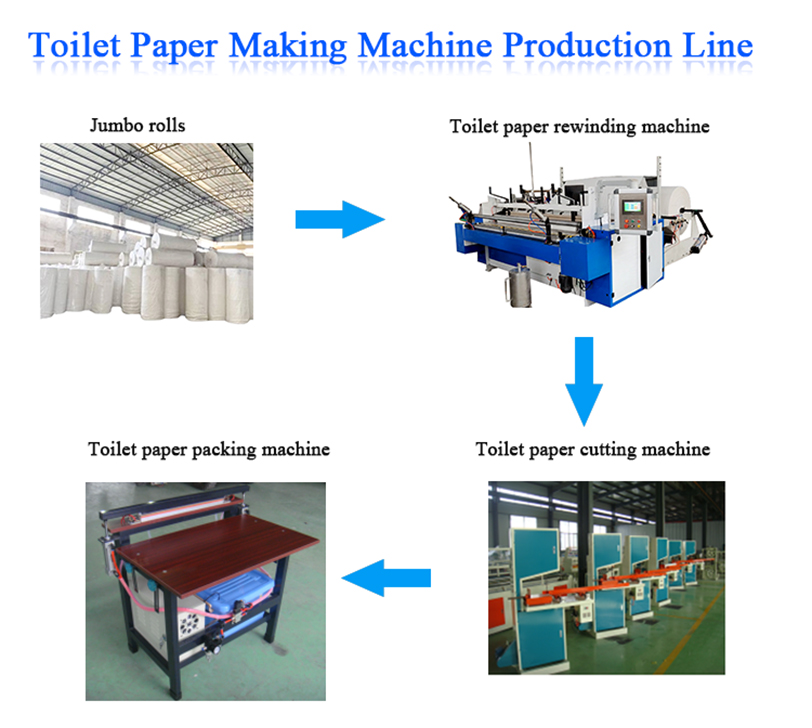
A toilet paper making machine is a compact integrated production line built specifically for low to medium production capacity. It serves perfectly for small businesses, new startups, community-based manufacturing workshops, and farm sideline diversification projects. The equipment converts huge jumbo parent paper rolls into market-ready finished toilet paper rolls, helping entrepreneurs quickly launch tissue production with reasonable investment and flexible layout.
There are two primary configurations available on the market: semi-automatic and fully automatic models, which cater to different budget scales and production targets.Semi-Automatic Machines: This version demands relatively more manual intervention during operation. Operators need to finish tasks such as paper core loading, raw paper feeding, roll replacement, and finished product packing manually. It features a lower upfront purchase cost, simple operation logic and easy maintenance. This option is highly recommended for micro startups with limited capital and small daily output requirements.
Fully Automatic Machines: As integrated continuous production lines, these systems realize automated rewinding, embossing, perforating, slitting, log cutting, and optional automatic wrapping. Once production parameters are preset via the control panel, the line runs continuously with minimal human operation. It delivers larger hourly output, stable product quality and consistent roll size, which reduces defective rates and labor expenses in mass production.
1.Key Components of a Complete Small Production Line
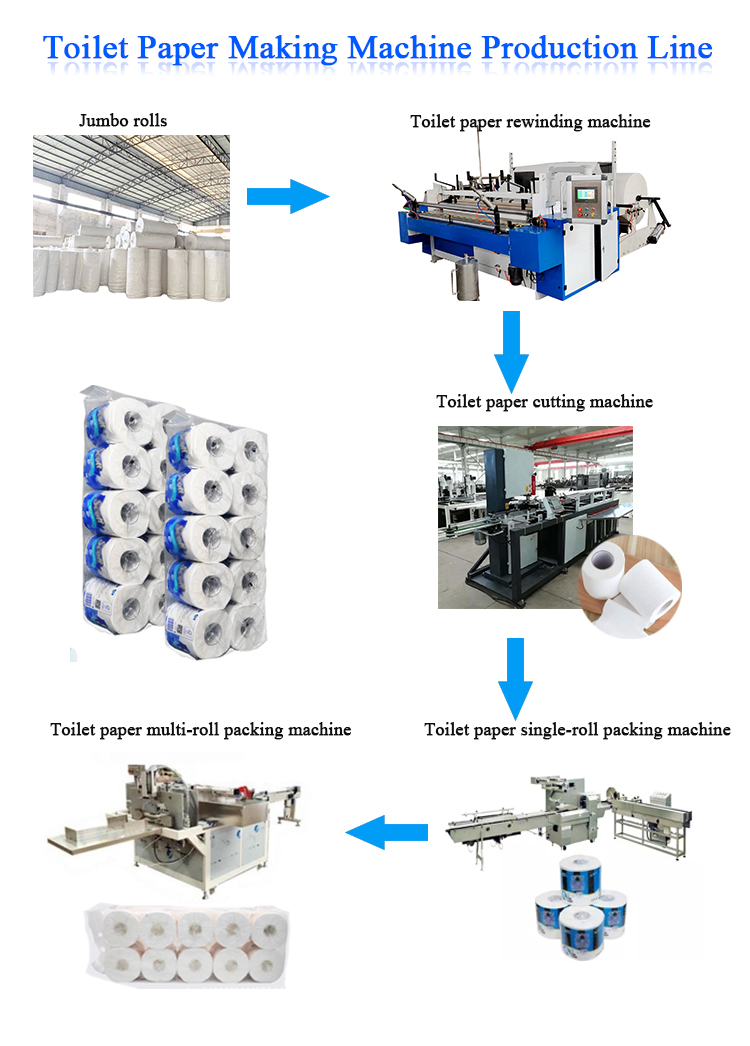
A full toilet paper production setup is not a single standalone unit but a matched combination of connected equipment working in sequence. Each module undertakes an independent production step and collaborates seamlessly to complete the whole tissue converting workflow.
Toilet Paper Rewinding Machine: The core host equipment of the entire line. It unwinds jumbo parent rolls, stacks 1 to 3 layers of tissue paper, embosses custom patterns, adds perforation lines, and winds layered paper onto cardboard cores. After rewinding, long continuous paper logs are produced for subsequent cutting processing. Operators can adjust embossing depth, perforation spacing and paper tension to customize softness and appearance of final toilet rolls.
Log Saw / Cutting Machine: This unit cuts the long rewound paper logs into separate toilet paper rolls according to preset width specifications. Servo-driven cutting ensures neat cutting edges without paper tearing or fluffing. Users can switch roll width settings easily to produce different sizes of toilet paper for retail markets.
Toilet Paper Packaging Machine (optional but recommended): It wraps single rolls with plastic film or packs multiple rolls into bags and cartons automatically. Manual packaging consumes heavy labor and slows down the whole production rhythm. Adding an automatic packer greatly raises packaging speed, keeps packing appearance uniform and reduces labor cost for medium-volume workshops.
Auxiliary supporting parts include paper core winders, glue supply systems, tension control assemblies and PLC touchscreen control cabinet. The control system centralizes all parameter settings, monitors real-time running status and sends fault alarms, helping operators manage the whole production line conveniently.
2.Main Benefits of This Compact Toilet Paper Production Line
Flexible site requirement. Unlike large industrial tissue factories, this compact line occupies less floor space, so it can be installed in ordinary workshops or farm warehouses.
Diversified product customization. It supports embossing pattern adjustment, multi-layer paper combination and variable roll width to produce household toilet paper for supermarkets, convenience stores and wholesale distributors.
Scalable investment. Buyers can start with semi-automatic configuration and upgrade to automatic packing module later when business expands, avoiding excessive one-time capital pressure.
Simple maintenance. Most mechanical parts are standard and easy to source. Daily inspection and routine lubrication can extend machine service life effectively.
3.FAQs
Q1: How much daily output can this compact toilet paper making line achieve?
A1: Output varies by machine type. Semi-automatic lines can produce 500–1200 kg finished toilet paper daily, while fully automatic models can reach 1200–2500 kg per day. Output is also affected by raw paper quality, operator proficiency and working hours. The line can run 8–12 hours per shift stably.
Q2: What raw materials do I need to prepare to run this toilet paper production line?
A2: Main raw materials include jumbo tissue parent rolls, cardboard paper cores and packaging film. Raw jumbo rolls can be virgin pulp or recycled pulp tissue base paper. The machine adapts to common base paper grammage used for household toilet tissue. Food-grade adhesive is required for paper core bonding.
Q3: How many workers are needed to operate this small toilet paper line?
A3: A semi-automatic line generally requires 2–3 operators for paper loading, log handling and packing. A fully automatic production line only needs 1–2 staff for raw material replenishment and finished product collection, greatly cutting labor dependence.
Q4: Can the machine make different styles of toilet rolls, such as embossed and non-embossed products?
A4: Yes. The rewinding host supports switching between embossed and plain paper modes. You can change embossing rollers to create different decorative patterns on toilet paper, meeting varied customer preferences for supermarket retail. Perforation spacing is adjustable as well.
Q5: What technical support is available for overseas buyers?
A5: We supply detailed English operation manuals, maintenance guides and operation videos. Remote online technical guidance is provided for machine commissioning and troubleshooting. Spare parts can be supplied globally. Optional on-site installation training service can be arranged upon request.

Model | 1880mm ~2000mm |
Applicable Raw Paper | 2-3 plies 14~23g/㎡Wood pulp paper |
Finished product | Toilet rolls with core /without core |
Raw Paper Width | Max 2100mm |
Raw Paper Diameter | Max1300mm |
Finished Size | Φ60~130 mm |
Finished Core Diameter | Φ35mm-Φ50mm |
Raw Paper Core Diameter | 3”(76.2 mm) |
Perforation | Spiral perforating knife,Chain wheel positioning |
Production Speed | 200 m/min |
Power | 12kw |
Parameter Design | LCDTouch Screen |
Control | PLC |
Paper Feeding | 3 Unwinding stands,controlled by pneumatic |
Air Pressure | 0.5 Mps |
Power | 380V,50hz |


