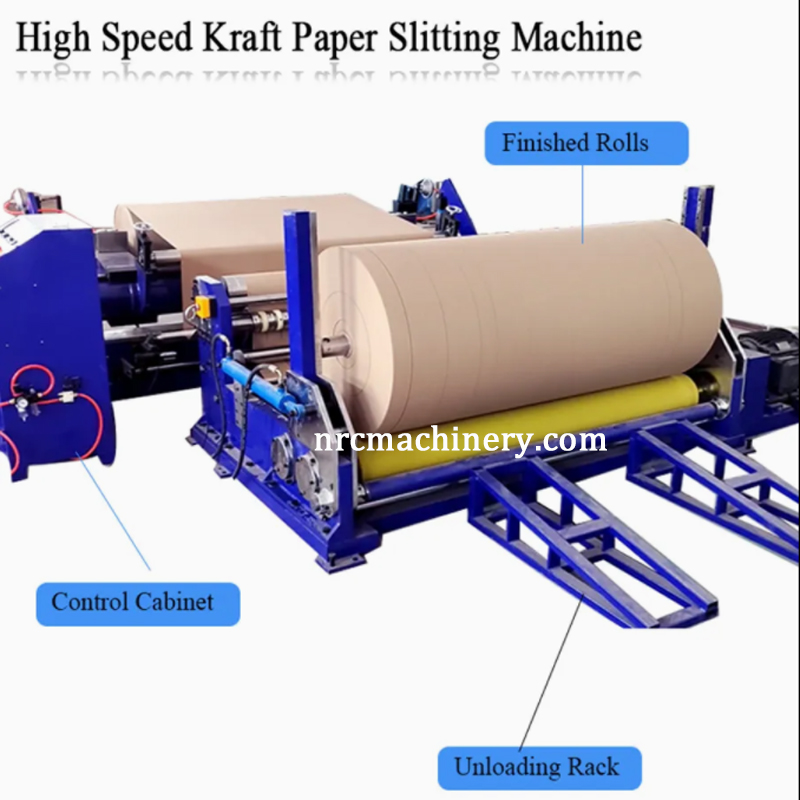
What is a High-Speed Kraft Paper Slitter Rewinder?In simple terms, it's a machine that performs two main functions simultaneously: Slitting: It cuts the wide kraft paper from a master roll (the "unwind") into multiple narrower strips using sharp blades. Rewinding: It winds these slit strips onto new, individual cores to create finished, customer-ready rolls.
The "high-speed" designation means it's engineered for maximum productivity, often running at speeds of 300 meters/min (1000 ft/min) and above, with some advanced models reaching over 1000 m/min. Main parts Unwind Stand: Holds the large master roll (often up to several tons). It can be a single-position stand or a dual-position "turret" type for non-stop operation during roll changes. Web Guide System: A critical component that ensures the paper web runs straight into the machine, preventing misalignment and ensuring clean, even edges on the final rolls. Tension Control System: Precisely controls the tension of the paper web throughout the process. Proper tension is vital to prevent stretching, wrinkling, or breaking the kraft paper. Slitting Section: This is where the cutting happens. There are two primary slitting methods: Razor Slitting: Uses a sharp, stationary razor blade pressed against a rotating rubber roller. Ideal for softer papers like kraft, as it's a simple, clean shear cut. Shear Slitting: Uses a circular upper blade pressed against a larger, rotating lower blade (like scissors). Provides a very precise, burr-free edge, excellent for heavier-weight kraft or laminated materials.
Spreader/Roll Separating Bars: These are essential for high-speed operation. They physically separate the slit strands of paper to prevent them from touching and causing friction, which leads to dust and poor roll formation. Rewind Shaft: The core onto which the slit paper is wound. High-speed machines often use a center-surface wind or center-driven wind system, where the shaft is driven by a motor and the paper is pressed against a large drum for support and heat dissipation. Lay-On Roll (or Pressure Roll): A roller that applies pressure to the rewinding rolls against the main drum. This helps build a tight, firm roll with a good hardness profile (Taper Tension Control). Control Panel (HMI): A computerized Human-Machine Interface that allows the operator to set all parameters like speed, tension, slit widths, and roll length. Modern machines feature programmable logic controllers (PLCs) for automation.
Applications of the Finished Rolls:The narrow rolls produced by this machine are used in a vast array of industries: Packaging: Core raw material for paper bags, sacks, and wrapping paper. Converting: For further processing into laminated materials, corrugated cardboard liners, or gummed tape. Construction: As a breather or sheathing paper in walls and roofs. Industrial: For masking, interleaving, and protective wrapping.
|