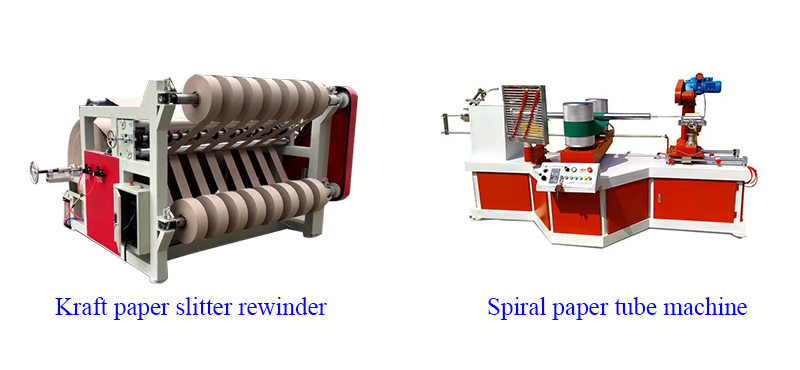
| What is a Paper Tube Making Machine? NRC80B paper tube making machine is an industrial system designed to automatically produce cylindrical containers and cores by winding multiple layers of paper (or paperboard) onto a mandrel with the use of adhesive. The final products are known as paper tubes, cores, or cones, depending on their shape and application. Key Components of a Paper Tube MachineA typical machine consists of several integrated stations: Unwinding Stand (Dispenser): Holds the large rolls of paper (called "slip") that will form the tube walls. Gluing System: Applies a consistent, controlled layer of adhesive (usually PVA, hot melt, or starch-based) to the paper before it is wound. This can be a roller, spray, or extrusion system. Mandrel (Spindle): A solid, cylindrical (or conical) metal shaft around which the paper is wound to form the tube's inner diameter and shape. It is the heart of the tooling. Winding Belt (or Carriage): A system of belts or rollers that press the glued paper layers onto the rotating mandrel, ensuring tight, uniform winding and proper adhesion between layers. Cutting Mechanism: Cuts the continuously produced tube into specific lengths. This can be a: Rotary Cutter: A spinning blade for high-speed, smooth cuts. Saw Cutter: A circular saw for thicker-walled tubes. Guillotine Cutter: A straight-down chopping action.
Control System: A PLC (Programmable Logic Controller) and HMI (Human-Machine Interface) that allows the operator to set parameters like tube length, wall thickness, and production speed. Ejection System: Automatically pushes the finished tubes off the mandrel.
The Paper Tube Making Process (Step-by-Step)The process is continuous and can be broken down into four main stages: Paper Feeding & Gluing: The paper web is fed from the unwinding stand. It passes through the gluing system, where adhesive is applied evenly to one side.
Winding: The glued paper is fed onto the rotating mandrel. The winding belt applies pressure, wrapping the paper tightly around the mandrel. For spiral tubes, the paper is fed at an angle, creating the characteristic spiral seam. Multiple layers are built up to achieve the desired wall thickness and strength.
Drying & Curing: Cutting & Ejection: Once the tube reaches a pre-set length, the cutting mechanism is activated, slicing it cleanly. The finished tube is then automatically pushed off the end of the mandrel and conveyed to a collection area.
Applications of Paper Tubes and CoresPaper tubes are incredibly versatile and are used across numerous industries: Packaging: Mailing and shipping tubes, containers for food (e.g., chips, coffee), gift boxes. Industrial Cores: Supports for winding paper, film, foil, textiles, carpet, adhesive tapes, and labels. Construction: Sonotubes® for forming concrete pillars and columns. Textiles: Cones and tubes for holding yarns and threads in weaving and spinning. Specialty Products: Toys, musical instruments, furniture, and decorative items.
|