


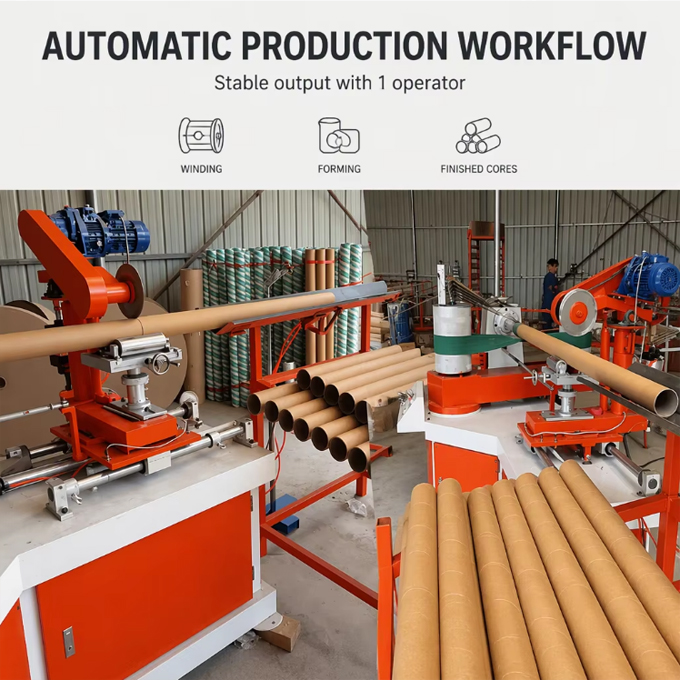


What is a Paper Tube Making Machine?
A paper tube making machine is an industrial system designed to produce cylindrical containers and cores by winding multiple layers of paper (or paperboard) onto a mandrel with the use of adhesive. These machines transform raw materials—paper in jumbo rolls and adhesive—into finished products like mailing tubes, fabric roll cores, industrial winding cores, and packaging containers.
The complexity and size of these machines can range from small, semi-automatic benchtop units for small-batch production to large, fully automated continuous production lines for mass manufacturing. Factories can select suitable models according to target tube diameter, wall thickness, daily output and budget. The finished paper tubes have wide applications, including textile yarn cores, plastic film cores, food packaging tubes, express mailing tubes, and construction protective tubes.
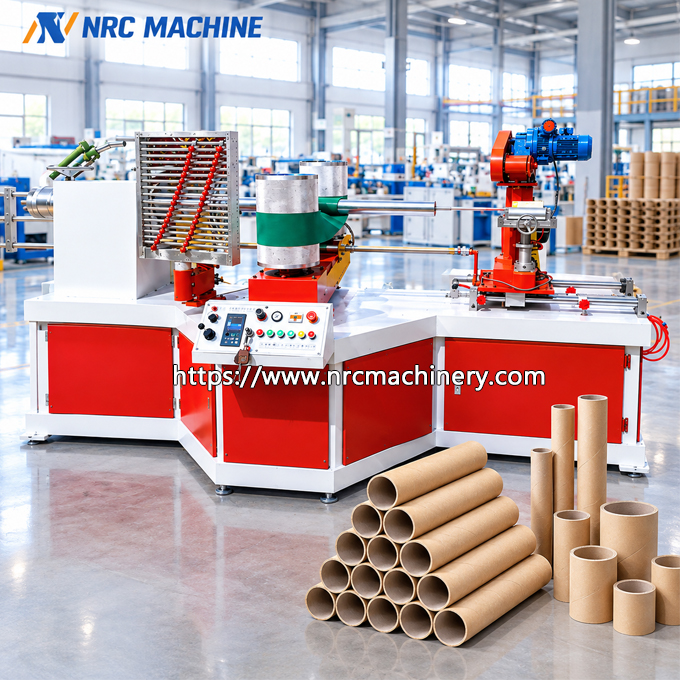
1. Key Components of a Paper Tube Making Machine
A typical machine consists of several integrated stations working cooperatively to complete continuous paper tube forming:
Unwind Stand(s): Holds the large jumbo rolls of paper (called "slitting rewound rolls"). Larger machines have multiple stands to allow feeding different paper grades or multiple paper layers at the same time.
Gluing System: Applies a precise, controlled amount of adhesive to the paper web. This can be a spray, roller, or slot nozzle system. Water-based glues (like PVA) are most common, featuring low cost, environmental protection and stable bonding effect.
Forming Belt / Driving Belts: A series of continuous belts that wrap the glued paper around the central mandrel with consistent pressure. This is the core of the winding action. Stable belt tension ensures uniform tube roundness and compact lamination.
Mandrel (Heart of the Machine): A hardened, polished steel shaft around which the paper is wound. Its diameter determines the inner diameter (ID) of the finished tube. Machines often have a carousel or magazine of mandrels for continuous production. Users can replace mandrels to produce paper tubes of different inner diameters.
Cutting Unit: Cuts the continuous wound tube into specific lengths. Methods include:
Saw Cutting: A circular saw that moves with the tube for a clean, square cut.
Shear Cutting: A blade that chops the tube without generating dust.
Fly Knife Cutter: A high-speed rotary cutter for very high production rates.
Drying System (Optional but common): Dries the adhesive quickly to ensure the tube maintains its shape and strength. This can be:
Infrared (IR) Heaters: Localized heating at the winding point.
Hot Air Tunnels: A long chamber the tubes pass through after being cut.
Radio Frequency (RF) Dryers: Very efficient method that heats the adhesive from the inside out.
Control System: A PLC (Programmable Logic Controller) and HMI (Human-Machine Interface) touchscreen panel to control all parameters: speed, length, glue amount, layer quantity and alarm settings. Operators can adjust parameters conveniently on the touch panel.
Ejection/Collection System: Conveyors or arms that neatly stack the finished tubes for collection or further processing (e.g., end capping, trimming).
2.The Paper Tube Manufacturing Process
The process is continuous and can be broken down into four main steps:
Unwinding and Gluing: The paper web is fed from the unwind stand through the gluing unit, where adhesive is applied to one side. The glue amount is precisely controlled to avoid glue overflow or insufficient bonding.
Winding and Forming: The glued paper is fed onto the rotating mandrel. The forming belts apply pressure, wrapping the paper tightly around the mandrel. The number of layers is determined by the number of paper webs being fed. More paper layers create thicker tube walls and higher compression strength.
Cutting to Length: Once the desired number of layers is achieved and the tube is formed, the continuous tube is pushed forward and cut to the pre-set length by the cutting unit. The cutting system follows the running tube synchronously to guarantee accurate cutting length.
Drying and Ejection: The cut tubes are moved through a drying system (if equipped) to cure the adhesive and then ejected onto a conveyor or collection rack. After drying, paper tubes can be sent for inspection, end capping or direct packaging.
3.Core Advantages of Modern Paper Tube Making Machine
✅ Continuous automatic production, greatly reduce manual labor
✅ Replaceable mandrels support various inner diameter specifications
✅ Multiple cutting options to meet different precision requirements
✅ PLC+HMI intelligent control, easy parameter adjustment
✅ Flexible matching with optional drying system for high-strength tubes
✅ Stable bonding, uniform tube roundness, low scrap rate
4.FAQs
Q1: What raw materials are required for a paper tube making machine?
A: Main raw materials are jumbo kraft paper rolls and water-based adhesive such as PVA glue. Multiple layers of paper can be fed together to adjust wall thickness.
Q2: What decides the inner diameter of finished paper tubes?
A: The inner diameter of paper tubes is determined by the size of the mandrel. You can change mandrels to produce tubes of different inner diameters.
Q3: What are the different cutting types for paper tube machines?
A: There are saw cutting, shear cutting and fly knife cutter. Saw cutting gives clean square cuts; shear cutting produces no dust; fly knife cutter is used for high-speed mass production.
Q4: Is the drying system mandatory for paper tube production?
A: It is optional but commonly equipped. The drying system cures adhesive quickly to improve tube hardness and prevent deformation. Some low-speed models can rely on natural air drying.
Q5: What finished products can a paper tube making machine produce?
A: It can produce industrial winding cores for textile, film and paper rolls, mailing tubes, food packaging paper tubes, protective construction tubes and cylindrical paper containers.
Main technical parameter
Machine name | Two heads spiral paper tube machine |
Paper tube inner diameter | 15-100mm |
Wall thickness | 1-8mm |
Productive speed | 1-16m/min |
Gluing type | Double sides gluing |
Paper layer | 16 layers |
Power | 380V 7.5KW |
Speed of main engine | 1400 r/min |
Operator | 1-2 |
Mainframe dimension(L*W*H) | 3000*1800*1680mm |


