


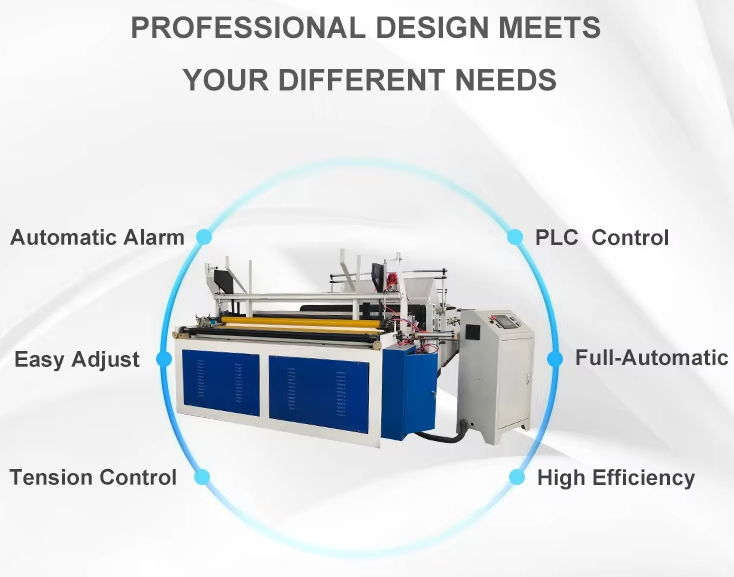
The bathroom toilet paper rolls machine is a production line designed to transform raw materials into the finished toilet paper rolls
used in bathrooms. These machines range from massive industrial systems to smaller setups suitable for small businesses.
The Converting Line (Making the Bathroom Rolls)
This stage takes the jumbo roll and converts it into the final product.
Unwind Stands: Holds one or more jumbo rolls. For 2-ply, two rolls are unwound simultaneously.
Embossing: Rolls with patterns press designs into the paper for decoration, softness, and bulk.
Ply Bonding (for 2-ply): If making 2-ply, the two layers are glued together at the embossed points.
Perforating: A blade creates the tear-off perforations between sheets.
Rewinding: The paper is wound onto long cardboard tubes at high speed, creating a continuous "log" of toilet paper.
Log Sawing: The long logs are cut by circular saws into individual, bathroom-sized rolls.
Packaging: Rolls are automatically wrapped in plastic or paper, grouped into packs, and boxed for shipping.
Types of Machines for Different Needs
Large Industrial Plants: Handle both Stage 1 and Stage 2. They have massive, custom-built lines that cost millions and produce tons of paper daily.
Small Businesses / Startups: Typically use only a Converting Line (Stage 2). They buy pre-made jumbo rolls and convert them into their own branded bathroom tissue. This is a much more affordable entry point.
Key Specifications for a Converting Machine
When looking for a machine, you'll see:
Production Speed: 50 - 200 meters per minute.
Output: 100 - 600 rolls per hour.
Roll Width: Adjustable, typically 90 - 130 mm.
Power: Often runs on standard 220V/380V electricity.
Automation Level: From semi-automatic to fully automatic.
Model | 1880mm ~2000mm |
Applicable Raw Paper | 2-3 plies 14~23g/㎡Wood pulp paper |
Finished product | Toilet rolls with core /without core |
Raw Paper Width | Max 2100mm |
Raw Paper Diameter | Max1300mm |
Finished Size | Φ60~130 mm |
Finished Core Diameter | Φ35mm-Φ50mm |
Raw Paper Core Diameter | 3”(76.2 mm) |
Perforation | Spiral perforating knife,Chain wheel positioning |
Production Speed | 200 m/min |
Power | 12kw |
Parameter Design | LCDTouch Screen |
Control | PLC |
Paper Feeding | 3 Unwinding stands,controlled by pneumatic |
Air Pressure | 0.5 Mps |
Power | 380V,50hz |


