




How Does a Toilet Roll Rewinding and Perforating Machine Work?

In today's tissue manufacturing industry, efficiency, precision, and product consistency are essential for meeting growing market demand. The Toilet Roll Rewinding and Perforating Machine plays a critical role in converting large parent paper rolls into finished toilet tissue rolls ready for packaging and distribution. Designed for high-speed production and reliable performance, this machine has become an indispensable part of modern tissue converting operations.
1. Working Principle
A toilet roll rewinding and perforating machine is designed to process jumbo tissue rolls into smaller consumer-sized rolls through a series of automated operations.
The production process typically begins with the unwinding of a large parent roll. The tissue paper is smoothly fed through tension control systems that maintain stable paper movement and prevent wrinkles or breakage.
As the paper travels through the machine, a perforating unit creates evenly spaced perforation lines. These perforations allow consumers to tear individual sheets easily while maintaining the strength and appearance of the finished roll.
After perforation, the paper enters the rewinding section where it is wound onto paper cores according to preset diameter and length specifications. Advanced control systems ensure accurate winding tension, resulting in rolls with consistent density and shape.
Once the target roll size is reached, the machine automatically cuts the log and prepares it for the next production stage, such as log sawing, packaging, and distribution.
2. Key Features
Modern toilet roll rewinding and perforating machines incorporate advanced technologies to improve productivity and reduce operating costs:
Fully automatic operation
High-speed production capability
Accurate perforation control
Stable rewinding performance
Servo-driven positioning systems
Touch-screen control interface
Automatic core feeding options
Low maintenance requirements
These features enable manufacturers to achieve higher production output while maintaining excellent product quality.

3.Wide Range of Applications
The versatility of a toilet roll rewinding and perforating machine makes it suitable for a variety of tissue products and industries.
3.1Household Tissue Production
The machine is widely used for producing standard toilet tissue rolls for supermarkets, retail chains, and household consumption markets.
3.2Commercial and Industrial Tissue Products
Hotels, restaurants, office buildings, hospitals, airports, and public facilities require large quantities of tissue products. The machine can produce customized roll sizes to meet commercial usage requirements.
3.3Private Label Manufacturing
Many tissue converters use rewinding and perforating machines to manufacture private-label toilet paper products for distributors, wholesalers, and retail brands.
3.4Eco-Friendly Tissue Production
As demand for sustainable paper products increases, the machine can process recycled tissue paper and environmentally friendly raw materials while maintaining production efficiency.
4.Benefits for Tissue Manufacturers
Investing in a modern rewinding and perforating machine offers several competitive advantages:
4.1 Increased Production Efficiency
Automated production significantly reduces manual labor while increasing output capacity.
4.2 Consistent Product Quality
Precise tension control and perforation systems ensure every roll meets strict quality standards.
4.3 Flexible Product Specifications
Manufacturers can easily adjust roll diameter, sheet length, perforation distance, and core size to accommodate different market demands.
4.4 Lower Operating Costs
Efficient machine design minimizes waste, reduces downtime, and improves overall production profitability.
5.Future Trends in Tissue Converting Technology
As the tissue industry continues to evolve, manufacturers are increasingly adopting intelligent automation and digital monitoring systems. New-generation toilet roll rewinding and perforating machines offer real-time production tracking, remote diagnostics, and energy-efficient operation, helping companies improve productivity while supporting sustainable manufacturing goals.
For tissue manufacturers seeking to expand production capacity and improve product consistency, advanced rewinding and perforating technology remains one of the most valuable investments in modern tissue converting operations.
Learn more about professional tissue converting solutions at:
https://www.nrcmachinery.com
6. FAQs for toilet paper making machine production line
Q1: What core units are included in a complete toilet paper making machine production line?
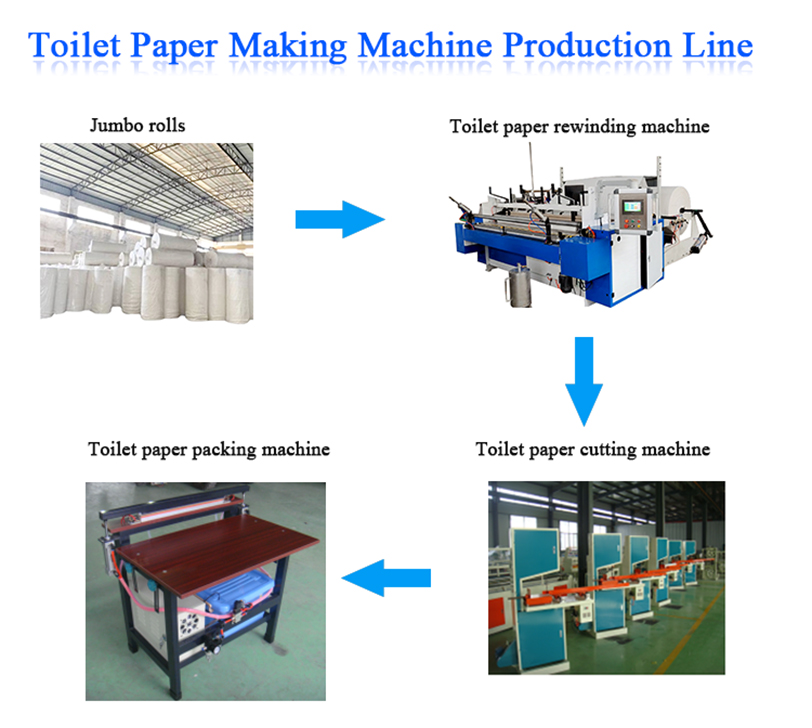
A1: A full toilet paper production line mainly consists of jumbo roll unwinder, rewinding embossing perforating host, log saw cutting machine and roll packing machine. Auxiliary parts include air compressor and electrical control cabinet. Buyers can choose modular configuration and add units step-by-step according to production budget and output goals.
Q2: What raw materials can the toilet paper making production line process?
A2: It supports virgin wood pulp jumbo tissue rolls and recycled pulp parent rolls. Applicable paper grammage ranges from 14 g/m² to 23 g/m², and it can produce 1-ply, 2-ply or 3-ply finished toilet paper rolls for household and commercial scenarios.
Q3: What factors affect the actual output capacity of the toilet paper production line?
A3: Key influencing factors include operating speed, finished roll size setting, raw paper quality, operator proficiency and equipment maintenance status. The theoretical maximum speed cannot be sustained continuously if raw material quality fluctuates.
Q4: How much workshop space and manpower are required to run a toilet paper making machine production line?
A4: For standard full auto converting line, a workshop area of 300-450 m² is recommended. Normally 2 3 operators per shift are enough. Semi automatic configurations need more manual labor for handling and packing finished rolls.
Q5: What after-sales services are available when purchasing a toilet paper making machine production line from NRC Machinery?
A5: NRC Machinery provides factory warranty, English operation manuals and maintenance video tutorials, plus lifelong remote technical support. On site commissioning and operator training are optional paid services. Spare parts can be delivered by sea or air. You may submit project inquiries via nrcmachinery.com for detailed solutions.
Model | 1880mm ~2000mm |
Applicable Raw Paper | 2-3 plies 14~23g/㎡Wood pulp paper |
Finished product | Toilet rolls with core /without core |
Raw Paper Width | Max 2100mm |
Raw Paper Diameter | Max1300mm |
Finished Size | Φ60~130 mm |
Finished Core Diameter | Φ35mm-Φ50mm |
Raw Paper Core Diameter | 3”(76.2 mm) |
Perforation | Spiral perforating knife,Chain wheel positioning |
Production Speed | 200 m/min |
Power | 12kw |
Parameter Design | LCDTouch Screen |
Control | PLC |
Paper Feeding | 3 Unwinding stands,controlled by pneumatic |
Air Pressure | 0.5 Mps |
Power | 380V,50hz |


