
How to Use a BOPP Adhesive Tape Slitting and Rewinding Machine: A Practical Production Guide
From BOPP Jumbo Rolls to High-Quality Finished Tape Rolls with Efficient Slitting and Rewinding
How to Use a BOPP Adhesive Tape Slitting and Rewinding Machine: A Practical Production Guide

1. From BOPP Jumbo Rolls to High-Quality Finished Tape Rolls with Efficient Slitting and Rewinding
As demand for packaging and adhesive tape continues to grow, manufacturers are looking for efficient equipment that can convert wide BOPP adhesive tape master rolls into accurately slit and neatly rewound finished rolls. A BOPP adhesive tape slitting and rewinding machine provides an integrated solution for slitting, tension control, rewinding, and roll formation, making it an important part of modern adhesive tape converting operations.
This guide explains how to use a BOPP adhesive tape slitting and rewinding machine, covering the basic operating process, key settings, production considerations, and practical tips for achieving consistent tape quality.
2. What Is a BOPP Adhesive Tape Slitting and Rewinding Machine?
A BOPP adhesive tape slitting and rewinding machine is designed to convert wide adhesive tape master rolls into multiple narrow rolls with predetermined widths and lengths.
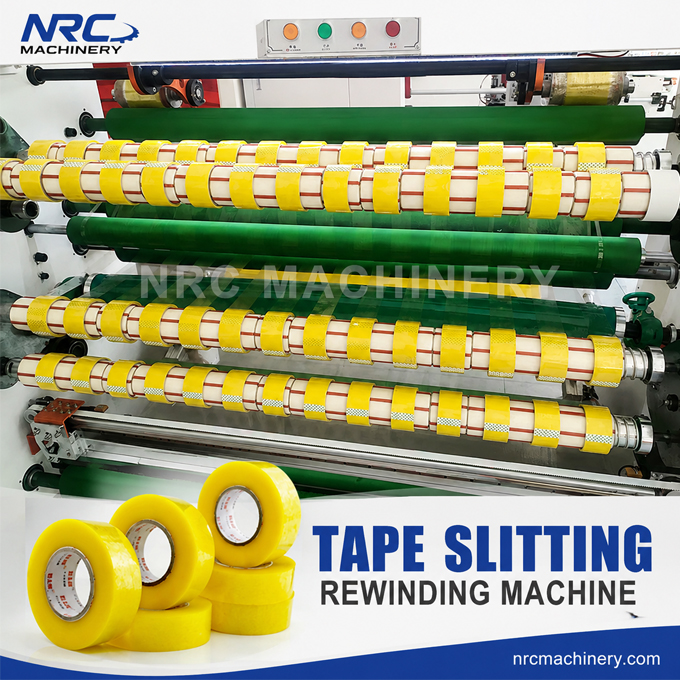
BOPP adhesive tape generally consists of a BOPP film backing coated with pressure-sensitive adhesive. During converting, the master roll is mounted on the unwinding section, passed through the slitting system, and then rewound into individual finished rolls.
A typical BOPP adhesive tape slitting and rewinding machine includes:
Unwinding system
Slitting knives or blades
Tension control system
Guiding system
Differential or individual rewinding shafts
Servo or variable-speed drive system
Automatic control panel
Finished roll unloading system
The exact configuration depends on the tape material, roll dimensions, target width, production speed, and required finished-roll quality.
3. How to Use a BOPP Adhesive Tape Slitting and Rewinding Machine
3.1 Prepare the BOPP Master Roll
Before production, check the master roll for:
Correct width and diameter
Suitable adhesive coating
Stable film quality
Clean roll edges
No visible wrinkles or damage
The master roll should be properly installed on the unwinding shaft and aligned with the machine centerline.
3.2 Set the Slitting Width
Determine the required finished tape width according to the customer's specification.
The slitting knives should be positioned accurately before starting production. Precise knife positioning is important because incorrect settings can result in uneven widths, damaged edges, or excessive material waste.
For manufacturers producing multiple tape sizes, an adjustable slitting system can help improve production flexibility.
3.3 Thread the Tape Web
After installing the master roll, thread the BOPP tape through the designated rollers and slitting section according to the machine's operating procedure.
The tape web should remain properly aligned throughout the process. Avoid excessive tension during threading, as excessive pulling can deform the material or affect finished-roll quality.
3.4 Set the Rewinding Tension
Rewinding tension is one of the most important parameters when operating a BOPP adhesive tape slitting and rewinding machine.
Appropriate tension helps produce:
Smooth roll surfaces
Stable roll edges
Uniform winding density
Reduced telescoping
Consistent finished-roll appearance
The correct setting depends on the BOPP film thickness, adhesive characteristics, roll diameter, and machine speed.
3.5 Start at a Controlled Speed
Instead of immediately running at maximum speed, start the machine at a relatively low speed and observe the tape movement.
Check whether:
The tape tracks correctly
The slitting edges are clean
The rewinding rolls remain stable
The tension is consistent
There are no wrinkles or adhesive-related problems
Once the process is stable, the operator can gradually increase production speed according to the machine's operating range and material characteristics.
4. Key Factors Affecting Finished Tape Quality
4.1 Slitting Accuracy
Clean and accurate slitting is essential for producing professional-looking BOPP tape rolls. Blades should be correctly positioned and maintained to minimize burrs, dust, edge damage, and width variation.
4.2 Tension Control
Incorrect tension can cause loose rolls, tight rolls, wrinkles, telescoping, or deformation. Modern machines may use automatic tension control and servo-driven systems to maintain more stable web handling.
4.3 Rewinding Quality
Finished rolls should have uniform edges and consistent winding density. Differential rewinding systems can help accommodate variations between individual rolls and improve roll formation.
4.4 Production Speed
Higher speed can increase output, but production speed should always be matched to the material and machine configuration. Stable operation is more important than simply reaching maximum speed.
5. Why Choose an Automatic BOPP Tape Slitting and Rewinding Machine?
For businesses producing BOPP packaging tape at commercial scale, automation can reduce manual intervention and improve production consistency.
An automatic BOPP adhesive tape slitting and rewinding machine can integrate functions such as automatic tension control, servo drive, digital parameter setting, web guiding, and efficient roll unloading.
This makes the equipment suitable for tape converters, packaging-material manufacturers, adhesive tape producers, and businesses expanding their converting capacity.
6. Common Applications
BOPP adhesive tape produced through slitting and rewinding is widely used for:
Carton sealing
Packaging
Logistics
E-commerce packaging
Industrial packaging
Warehouse applications
General-purpose adhesive tape
By changing the slitting configuration, manufacturers can produce different tape widths and roll specifications from a single master roll.
7. FAQs About BOPP Adhesive Tape Slitting and Rewinding
7.1 What does a BOPP adhesive tape slitting and rewinding machine do?
It converts wide BOPP adhesive tape master rolls into narrower finished tape rolls through controlled slitting and rewinding.
7.2 What should be checked before starting the machine?
Operators should check the master roll, knife position, web alignment, rewinding cores, tension settings, and machine safety systems before production.
7.3 How can wrinkles be reduced during rewinding?
Proper web alignment, suitable tension, stable roller operation, and correctly maintained slitting components can help reduce wrinkles.
7.4 Can the machine produce different tape widths?
Yes. The machine can generally be configured for different finished widths by adjusting the slitting knife positions and rewinding configuration.
7.5 Is automatic tension control important?
For high-volume production, stable tension control can help improve winding consistency and reduce common roll-quality problems.


