


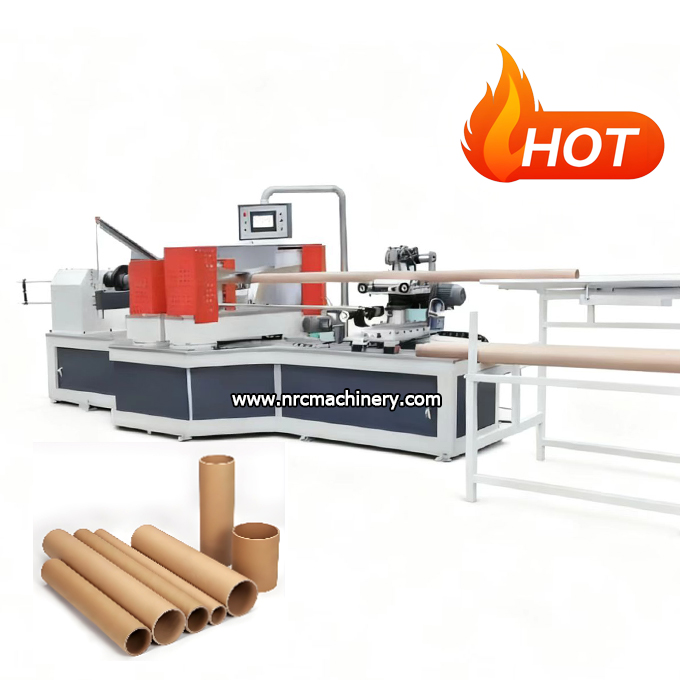


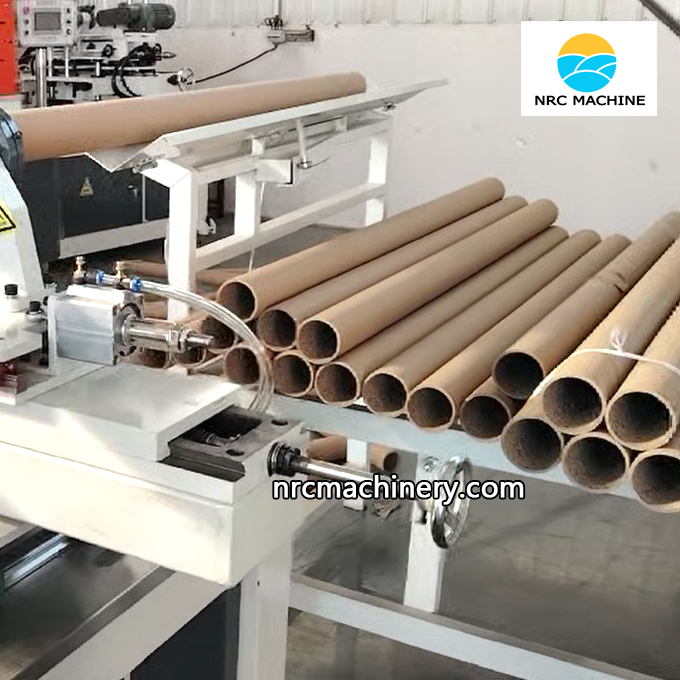
High‑Speed CNC Paper Core Roll Converting Equipment – Full Product Details
1. Product Overview
High‑Speed CNC Paper Core Roll Converting Equipment stands for top‑tier automation and precision within paper core finishing sector. Far more than a simple cutting machine, it functions as a fully programmable manufacturing cell, turning ordinary raw mother paper tubes into high‑value engineered core components required for modern high‑speed winding, slitting‑rewinding and converting workflows. Traditional standalone paper tube cutters can only realize simple length cutting, requiring multiple separate offline stations for chamfering, grooving, marking and deburring, which brings extra labour cost, secondary handling damage, inconsistent dimensional accuracy and low throughput. This integrated CNC line merges multi‑step finishing procedures into one continuous workflow. Raw long mother tubes go through feeding, positioning, multi‑function machining, marking, cleaning and automatic sorting‑output in sequence. It guarantees stable dimensional repeatability, minimises manual intervention, lowers reject rate and perfectly matches mass‑production demands from flexible packaging, adhesive tape, label, non‑woven textile and special technical‑film manufacturers.
2. Core Functions & Key Processing Operations
This system automates and integrates comprehensive finishing procedures for paper mother tubes:
2.1 Precision Cutting & Chamfering
Long mother tubes are cut accurately to customer‑defined finished lengths. Meanwhile inner‑edge and/or outer‑edge chamfering (beveling) is completed synchronously. Chamfered edges eliminate sharp burrs, making subsequent loading of film rolls, foil webs and other winding materials much smoother, preventing scratching to flexible substrates during winding‑unwinding processes.
2.2 Grooving & Fluting
Accurate circumferential grooves or spiral grooves are machined on the outer surface of paper cores, delivering three core practical values:
Braking Grooves: Deliver controlled friction for stable tension management while unwinding film, aluminium foil or textile materials.
Venting Grooves: Enable rapid air escape under high‑speed winding conditions, avoiding air‑entrapment that causes wrinkling, uneven roll density and telescoping finished rolls.
Grip / Locating Groove Patterns: Create mechanical positioning surfaces to cooperate with winding machinery fixtures.
2.3 Notching & Slotting
Process longitudinal slots, V‑shape notches and other custom profiles. These features serve for core‑locking structures such as stretch‑film dispensers, as well as mechanical locating for shaft mounting, ensuring cores lock firmly on winding mandrels without slipping during high‑speed rotation.
2.4 Printing & Marking
Built‑in high‑resolution ink‑jet or laser marking modules directly print content onto paper core surfaces. Supported contents include brand logos, production batch numbers, barcodes/QR‑codes and engineering technical specifications, facilitating full‑process traceability for end customers.
2.5 Drilling & Perforating
Machine precise positioning holes to fit locating pins, sensor installation and special mechanical assembly requirements for custom engineered cores.
2.6 Deburring & Cleaning
Automatic brushing and air‑blowing stations remove paper dust, cutting chips and residual burrs generated during cutting and grooving steps. Clean cores avoid particle contamination for sensitive film‑grade converting.
2.7 Automated Material Handling & Sorting
Robotic manipulators, conveying chains and vision‑aided orientation systems complete automatic tube feeding, posture correction and finished‑product sorting. Products can be grouped by dimension, production batch or customer order, preparing for downstream bundling and palletising.
3. Core Advantages: CNC Control & High‑Speed Performance
3.1 CNC / PLC‑Servo Control
Central PLC system governs all servo motors, actuators and tool movement trajectories, bringing prominent strengths:
Instant Production Changeover: Thousands of core production recipes (length parameters, groove profiles, notch dimensions etc.) can be stored in system memory. Operators switch between different core specifications on the HMI touch‑screen within minutes, instead of time‑consuming manual mechanical adjustment that takes hours on conventional equipment.
Micron‑Grade Repeat Precision: Cutting, grooving and notching repeat accuracy reaches ±0.1 mm. Such tight tolerance is indispensable for high‑performance winding applications where poor core precision will trigger web wandering, tension fluctuation and defective finished rolls.
Complex Custom Geometries: Capable of producing sophisticated spiral‑groove, multi‑notch combined profiles which cannot be achieved by old‑style mechanical non‑CNC machines.
3.2 High‑Speed Production Capacity
Optimised servo drive architecture plus streamlined automatic tube‑handling mechanisms realise output of hundreds of finished paper cores every hour. Compared with discrete traditional production lines with separate cutting, chamfering and grooving machines, it greatly lifts overall throughput, shortens production cycles and reduces unit‑product manufacturing cost for large‑volume orders.
4. Typical Configuration of Complete Turnkey Production Line
A full‑scope turnkey paper core converting line consists of these functional units:
Automatic Tube Feeder: Magazine‑type storage rack or robotic feeding arm, continuously supplying raw mother tubes to the machining section.
CNC Precision Lathe & Cutting Unit: The central core of the whole line. Rotating spindle clamps and spins paper tubes; servo‑driven linear tool holders perform cutting, chamfering, grooving, notching and drilling operations.
Printing / Marking Station: Integrated ink‑jet printer or laser coder for direct surface marking.
Deburring & Brushing Station: Combined mechanical brushing plus compressed‑air cleaning for chip and burr removal.
Output Conveyor & Sorting System: Equipped with vision inspection option; expandable functions cover automatic bundling and robotic palletising for finished cores.
5. Primary Applications & Target Industries
This equipment is deployed for sectors where paper‑core quality directly determines high‑speed downstream converting stability:
Flexible Packaging: Precision‑grooved paper cores for BOPP, CPP, PET plastic films, aluminium foil and multi‑layer composite laminates.
Label & Adhesive Tape Manufacturing: Custom notched / slotted cores matching tape and label dispensing machinery.
Textile & Non‑woven Fabrics: Large‑size heavy‑duty cores for yarn, fibre and fabric roll winding.
Paper Converting Industry: Paper cores for large parent rolls of newsprint, cardboard and other paper stock.
Technical‑Film Field: Precision‑critical cores for capacitor films, insulation materials and other high‑end functional substrates.
6. FAQs
Q1: What paper core sizes can this CNC converting line handle?
A: It supports custom‑configured inner diameter, wall thickness and finished‑length ranges according to client requirements. Common coverage includes small tape‑grade cores up to large‑diameter heavy‑duty industrial cores for film and non‑woven production. All key dimension parameters are adjustable via HMI recipe setup.
Q2: Can I select partial‑function configuration instead of the full turnkey line?
A: Yes. Clients may opt for standalone CNC cutting‑chamfering unit, or add grooving / marking / automatic sorting modules progressively based on existing workshop conditions and budget. Modular design supports phased‑investment deployment.
Q3: How quick is product change‑over between different core specifications?
A: With stored CNC recipes, product switch takes only several minutes. No manual re‑alignment for mechanical tool positions is required for saved profiles. For brand‑new custom patterns, operators input geometry parameters on touch‑screen to generate new recipes.
Q4: What quality problems can precision‑machined grooved cores help avoid?
A: Proper venting grooves eliminate air trapping, roll wrinkling and telescoping. Braking grooves stabilise unwinding tension, minimising web fluctuation during slitting‑rewinding processes and lowering final‑product reject ratio.
Q5: Is operator training complicated for this CNC paper core machine?
A: The HMI touch‑screen adopts visualised operation interface. Basic operation, recipe calling and alarm checking can be mastered after short‑term training. Professional maintenance guidance is supplied for servo‑system and tool‑replacement work.
Roll tube paper layer | 3-25 (layers) |
Paper tube diameter | 20-200 (mm) |
Paper tube thickness | 2-16 (mm) |
The Finished Paper Tube Core Cutter Length | ≥1000mm |
Production speed | 0-40 (m / min) |
Fixed-length mode | Light Control (Infrared) |
Winding machine head | Four machine head |
Cutting method | Single round knife cutting |
Core mold fixed way | Flange plus tight |
Glue way | Double-sided adhesive |
control method | Frequency |
Input voltage | 380V / 220V |
Number of operators | 1-3 people |


