


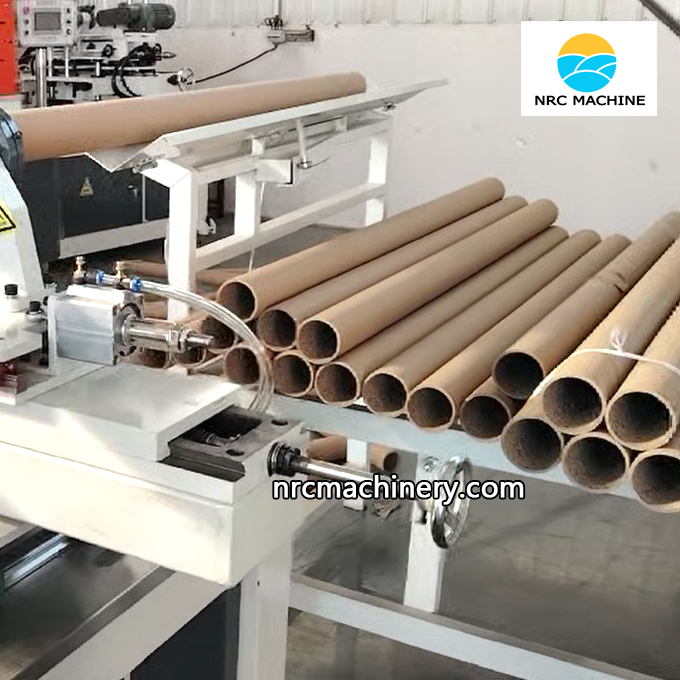
1. What is a Spiral Paper Tube Making Machine?
It is an industrial machine that manufactures paper tubes and cores by winding multiple layers of paper (kraft, recycled, specialty papers) in a spiral pattern around a rotating mandrel, using adhesive to bond the layers. This method creates strong, durable, and dimensionally stable cylindrical products.
2. Key Advantages of the Spiral Winding Process:
High Strength: The cross-grain spiral structure provides excellent crush resistance and torsional strength.Flexibility in Dimensions: Can produce very long tubes (cut to any length) and a wide range of diameters from a few mm to over 500 mm.
Material Flexibility: Can use various paper grades, laminated papers, or composite materials (e.g., paper with foil or plastic layers).
Seamless Structure: The spiral overlap creates a consistent wall thickness without a straight seam vulnerability.
3. How It Works: The Production Process
A typical spiral tube machine operates in a continuous process:Unwinding: Multiple rolls of paper (slitting rolls) are mounted on a creel stand. The number of plies determines the tube wall thickness.
Gluing: Each paper web passes through a precision gluing unit, applying a controlled amount of adhesive (PVA, hot melt, etc.) to one side.
Spiral Winding: The glued paper strips are fed onto a rotating, fixed-diameter mandrel. The angle of the feed determines the winding angle (typically 15-30°). The paper wraps around the mandrel, bonding layer upon layer.
Forming & Drying: The wound tube travels along the length of the mandrel. Heaters (IR or hot air) or air drying partially cures the adhesive to set the shape.
Cutting: A traveling rotary saw or cut-off system cuts the continuous tube into pre-set lengths.
Ejection & Stacking: Finished tubes are ejected, automatically stacked, and bundled for shipment.
4. Types of Machines
Semi-Automatic Machines: Require more manual intervention for loading paper, changing mandrels, and removing finished tubes. Suitable for lower-volume or multi-diameter production.
Fully Automatic Machines: High-speed, computer-controlled systems with automatic roll splicing, CNC cutting, and robotic handling. Designed for large-scale, single-diameter production.
Specialized Machines: Designed for specific products like edgeboard (paper protection for pallets), latex spiral tubes (for concrete columns), or composite tubes (paper + other materials).
5. Common Applications of Spiral Paper Tubes
Industrial Cores: For winding textiles, films, foil, laminates, paper, and adhesive tapes.
Packaging: Heavy-duty mailing tubes, poster tubes, packaging for carpets, and protective edgeboard.
Construction: Sonotubes® for concrete columns, forms for piers.
Specialty Products: Cores for capacitors, electrical insulation tubes, fireworks tubes, and furniture legs.
6. FAQs
Q1: What paper core sizes can this CNC converting line handle?
A: It supports custom‑configured inner diameter, wall thickness and finished‑length ranges according to client requirements. Common coverage includes small tape‑grade cores up to large‑diameter heavy‑duty industrial cores for film and non‑woven production. All key dimension parameters are adjustable via HMI recipe setup.
Q2: Can I select partial‑function configuration instead of the full turnkey line?
A: Yes. Clients may opt for standalone CNC cutting‑chamfering unit, or add grooving / marking / automatic sorting modules progressively based on existing workshop conditions and budget. Modular design supports phased‑investment deployment.
Q3: How quick is product change‑over between different core specifications?
A: With stored CNC recipes, product switch takes only several minutes. No manual re‑alignment for mechanical tool positions is required for saved profiles. For brand‑new custom patterns, operators input geometry parameters on touch‑screen to generate new recipes.
Q4: What quality problems can precision‑machined grooved cores help avoid?
A: Proper venting grooves eliminate air trapping, roll wrinkling and telescoping. Braking grooves stabilise unwinding tension, minimising web fluctuation during slitting‑rewinding processes and lowering final‑product reject ratio.
Q5: Is operator training complicated for this CNC paper core machine?
A: The HMI touch‑screen adopts visualised operation interface. Basic operation, recipe calling and alarm checking can be mastered after short‑term training. Professional maintenance guidance is supplied for servo‑system and tool‑replacement work.
Roll tube paper layer | 3-25 (layers) |
Paper tube diameter | 20-200 (mm) |
Paper tube thickness | 2-16 (mm) |
The Finished Paper Tube Core Cutter Length | ≥1000mm |
Production speed | 0-40 (m / min) |
Fixed-length mode | Light Control (Infrared) |
Winding machine head | Four machine head |
Cutting method | Single round knife cutting |
Core mold fixed way | Flange plus tight |
Glue way | Double-sided adhesive |
control method | Frequency |
Input voltage | 380V / 220V |
Number of operators | 1-3 people |


