
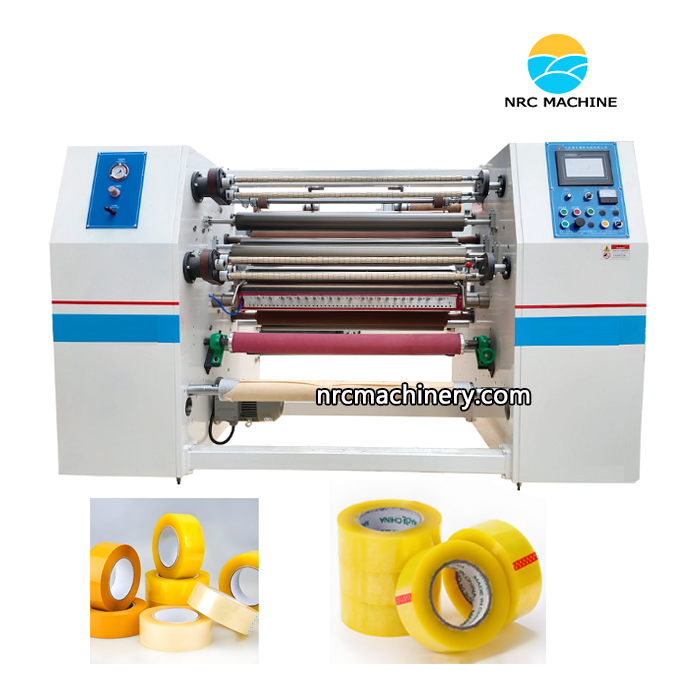


Scotch Tape Making Machine

The Slitting/Rewinding Machine (The Core Process)
This machine takes the jumbo roll from the coating line and converts it into the small rolls you see in stores.
Key Components & The Slitting Process:
Unwind Stand: Holds the master jumbo roll. It often includes a braking system or a drive to maintain precise, constant web tension.
Web Guide: A critical component that ensures the film runs perfectly centered through the machine, preventing misaligned slitting and damaged edges.
Slitting Unit (The Most Critical Part): This is where the wide web is cut into multiple narrow strips. There are two primary slitting methods:
Razor Slitting / Shear Cutting:
How it works: A sharp, circular razor blade is pressed against a hardened anvil roll. The web passes between them, creating a clean, scissor-like cut.
Best for: Thin, flexible materials like BOPP (for Scotch Magic Tape, etc.), PVC, and some papers. It's a very common method for consumer tapes.
Crush (Score) Cutting:
How it works: A male circular blade with a sharp edge is pressed directly into a female rubber-covered roll. The blade "crushes" or scores through the material.
Best for: Thicker, more fibrous materials like duct tape, masking tape, and cloth tapes.
Rewind Shaft: This is where the individual slit tape strips are wound onto individual cores. The machine can have multiple rewind shafts to produce many rolls simultaneously.
Tension Control System: A sophisticated system (using dancers, load cells, or ultrasonic sensors) that ensures each individual tape strip is wound with consistent hardness and without wrinkles. Poor tension control leads to telescoped rolls or soft centers.
Ejection System: Once the roll reaches the preset length (e.g., 10, 20, 40 meters), the machine automatically stops, cuts the tape, and ejects the finished rolls. Modern machines often have automatic core loading and roll labeling.
Types of Slitting/Rewinding Machines
Center-Surface Winder: The most common type. The rewinding rolls are driven by both their central shaft and contact with a large drum. This provides excellent tension control and is ideal for sticky, pressure-sensitive materials like tape.
Center Winder: The rolls are driven only by their central shaft. Less common for adhesive tapes as it can struggle with the tackiness.
Key Specifications for a Tape Slitting Machine
When selecting a machine, manufacturers consider:
Max Unroll & Rewind Diameter: The size of the jumbo rolls it can handle (e.g., 600mm, 1000mm).
Web Width: The maximum width of the master roll (e.g., 1300mm).
Slitting Width Range: The minimum and maximum width of the finished tape rolls.
Production Speed: Measured in meters per minute (m/min). Can range from 100 to over 600 m/min.
Tension Control: The precision of the system (often in kg or N).
Automation Level: From manual core loading to fully automated lines with robotic arms.
1300 tape slitting rewinding machine | |
L*W*H(m) | 2.45m*1.3m*1.35m |
Voltage | 380V 50HZ |
Slitting speed | 0-180 m/min |
Maximum master coil width | 1.3m |
Minimum cutting width | 10mm |
1300 Pipe loader | |
L*W*H(M) | 5.6m*0.8m*1.35m |
Paper tube diameter | 25.4-76.2mm |
Paper core cutting machine | |
L*W*H(M) | 1.5m*0.6m*1.15m |
Slitting width | Mold control |


