


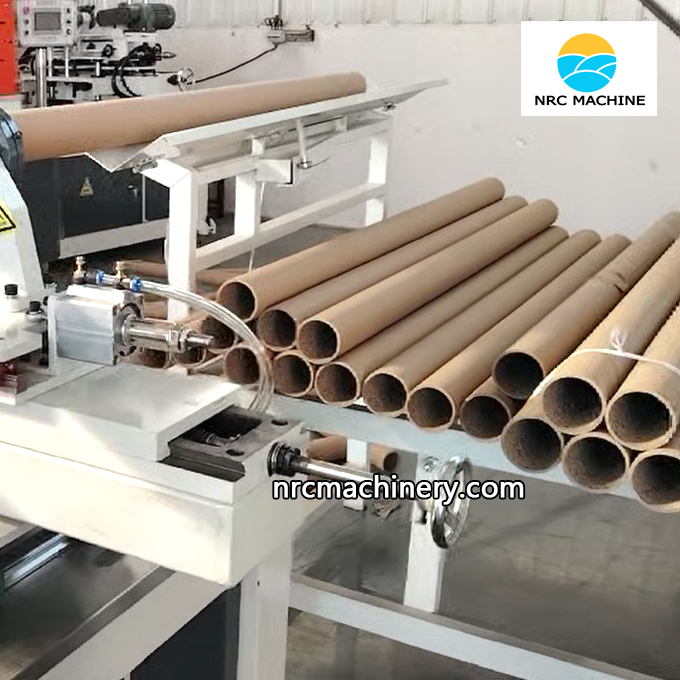


Core Principle: Spiral Winding vs. Parallel Winding
It's crucial to distinguish this from a parallel (or convolute) winder:
Spiral Winding: The paper is fed at a continuous, fixed angle (typically 15° to 45°) relative to the mandrel axis. This creates a seamless, helical structure that is extremely strong in all directions, flexible, and ideal for long lengths and high-speed unwinding applications.
Parallel Winding: The paper is wound edge-to-edge, layer upon layer. This creates a stiffer, more rigid tube with visible seams, better for precise-length, heavy-duty applications like postal tubes.
How a High-Speed Spiral Tube Machine Works (The Process)
A modern high-speed line is a continuous, integrated system:
Unwinding & Ply Preparation: Multiple rolls of paper (kraft, recycled, specialty) are mounted on unwind stands. They pass through tension control systems and pre-conditioning units (moisturizers, pre-heaters) to make the paper pliable.
Gluing System: The heart of the bond. A precise, controlled glue application system (often wheel, nozzle, or curtain coating) applies adhesive to one side of each paper ply just before winding. Modern machines use fast-setting PVA or hot-melt adhesives.
Spiral Winding Head: This is the core mechanism. The angled, glued paper strips are fed onto a rotating, long steel mandrel. The combination of the mandrel's rotation and the linear feed of the paper creates the precise spiral helix.
High-speed secret: The mandrel is often stationary (does not rotate), while the winding head itself rotates around it. This allows for much higher speeds and easier integration of downstream processes.
Forming & Pressure Belts: A system of belts or rollers applies consistent pressure on the forming tube on the mandrel, ensuring tight bonding, eliminating air bubbles, and setting the final diameter.
Cutting Unit: As the continuous tube exits the mandrel, a high-precision rotary cutter or flying saw cuts it to pre-set lengths without stopping production. Synchronization here is critical for clean, square cuts.
Drying/Curing Section: Freshly cut tubes are conveyed through a drying oven (infrared, hot air, or microwave) to fully cure the adhesive and achieve final hardness and moisture content.
Ejection & Handling: Automated systems eject, stack, bundle, and sometimes even palletize the finished tubes.
Key Components for "High-Speed" Operation
Stationary Mandrel Design: Eliminates the limitations of a rotating mandrel, allowing speeds of 100+ meters/minute.
Servo-Driven Technology: All axes (winding, feeding, cutting) are synchronized with servo motors and PLCs for precision and rapid changeovers.
Advanced Glue Application: Precise, non-drip systems with quick-clean features to minimize downtime during grade changes.
High-Precision Rotary Cutter: Enables cuts at full line speed with burr-free edges.
Integrated Drying: Efficient, energy-saving dryers that match the line speed to ensure complete curing.
Types & Configurations
Single-Head Machines: Produce one tube stream. Most common for standard core production.
Dual-Head/Multi-Head Machines: Two or more winding heads operating side-by-side, doubling or tripling output from a single line. The ultimate in high-volume production.
Specialized Machines:
Variable Diameter Machines: Can produce tapered cones or tubes with changing diameters.
Heavy-Duty Machines: For thick-wall tubes used in construction (concrete forming) or industrial shipping.
Primary Applications of the Tubes Produced
Industrial Cores: For winding textiles (yarn), plastic films, foil, laminates, paper, and adhesive tapes.
Consumer Cores: For toilet paper, paper towels, aluminum foil, cling film, and gift wrap.
Technical Cores: Concrete forming tubes (Sonotubes), insulation cores, and fiber-optic cable cores.
Specialty Products: Fireworks casings, mailing tubes (though often parallel wound), and display stands.
Roll tube paper layer | 3-25 (layers) |
Paper tube diameter | 20-200 (mm) |
Paper tube thickness | 2-16 (mm) |
The Finished Paper Tube Core Cutter Length | ≥1000mm |
Production speed | 0-40 (m / min) |
Fixed-length mode | Light Control (Infrared) |
Winding machine head | Four machine head |
Cutting method | Single round knife cutting |
Core mold fixed way | Flange plus tight |
Glue way | Double-sided adhesive |
control method | Frequency |
Input voltage | 380V / 220V |
Number of operators | 1-3 people |


