



1. Core Concepts: DTY & POY
POY (Partially Oriented Yarn): The initial synthetic yarn (e.g., polyester, nylon) produced after spinning. It has low orientation and needs further processing.
DTY (Draw Textured Yarn): The finished yarn made by drawing and texturing POY. It's bulky, stretchy, and used directly in weaving/knitting.
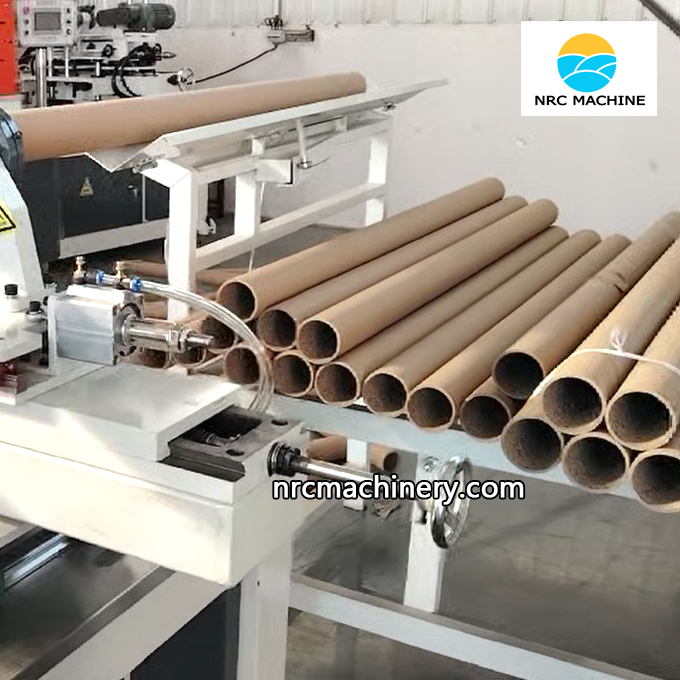
Paper Tube (Core/Cheese): The cylindrical cardboard tube onto which POY and DTY are wound. It must be precisely manufactured to ensure smooth unwinding at high speeds in downstream processes.
2. Purpose of the Production Line
To automatically manufacture high-precision, strong, and smooth paper tubes (cores) used specifically for winding and transporting POY and DTY in textile mills.
3. Standard Workflow of a Modern Production Line
A fully automated line integrates several machines:
Step 1: Slitting & Rewinding
Machine: Heavy-Duty Slitter-Rewinder.
Process: Large jumbo rolls of specific coreboard (high-strength, smooth-surface paper) are slit into narrow strips of precise width (determines the tube's length).
Step 2: Glue Application
Machine: Equipped with precision glue application system.
Process: A controlled amount of adhesive (usually PVA or hot melt) is applied to the leading edge of the paper strip. Advanced systems apply glue in a spiral or specific pattern for optimal bonding.
Step 3: Tube Forming & Winding (The Heart of the Line)
Machine: Automatic High-Speed Tube Winding Machine.
Process: The glued paper strip is fed onto a rotating mandrel (a metal rod of specific diameter). It is wound in a tight, continuous spiral. The number of layers (plies) determines the tube's wall thickness and crush strength. This is where the tube's Inner Diameter (ID) is defined.
Step 4: Cutting & Ejection
Machine: Integrated CNC Cutting System.
Process: Once the tube reaches the pre-set length, a high-speed circular blade or saw cuts it cleanly. The finished tube is then ejected from the mandrel onto a conveyor.
Step 5: Drying/Curing
Method 1: Infrared (IR) Drying Tunnels on the conveyor line.
Method 2: Accumulation and batch curing in a controlled environment.
Purpose: To fully set the adhesive and achieve maximum strength before the tubes are used for winding yarn.
Step 6: Printing/Identification (Optional)
Machine: Flexographic or Inkjet Printer.
Process: Tubes are printed with logos, yarn type, count, batch number, or barcodes for traceability.
Step 7: Packaging & Palletizing
Automated systems bundle tubes in set quantities (e.g., 100 pieces) and stack them on pallets for shipping.
4. Key Machines in the Line (Typical Configuration)
Jumbo Roll Stand: Holds the raw material.
Precision Slitter-Rewinder.
Automatic High-Speed Spiral Tube Winding Machine (The central unit).
Glue Preparation & Supply System.
CNC Tube Cutter.
IR Drying Tunnel.
Conveyor System.
Automated Stacking/Packaging Unit.
Paper tube diameter | Φ40-100(mm) |
Paper tube thickness | 3-10(mm) |
Length of the tube | 100-300(mm) |
Feeding method | Automatic |
Total power | 2.2kw*2+3.0kw+0.75kw |


