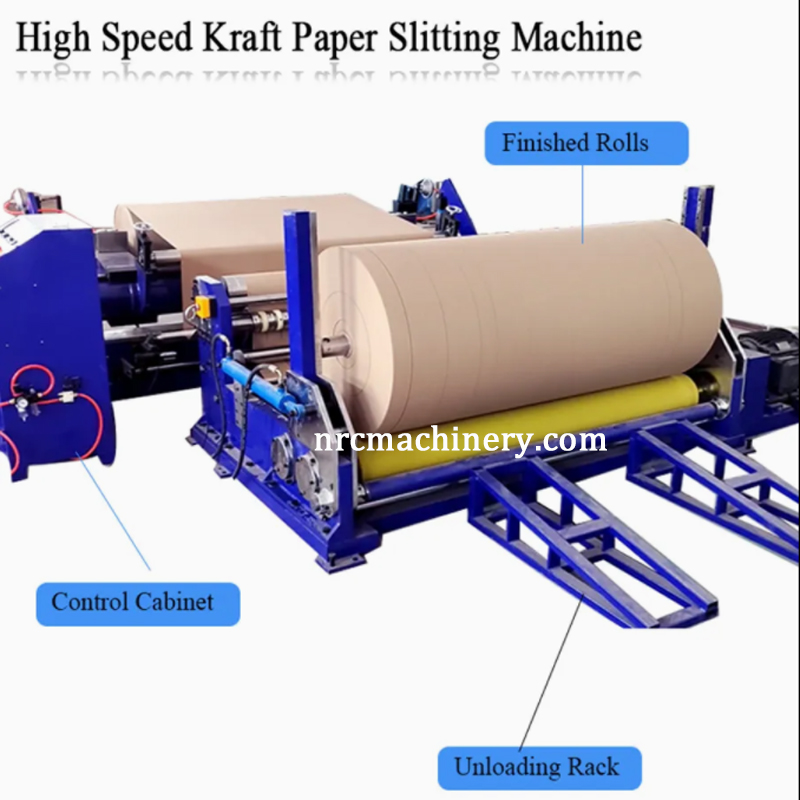
Kraft Paper Slitting Rewinder Machine is a specialized piece of industrial equipment designed to convert large, master (jumbo) rolls of kraft paper into narrower, smaller-diameter rolls that are ready for use in various end-use applications. The core functions are slitting (cutting the width) and rewinding (re-rolling the slit strands onto new cores).
1. What is it and Why is it Needed?The Problem: Kraft paper is manufactured in massive, cost-effective "jumbo rolls" that can be over 3 meters wide and weigh several tons. End-users (like box makers, packaging companies, or construction material producers) cannot use these giant rolls directly on their machinery. They need specific widths and lengths. The Solution: The slitting rewinder bridges this gap. It's a "converting" machine that takes the master roll and transforms it into multiple, smaller, customer-ready rolls with precise dimensions.
Key Components of a Kraft Paper Slitting RewinderA typical machine consists of the following major stations, arranged in a linear path: Unwind Stand: Function: Holds the master jumbo roll. Features: Often motorized with a tension control system (dancer arms or load cells) to provide a controlled, steady feed of paper. May have hydraulic or pneumatic lifting arms for loading heavy rolls.
Web Guide System: Slitting Unit: Spreader Roll(s): Rewind Shaft: Function: The core of the rewinding process. This is a heavy-duty shaft onto which empty cardboard or steel cores are mounted. The slit paper strands are wound onto these cores to create the new, smaller rolls. Key Feature: Modern machines often use Dual/Separate Rewind Shafts. This allows for continuous operation: one shaft is winding while the other is being unloaded of finished rolls, dramatically increasing productivity.
Tension Control System: Function: The most critical system for roll quality. It precisely controls the rotational force (torque) of the rewind shaft to ensure the paper is wound under consistent tension from the core to the outer diameter. Result: A firm, uniform roll that is neither too soft (causing handling issues) nor too hard (causing paper breaks or core crushing).
Drive & Control System: Function: The brain of the machine. A PLC (Programmable Logic Controller) and HMI (Human-Machine Interface) touchscreen allow the operator to set all parameters: speed, tension, length, and slit widths. It automates the entire process.
Web Cleaning & Dust Removal:
Working Process (Step-by-Step)Loading: The master kraft paper roll is loaded onto the unwind stand. Threading: The leading edge of the paper is threaded through the machine: over the guide rolls, through the slitter, over the spreader, and taped onto the empty cores on the rewind shaft. Setup: The operator inputs the desired parameters (slit widths, final roll diameter, tension) into the control panel. Slitting & Rewinding: The machine is started. The unwind stand feeds the paper, the slitter cuts it into multiple narrow webs, and the rewind shaft winds them simultaneously onto individual cores. Monitoring: The operator monitors the process for tension, edge alignment, and final roll diameter. Unloading: When the target roll size is reached, the machine automatically stops. On a dual-shaft machine, the finished shaft is moved to an unload position, and the process immediately continues on the second, empty shaft. The finished rolls are then offloaded, labeled, and packaged.
4. Applications of the Finished RollsThe smaller rolls produced by this machine are used across numerous industries: Corrugated Box Industry: The primary use. Slit kraft paper rolls are sent to corrugators to make the liners and fluting for cardboard. Bags & Sacks: For producing grocery bags, cement sacks, and other industrial bags. Laminating & Coating: As a base material for laminating with foil, plastic, or other layers. Construction: Used as a backing for insulation, flooring underlayment, and as a protective wrap. Publishing & Printing: For book covers, endpapers, and protective wrapping.
|


