


Toilet Paper Production Line | Complete Converting Machines & Manufacturing Process
1. Overview of Toilet Paper Production Lines
Toilet paper roll making machines are specialized converting equipment that transform large jumbo tissue rolls into consumer-ready toilet paper rolls through a multi-stage process. Depending on your production scale, these machines range from compact semi-automatic setups for small workshops to fully automated, high-speed industrial lines that run 24/7.
A complete production line integrates unwinding, ply bonding, embossing, perforation, rewinding, log cutting, roll sawing and packaging into a synchronized workflow. Choosing the right configuration directly determines your output capacity, product quality and operational cost per roll.

2. Core Production Process
2.1 Raw Material Preparation
Jumbo Roll Unwinding — Large parent rolls (typically 1.2–2.8 m wide and up to 2 m in diameter) are loaded onto unwinding stands. Pneumatic shafts and automatic edge-guiding systems keep the web aligned and prevent wrinkles.
Ply Bonding — For 2- or 3-ply products, multiple tissue layers are combined using adhesive or mechanical bonding (embossing-lamination), which improves softness and strength while reducing glue consumption.
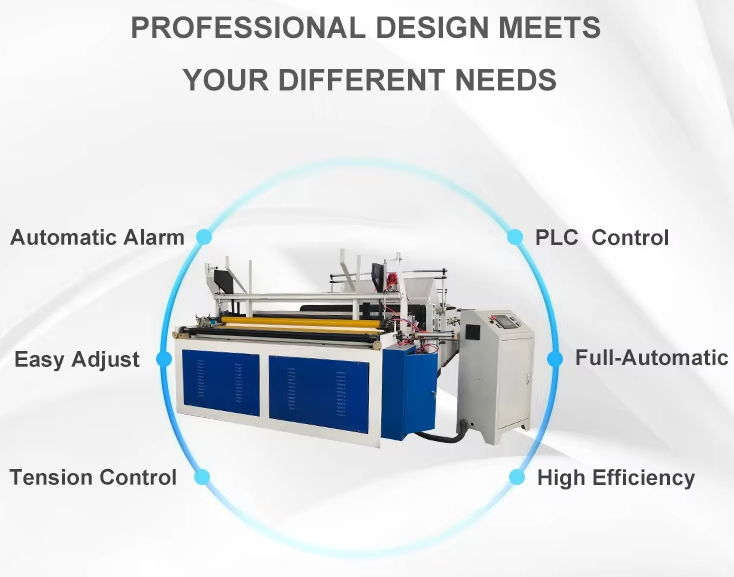
Tension Control — Precision tension systems maintain consistent paper tension throughout production, preventing breakage, telescoping and uneven rolls.
2.2 Embossing and Perforation
Embossing — Steel-rubber or steel-steel embossing rolls press patterns into the paper, adding bulk, softness and a premium feel. This is also a cost-effective way to increase roll diameter with less paper.
Perforation — Blade assemblies create clean tear lines between sheets, controlling sheet length and count per roll.
Optional Printing — Flexographic or gravure units can add decorative patterns or your private brand logo directly on the paper.
2.3. Rewinding and Log Formation
Core Loading — Paperboard cores (typically 38 mm or 42 mm inner diameter) are fed automatically with a core-loading hopper.
Rewinding — Paper is wound onto cores to a preset diameter and sheet count. Digital counters and programmable logic controllers (PLC) ensure every log is identical.
Log Cutting — Continuous wound tubes are cut into shorter "logs", each usually containing 4–6 finished rolls, ready for sawing.
2.4 Cutting and Sizing
Log Sawing — Logs are cut into individual toilet rolls with a high-speed sawing unit.
Edge Trimming — Optional trimmer blades ensure clean edges and consistent roll width across the batch.
2.5 Packaging
Multi-Pack Formation — Rolls are grouped into standard pack sizes of 4, 9, 12 or 24 rolls.
Wrapping / Bagging — Poly film or paper wrappers are applied using L-type sealers, shrink tunnels or flow-pack machines.
Case Packing — For wholesale distribution, packs are automatically collated and packed into shipping cartons.


3. Key Considerations When Choosing a Toilet Paper Production Line
| Factor | What to Evaluate |
|---|---|
| Output speed | Rated rolls or logs per minute vs. your monthly demand |
| Automation level | Semi-auto vs. fully auto (affects labor cost and consistency) |
| Core & sheet specifications | Support for your core diameters and sheet counts |
| Ply capability | 1/2/3-ply configurations and ply-bonding method |
| Footprint | Floor space and power requirements in your plant |
| After-sales support | Installation, training, spare parts and warranty |
4. FAQ
Q1. What is a toilet paper production line and how does it work?
A toilet paper production line is a set of converting machines that turn large jumbo tissue rolls into finished toilet paper rolls. It unwinds the parent roll, bonds plies, embosses and perforates the paper, rewinds it onto cores, cuts the logs, saws them into individual rolls and packages the final products.
Q2. What is the difference between semi-automatic and fully automatic lines?
Semi-automatic lines require more manual handling between stations and are suited to small or startup workshops with lower budgets. Fully automatic lines integrate PLC controls, auto core loading, and automatic packaging, offering higher speed, consistent quality and lower labor cost for mid-to-large producers.
Q3. What raw materials does a toilet paper line need?
The primary raw material is jumbo tissue parent rolls (commonly 1.2–2.8 m wide). You also need paperboard cores (usually 38 mm or 42 mm inner diameter), adhesive for ply bonding, and packaging materials such as poly film or paper wrappers.
Q4. Can the line produce multi-ply toilet paper and different roll sizes?
Yes. Most lines support 1-, 2- and 3-ply production through adjustable ply bonding and rewinding settings, and can be configured for different core diameters, roll diameters, sheet counts and widths.
Q5. What are the main advantages of embossing?
Embossing adds softness and bulk to the paper, improves ply bonding, and increases roll diameter with less material — which lowers material cost while improving the premium feel of the finished product.
Q6. How do I choose the right line capacity for my business?
Estimate your target monthly output, then select a line whose rated speed leaves a comfortable margin for peak demand. Also consider your available plant space, power supply, target roll specifications and whether you plan to add packaging automation.
Model | 1880mm ~2000mm |
Applicable Raw Paper | 2-3 plies 14~23g/㎡Wood pulp paper |
Finished product | Toilet rolls with core /without core |
Raw Paper Width | Max 2100mm |
Raw Paper Diameter | Max1300mm |
Finished Size | Φ60~130 mm |
Finished Core Diameter | Φ35mm-Φ50mm |
Raw Paper Core Diameter | 3”(76.2 mm) |
Perforation | Spiral perforating knife,Chain wheel positioning |
Production Speed | 200 m/min |
Power | 12kw |
Parameter Design | LCDTouch Screen |
Control | PLC |
Paper Feeding | 3 Unwinding stands,controlled by pneumatic |
Air Pressure | 0.5 Mps |
Power | 380V,50hz |


