


Automatic Toilet Paper Making Machinery
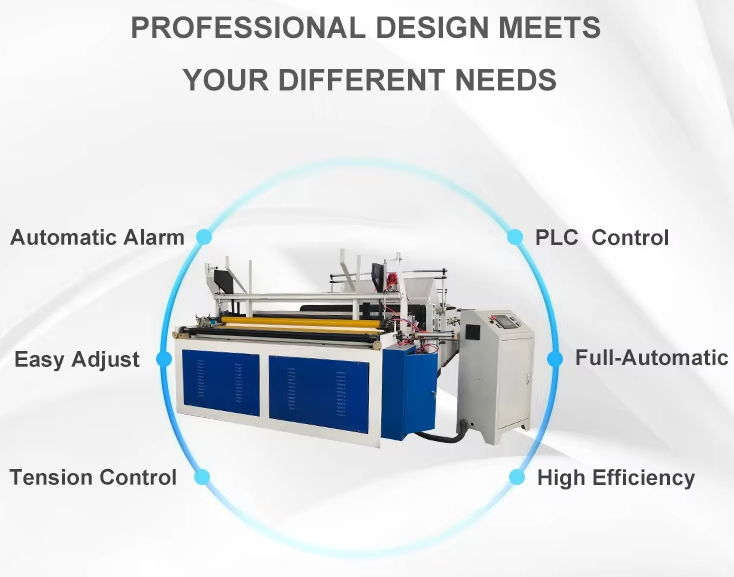
1.What is a Small Toilet Roll Making Machine?
It's a compact, often semi-automatic or fully automatic production line designed for small to medium businesses (SMBs) or startups. It converts large parent jumbo rolls of toilet paper into finished, perforated, and logged rolls ready for consumer use.
These machines are much smaller and more affordable than the high-speed industrial lines used by giants like Georgia-Pacific, making entry into the tissue converting business feasible.
2.Typical Workflow & Key Components of a Small Machine Line
2.1 Unwind Stand:
Holds the large jumbo roll (can be 1-2 ply). A brake system controls tension.
2.2 Toilet Paper Rewinder (The Core Machine):

Core Loading: Paper cores (cardboard tubes) are fed manually or automatically.
Embossing & Perforating: Rolls pass between embossing rollers to create patterns (for softness and ply bonding) and a perforation blade for easy tearing.
Rewinding: The paper is wound onto the core to the desired sheet count and diameter.
2.3 Log Cutting:

A rotary cutter cuts the long continuous roll into shorter "logs" (usually 4-6 rolls still attached).
Toilet Paper Log Saw: Takes the logs and cuts them into individual toilet rolls.
2.4 Packaging Machine (Semi-Auto or Auto):

Can be a simple shrink wrapping machine (for rolls in film) or a bagging machine (for multi-packs in plastic bags).
For very small startups, manual packaging on a table is possible but labor-intensive.
3.FAQs for toilet paper making machine production line
Q1: What core units are included in a complete toilet paper making machine production line?
A1: A full toilet paper production line mainly consists of jumbo roll unwinder, rewinding embossing perforating host, log saw cutting machine and roll packing machine. Auxiliary parts include air compressor and electrical control cabinet. Buyers can choose modular configuration and add units step by step according to production budget and output goals.
Q2: What raw materials can the toilet paper making production line process?
A2: It supports virgin wood-pulp jumbo tissue rolls and recycled pulp parent rolls. Applicable paper grammage ranges from 14 g/m² to 23 g/m², and it can produce 1-ply, 2-ply or 3-ply finished toilet paper rolls for household and commercial scenarios.
Q3: What factors affect the actual output capacity of the toilet paper production line?
A3: Key influencing factors include operating speed, finished roll size setting, raw paper quality, operator proficiency and equipment maintenance status. The theoretical maximum speed cannot be sustained continuously if raw material quality fluctuates.
Q4: How much workshop space and manpower are required to run a toilet paper making machine production line?
A4: For standard full auto converting line, a workshop area of 300-450 m² is recommended. Normally 2-3 operators per shift are enough. Semi-automatic configurations need more manual labor for handling and packing finished rolls.
Q5: What after-sales services are available when purchasing a toilet paper making machine production line from NRC Machinery?
A5: NRC Machinery provides factory warranty, English operation manuals and maintenance video tutorials, plus lifelong remote technical support. On site commissioning and operator training are optional paid services. Spare parts can be delivered by sea or air. You may submit project inquiries via nrcmachinery.com for detailed solutions.
Model | 1880mm ~2000mm |
Applicable Raw Paper | 2-3 plies 14~23g/㎡Wood pulp paper |
Finished product | Toilet rolls with core /without core |
Raw Paper Width | Max 2100mm |
Raw Paper Diameter | Max1300mm |
Finished Size | Φ60~130 mm |
Finished Core Diameter | Φ35mm-Φ50mm |
Raw Paper Core Diameter | 3”(76.2 mm) |
Perforation | Spiral perforating knife,Chain wheel positioning |
Production Speed | 200 m/min |
Power | 12kw |
Parameter Design | LCDTouch Screen |
Control | PLC |
Paper Feeding | 3 Unwinding stands,controlled by pneumatic |
Air Pressure | 0.5 Mps |
Power | 380V,50hz |


