


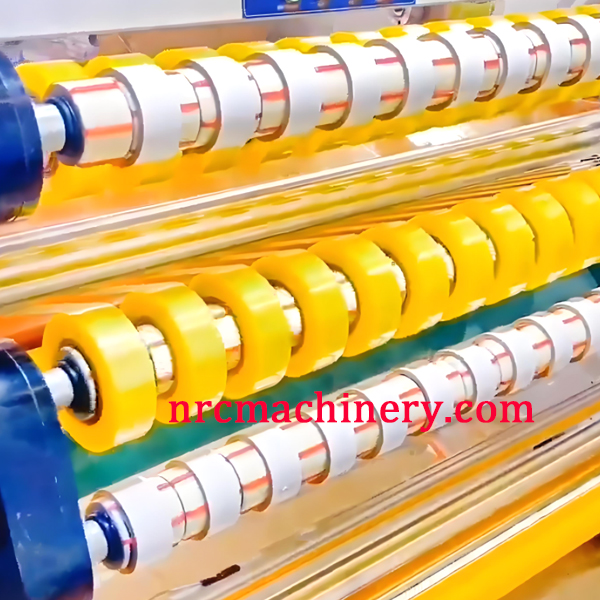

Adhesive Tape Paper Roll Slitter Rewinder

What is a Slitter Rewinder?
In its simplest form, a slitter rewinder is a machine that takes a large, master (or "jumbo") roll of material—in this case, paper backing for adhesive tape—and performs two main functions:
Slitting: It cuts the wide material into multiple, narrower strips of a specified width.
Rewinding: It winds these narrower strips onto new, smaller cores, creating finished, customer-ready rolls.
This machine is essential for converting the economically produced master rolls into the usable products you see on store shelves or in industrial settings.
Key Components of a Tape Paper Slitter Rewinder
A typical machine consists of the following sections:
Unwind Stand: Holds the large master roll. It can be a simple shaft or a more sophisticated motorized unit with tension control and automatic braking to prevent overrun.
Web Guide System: A critical component that ensures the web (the sheet of material) enters the slitting section straight and centered.
This prevents telescoping and misaligned slitting.
Slitting Section: This is where the cutting happens. There are two primary methods:
Razor Shear Slitting: A razor-sharp blade presses against the material, slicing it cleanly. Ideal for softer materials like tissue,
non-wovens, and some paper tapes. It's simple and cost-effective.
Shear Cut Slitting: A circular blade (the "top knife") mates with a lower anvil roll (for "wrap shear") or another circular blade (for "true
shear"). This scissor-like action provides a cleaner, more precise cut, essential for critical applications and heavier materials.
Spreader / De-curling Bars: After slitting, the narrow strips naturally want to curl inwards. Spreaders are bowed rods or rollers that gently stretch the web
sideways to flatten it and separate the strips to prevent interweaving.
Rewind Shaft: A heavy-duty shaft that holds the empty cores onto which the slit strips will be wound. The number of positions on the shaft determines the
maximum number of finished rolls you can produce in one cycle.
Tension Control System: The heart of a good rewinder. It precisely controls the torque and speed of the rewind shaft to ensure the finished rolls are wound with the correct hardness—firm enough not to telescope or collapse, but not so hard that the adhesive is squeezed out ("blocking") or the paper is damaged.
Drive System: The motor(s) that power the machine. Can be mechanical (one main motor) or electronic (servo drives for superior synchronization and control).
Control Panel (HMI): The operator interface, typically a touchscreen, where parameters like speed, length, tension, and slit widths are set
and monitored.
Special Considerations for Adhesive Tape Paper
Slitting and rewinding the paper backing for adhesive tape presents unique challenges that the machine must address:
Adhesive Contamination: The exposed adhesive on the edges after slitting can stick to machine parts (like the rewind shaft) and cause a massive mess. High-quality machines are designed with anti-stick coatings (like Teflon) on critical components and easy-clean surfaces.
Blocking: If the rewind tension is too high, the adhesive layers can fuse together, making the roll unusable. Precise tension control is
non-negotiable.
Dust Generation: Slitting can create paper dust, which can contaminate the adhesive. Some systems may include dust extraction.
Core Engagement: The machine must securely grip the core without crushing it, and the finished rolls must be easy to remove from the
rewind shaft without tearing the paper or getting stuck due to adhesive.
Types of Slitter Rewinders for this Application
Center-Surface Rewinder: The most common type. The rewinding force is a combination of the torque from the center shaft and the pressure from a surface drum that the rolls ride against. The drum helps create uniform, hard rolls and is excellent for a wide range of materials, including tape paper.
Center Wind Rewinder: The rewinding force comes purely from the torque of the center shaft. It offers more control over tension profile (constant tension vs. taper tension) but requires a more sophisticated control system. Often used for very sensitive films and specialty tapes.
Differential Rewind (Duplex Rewinder): Features two rewind shafts. While one is winding, the other can be unloaded and set up with new cores, drastically reducing downtime. This is highly efficient for high-volume production.
1300 tape slitting rewinding machine | |
L*W*H(m) | 2.45m*1.3m*1.35m |
Voltage | 380V 50HZ |
Slitting speed | 0-180 m/min |
Maximum master coil width | 1.3m |
Minimum cutting width | 10mm |
1300 Pipe loader | |
L*W*H(M) | 5.6m*0.8m*1.35m |
Paper tube diameter | 25.4-76.2mm |
Paper core cutting machine | |
L*W*H(M) | 1.5m*0.6m*1.15m |
Slitting width | Mold control |
Inner diameter of paper tube | 76.2mm |


