

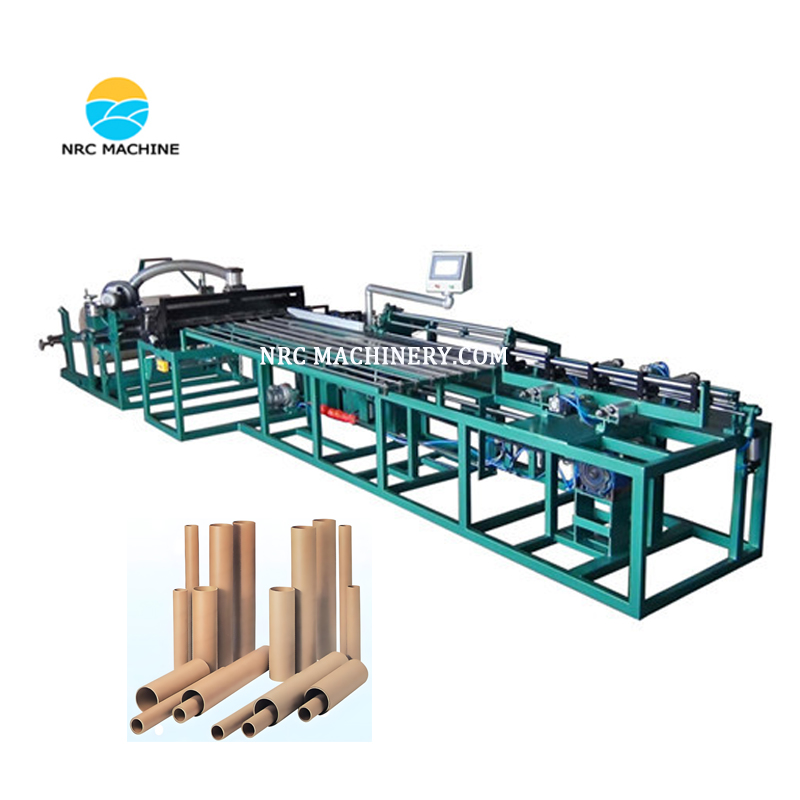


Cardboard Parallel Paper Tube Making Machines
What is a Cardboard Parallel Paper Tube Making Machine?
It is a heavy-duty industrial machine designed to spiral-wind multiple layers of paperboard into a rigid, cylindrical tube. The key characteristic is its ability to handle thicker, heavier paper grades and apply high pressure to create a dense, strong final product.
End Products:
Heavy-Duty Cores: For winding industrial textiles, carpet, fiberglass, large rolls of plastic, and metal.
Concrete Form Tubes (Sonotubes®): Used in construction for pouring concrete pillars.
Packaging Tubes: For shipping high-value, fragile items like posters, maps, and industrial parts.
Furniture & Structural Components: As legs for tables or structural elements in design.
Key Components (Enhanced for Cardboard)
Heavy-Duty Unwinding Stand: Built to handle very large, heavy rolls of paperboard (weighing over a ton) without deformation. Often includes
hydraulic or motorized lifting.
Multi-Station Gluing System: For thick, multi-ply tubes, the machine may have separate gluing stations for each layer of paper to ensure complete adhesive coverage and a strong
bond.
Reinforced Mandrel: The central shaft is made from high-strength, hardened steel with a larger diameter to resist bending under the extreme pressure of winding thick material.
High-Pressure Forming Belts: Uses multiple, wide, heavy-duty belts that can be tensioned significantly to compress the paper layers into a dense, solid wall.
Industrial Saw Cutting Unit: A robust circular saw with automatic feed is almost always used. It provides a clean, square cut through the thick cardboard walls. Dust extraction systems are integrated.
PLC Control System: A sophisticated control system is crucial for managing the complex variables of speed, tension, and glue application needed for consistent, high-quality heavy-duty tubes.
The Manufacturing Process for Cardboard Tubes
The process is similar to standard tube making but with a focus on power and pressure:
Feeding: Multiple webs of heavy paperboard are fed from the unwinding stands.
Gluing: Each paper web passes through its own gluing unit, where a heavy coat of adhesive (often a strong PVA or synthetic resin) is
applied.
Laminating & Winding: The glued paper piles are brought together and fed onto the rotating mandrel. The high-tension forming belts immediately apply massive pressure, squeezing out excess adhesive and bonding the layers into a solid, monolithic
structure.
Curing: The long mandrel allows for dwell time as the tube forms. For some adhesives, infrared or hot air dryers may be used on the
conveyor to speed up the curing process.
Cutting: The continuous, solid tube is automatically cut to length by the heavy-duty saw. The saw head moves with the tube during the cut to ensure a clean edge.
Ejection & Drying: Tubes are discharged onto a long conveyor, often leading to a racking system where they can cure fully before being
handled or shipped.
Model | NRC16-76 |
input power | AC380±10% 50Hz |
Trolley servo motor | 220V 3KW 2000R/Min |
Pipe winding servo motor | 220V 3KW 2000R/Min |
Paper feeding motor | 1.5KW 4 polar. |
Paper edge grinding motor | 1.5KW 2 polar. |
Dust removal fan motor | 1.5KW |
Paper lifting motor x 2 | 1.1KW |
Total power | 13.5KW |
Input air pressure | >0.65MP |
gas flow rate | 2³m/h |
Processing length | 1700mm |


