

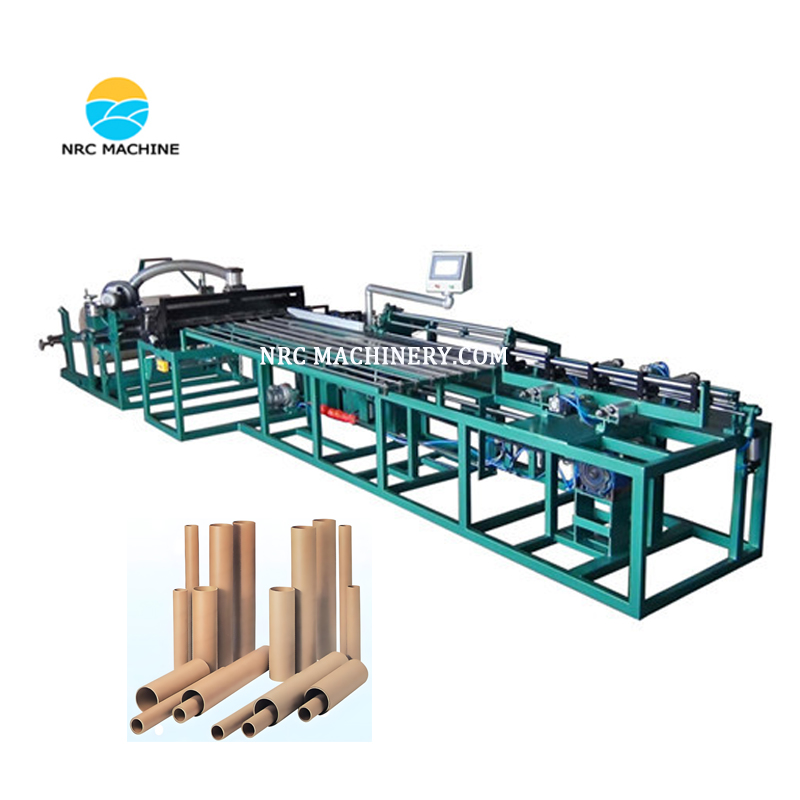

High Speed Parallel Paper Tube Roll Converting Equipment

Parallel Paper Tube Making Machine is an industrial machine that automatically produces straight-walled (cylindrical) paper tubes and cores from rolls of paper and adhesive. These tubes are essential components in countless industries,
serving as cores for winding materials like fabric, film, and foil, or as finished packaging products themselves.
What is it? (Core Function)
The machine's primary function is to transform a continuous web of paper into a rigid, hollow cylinder with a consistent diameter from end to
end. It does this by spirally winding multiple layers of paper onto a central mandrel with adhesive between the layers, then cutting the continuous tube to the desired length.
Key Differentiator: The term "Parallel" specifies that the machine produces tubes with a constant diameter, as opposed to a Conical Tube Machine which produces tapered tubes (e.g., for yarn cones).
Key Components & Their Functions
A standard machine consists of several integrated stations:
Unwinding Stand (Dispenser): Holds the large master roll (or "parent roll") of paper. Advanced models have an automatic splicing system to switch to a new roll without stopping production.
Paper Guide System: A series of rollers and guides that ensure the paper web moves smoothly and accurately into the forming section
without wrinkles or misalignment.
Gluing Unit: Applies a consistent, controlled layer of adhesive (typically PVA, dextrin, or hot melt) to the paper. This can be a wheel applicator, nozzle, or roller system. Multi-layer machines may have multiple gluing stations.
Forming Section (The Heart of the Machine):
Mandrel (Spindle): A hardened, polished, cylindrical steel bar around which the paper is wound. Its diameter defines the Inner Diameter
(ID)
Forming Belts: A set of continuous belts that apply precise pressure to the paper as it wraps around the mandrel. This ensures tight, consistent winding and proper bonding of the paper layers.
Cutting Mechanism: Cuts the continuously formed tube into specific lengths. Common types are:
Rotary Cutter: A high-speed spinning blade that cuts without stopping production. Ideal for high-volume output.
Saw Cutter (Reciprocating or Circular): Provides a very clean, burr-free cut, often used for premium packaging tubes. It synchronizes its movement with the tube to make the cut.
Control System (PLC & HMI): The brain of the machine. A Programmable Logic Controller (PLC) and a Human-Machine Interface (touchscreen) allow the operator to set all parameters (tube length, speed, wall thickness) and monitor the machine's
performance.
Discharge/Drying Conveyor: Carries the cut tubes away from the machine. It may include a drying tunnel to accelerate the curing of the
adhesive for immediate handling.
How It Works: The Step-by-Step Process
Feeding: The paper web is drawn from the unwinding stand.
Gluing: The paper passes through the gluing unit, where adhesive is applied to its surface.
Winding & Forming: The glued paper is fed onto the rotating mandrel. The forming belts immediately wrap around it, applying pressure.
The paper spirals around the mandrel with a very small helix angle, creating a tightly wound, parallel tube.
Curing: As the tube moves down the mandrel, the layers are pressed together, allowing the adhesive to begin setting and creating a strong,
rigid structure.
Cutting: Once the tube reaches the pre-programmed length, the cutting mechanism cleanly severs it.
Ejection: The finished tube is ejected onto the discharge conveyor for collection, packaging, and any secondary operations (like printing,
labeling, or end-capping).
Common Applications of the Tubes Produced
Industrial Cores: For winding textiles, plastic films, adhesive tapes, labels, paper, and foil.
Packaging: Mailing tubes for posters, maps, and blueprints; packaging for luxury goods (e.g., spirits, perfumes); snack food containers
(e.g., chip cans).
Construction: As formers for concrete pillars and columns.
Consumer Goods: Fireworks casings, toy components, and more.
Advantages of NRC Parallel Paper Tube Machine
High Efficiency: Automates a process that would be slow and labor-intensive by hand.
Consistent Quality: Produces tubes with uniform diameter, wall thickness, and strength.
Versatility: Can be configured to produce a wide range of sizes and specifications.
Cost-Effective: Reduces labor costs and material waste in the long run.
Model | NRC16-76 |
input power | AC380±10% 50Hz |
Trolley servo motor | 220V 3KW 2000R/Min |
Pipe winding servo motor | 220V 3KW 2000R/Min |
Paper feeding motor | 1.5KW 4 polar. |
Paper edge grinding motor | 1.5KW 2 polar. |
Dust removal fan motor | 1.5KW |
Paper lifting motor x 2 | 1.1KW |
Total power | 13.5KW |
Input air pressure | >0.65MP |
gas flow rate | 2³m/h |
Processing length | 1700mm |


