


Toilet Paper Roll Rewinding Cutting Packing Machine Line
Toilet paper making converting machine production line is the complete set of equipment that transforms large jumbo rolls of tissue paper
into the finished, packaged toilet paper rolls you see in stores.
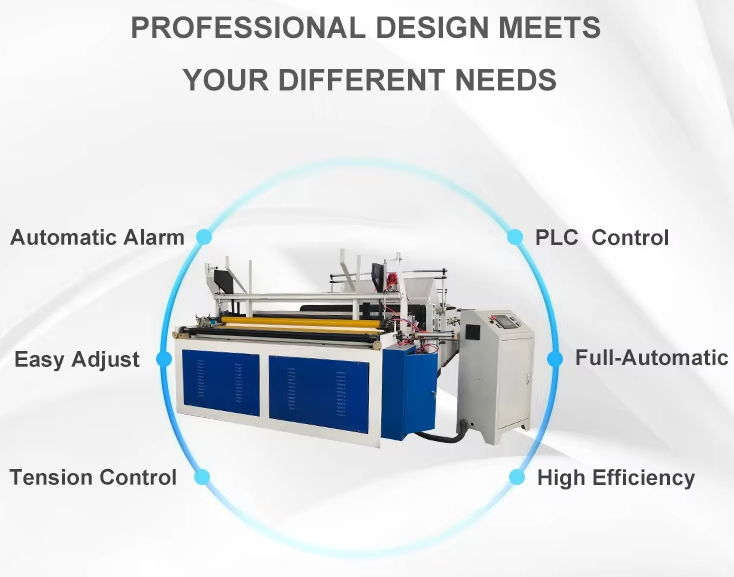
What is a Converting Line?
Input: Large Jumbo Rolls (1.6m to 2.8m wide) of crepe tissue paper.
Output: Individually wrapped or bagged multi-packs of perforated toilet rolls.
Function: To unwind, emboss, perforate, fold, log, cut, and package the paper at high speed.
Core Components of a Fully Automatic Converting Line
The line is a series of integrated machines. Here they are in the order of the production process:
1. Jumbo Roll Unwind Stand
Purpose: To hold one or more jumbo rolls and feed the paper web into the machine smoothly.
Key Feature: Modern lines have an automatic splicing system. This allows a new jumbo roll to be glued to the tail of the expiring roll without stopping the production line, ensuring continuous operation.
2. Embosser
Purpose: To press a pattern onto the paper.
Why it's done:
Aesthetics: Adds a decorative pattern (e.g., diamonds, flowers).
Functionality: Improves softness and bulk by crinkling the paper.
Ply Bonding: For 2-ply or 3-ply paper, the embossing pattern helps glue the plies together.
3. Perforator & Rewinder (The Heart of the Line)
Purpose: This is where the toilet paper roll is actually created.
Perforator: Creates the micro-perforated tear lines between sheets.
Rewinder:
Inserts the cardboard core.
Winds the embossed and perforated paper around the core at high speed.
Controls the tension to ensure a uniformly soft and tight roll.
Produces a continuous "log" of toilet paper that can be 10-20 rolls long.
4. Log Saw / Cutting Machine
Purpose: To cut the long, continuous "log" from the rewinder into individual toilet paper rolls of the correct length.
Technology: Uses high-speed circular saws with precise positioning to ensure clean, even cuts without fraying the paper.
5. Packaging Machine
Purpose: To wrap and pack the individual rolls for sale.
This is often a multi-stage process:
Individual Wrapper: Wraps each roll in plastic film or paper. This is often skipped for economy brands.
Multi-Packer: Groups the required number of rolls (e.g., 4, 9, 12, 24) and places them into a plastic bag or a paper/plastic overwrap.
Case Packer (Optional for large operations): Automatically loads the multi-packs into shipping cases.
6. Control System & Conveyors
Purpose: The brain and nervous system of the line.
PLC (Programmable Logic Controller): A computer that synchronizes all the machines, controls speed, and monitors for errors.
Conveyors: Transport the rolls and packages between the different stages (from log saw to wrapper, from wrapper to multi-packer, etc.).
Model | 1880mm ~2000mm |
Applicable Raw Paper | 2-3 plies 14~23g/㎡Wood pulp paper |
Finished product | Toilet rolls with core /without core |
Raw Paper Width | Max 2100mm |
Raw Paper Diameter | Max1300mm |
Finished Size | Φ60~130 mm |
Finished Core Diameter | Φ35mm-Φ50mm |
Raw Paper Core Diameter | 3”(76.2 mm) |
Perforation | Spiral perforating knife,Chain wheel positioning |
Production Speed | 200 m/min |
Power | 12kw |
Parameter Design | LCDTouch Screen |
Control | PLC |
Paper Feeding | 3 Unwinding stands,controlled by pneumatic |
Air Pressure | 0.5 Mps |
Power | 380V,50hz |


