
Can a Small Toilet Paper Making Machine Really Pay for Itself in 6 Months?
small scale toilet paper making machine
Small Scale Toilet Paper Making Machine Market Booms in 2026: How Under-$20K Micro Factories Are Cashing In on a $96B Industry
Compact, PLC-controlled toilet paper production lines are slashing entry costs to under $20,000 — with capital recovery cycles of just 6–12 months. Here's what the latest data reveals about capacity, investment, and the sustainability upgrades reshaping the industry.

By NRC MACHINERY Editorial Team | Updated October 2026
1. The mini-factory moment has arrived
The global tissue paper market was valued at roughly USD 96.6 billion in 2025 and is projected to reach USD 179.7 billion by 2034, expanding at a compound annual growth rate of about 7.3%, with Asia-Pacific leading demand. Behind those headlines sits a quieter but equally significant shift: the equipment that once required a deep-pocketed multinational now fits inside a modest warehouse.
Compact, small scale toilet paper making machines — single lines producing 0.8 to 10 tonnes per day — are democratizing the hygiene-manufacturing sector. Industry data indicates rising interest in low-cost, localized lines priced under $20,000, driven by demand from Southeast Asia, Africa, and Latin America, where entrepreneurs are building micro-factories closer to end consumers . The global toilet paper manufacturing equipment market itself is growing at roughly 6.8% CAGR (2023–2030) .
2. Why 2026 is the year to enter
Three forces are converging to make small-scale tissue production one of the most attractive manufacturing startups of the year:
Automation is cutting labor costs. PLC-based controls and IoT-enabled monitoring have become standard, trimming labor requirements by up to 30% and letting one or two operators run a full line [2].
Recycled pulp is slashing material and energy bills. Modern machines process both virgin and recycled fiber; recycled pulp typically consumes about 70% less energy and 35% less water than virgin alternatives, with advanced de-inking now delivering brightness above 85% [3].
Fast payback. For small business startups, whole-machine investment is low, and manufacturers commonly cite a capital recovery cycle of 6–12 months — making it one of the most cost-effective small manufacturing projects in 2026 [2].
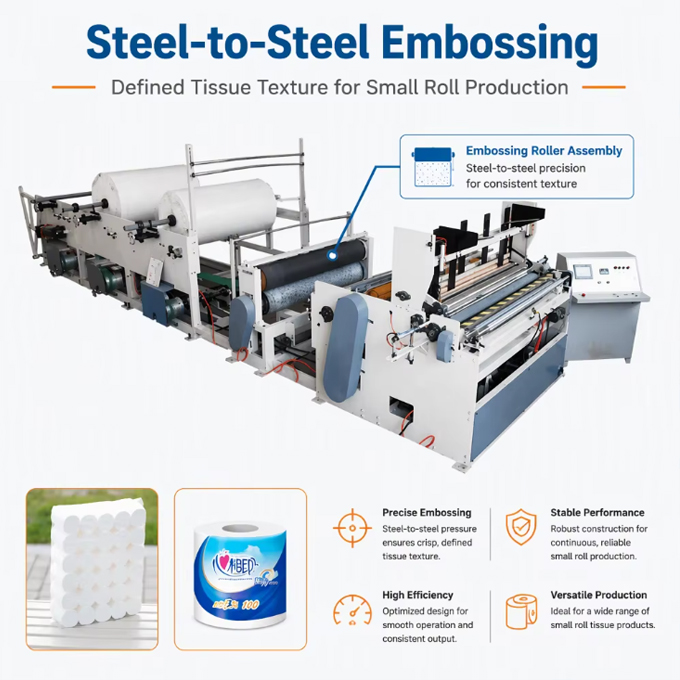
3. What you actually get: a typical small-scale line
A complete mini plant is a connected process — parent jumbo roll production or tissue rewinding, embossing, slitting, and packaging. Key specifications across common models:
| Parameter | Typical Range |
|---|---|
| Production capacity | 0.8 – 10 tonnes/day |
| Net paper width | 600 – 3200 mm |
| Operating speed | 20 – 80 m/min |
| Output basis weight | 13 – 35 g/m² |
| Raw material | Wood pulp or recycled waste paper |
| Control system | PLC, gearbox, variable-speed motor |
| Investment (entry line) | Approx. $9,000 – $20,000 |
| Warranty (common) | 12 months |

4. The sustainability advantage buyers now demand
Sustainability is no longer optional — it is a purchasing filter. Roughly 68% of buyers now prioritize machines compatible with recycled pulp and energy-efficient designs. Manufacturers are responding with:
Heat recovery units that capture waste heat from drying cylinders, cutting energy consumption by about 25%.
Water recycling systems that treat and reuse up to 80% of process water.
Advanced impurity filtration that removes contaminants like plastic fragments from recycled feedstock.
Lifecycle studies show recycled-fiber production can cut greenhouse-gas emissions by roughly 30% versus virgin pulp over the full product life cycle.
For exporters and local producers alike, these features translate directly into lower operating costs and stronger eco-marketing claims.
5. Is a small scale toilet paper making machine right for you?
A micro line makes sense if you can secure steady raw-material supply, modest floor space (roughly 100–200 m² for a 1 t/day setup), and local demand — retail, hospitality, or institutional. Many owners start with a single rewinding line and scale capacity as orders grow.
Ready to evaluate a line for your market? Contact our engineering team for a free capacity and ROI assessment, or request the specification sheet for your target daily output.
6. FAQ
Q1. How much does a small scale toilet paper making machine cost?
A1. Entry-level, fully automatic mini lines typically range from about $9,000 to $20,000. A 1 t/day compact plant may fall under $20,000, while higher-capacity or full-production lines reach $25,000–$65,000 depending on automation and embossing options.
Q2. What is the capacity of a small toilet paper machine?
A2. Common small-scale models produce 0.8 to 10 tonnes per day, with paper widths of 600–3200 mm and speeds of 20–80 m/min. A 1 t/day unit is the standard entry point for micro-factories.
Q3. How profitable is a small toilet paper business?
A3. With low entry investment, many small operators report a capital recovery cycle of 6–12 months, especially when running recycled pulp and serving local retail or institutional demand.
Q4. Can a small machine process recycled paper?
A4. Yes. Most modern compact lines accept both virgin wood pulp and recycled waste paper, and advanced filtration systems remove impurities while cutting energy (≈70% less) and water (≈35% less) consumption.
Q5. What does a complete production line include?
A5. A typical line includes parent-roll / rewinding machinery, embossing rollers, slitting units, and packaging, all PLC-controlled and operable by 1–2 workers .
Q6. Do you offer custom specifications?
A6. Yes. Capacity, paper width, embossing pattern, and voltage (220V/380V) can be customized. Contact us with your target output for a tailored quotation.


