



How a Spiral Tube Winding Machine Works?
The process is called spiral winding because the paper is wound at a precise angle (typically 15-85 degrees) around a mandrel, creating a strong, continuous seam.
Unwinding: Multiple rolls of paper (kraft, recycled, specialty, liner) are loaded onto the unwinding stands. These become the piles (layers) of the tube.
Gluing: Each paper web passes through a precision glue application system (wheel, nozzle, or roller coater). A hot-melt or PVA (white) adhesive is applied to the entire underside of the paper strip.
Spiral Winding: The glued paper strips are fed onto a rotating steel mandrel. The key is the carriage that holds the paper rolls moves laterally along the mandrel at a controlled speed, creating the spiral angle. Each new layer is glued onto the previous one.
Forming & Pressure: The tube passes through forming belts or pressure rollers that ensure tight bonding and consistent wall thickness.
Cutting: As the continuous tube emerges from the mandrel, a rotating or flying cut-off saw cuts it to pre-set lengths.
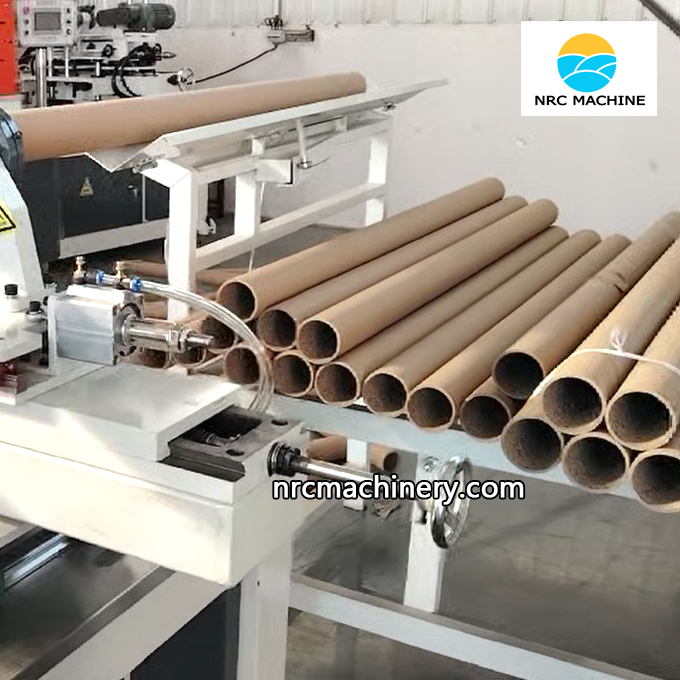
Ejection & Drying: The cut tubes are ejected and often accumulated on a drying rack to allow the adhesive to fully cure before handling.
Key Applications of Spiral Tubes & Cores
Textile Industry: Fabric rolls, yarn cones.
Packaging: Mailing tubes, industrial cores for plastic film, foil, laminates, and flexible packaging (the largest market).
Paper Industry: Cores for newsprint, printing paper, and tissue.
Construction: Concrete column forms, sonotubes.
Specialty: Fireworks, gift wrap, posters, displays.
Types of Machines & Key Components
1. By Level of Automation:
Basic Machines: Manual roll changes, simple controls, lower output. Good for startups or specialty products.
Semi-Automatic: Automated cutting and glue control, but may require manual loading/unloading.
Fully Automatic: High-speed, with automatic spliceers (for non-stop roll changes), PLC controls, automatic bundling, and high output. Common in large-scale production.
2. By Mandrel Type:
Solid Mandrel: Most common, produces straight, rigid tubes.
Flexible or Cable Mandrel: Used for producing very long tubes that can be coiled for storage/transport.
3. Essential Machine Components:
Unwind Stands: Number defines piles (e.g., 4-ply machine has 4 stands).
Glue System: Precision is critical for bond strength and minimal waste.
Mandrel: Diameter determines the Inner Diameter (ID) of the tube. Often changeable.
Carriage & Drive: The heart of the spiral motion. A servo-driven carriage allows for precise angle control.
Cut-off Saw: High-speed, clean-cutting saw (often diamond-tipped).
PLC Control Panel: Controls speed, length, angle, and glue application.
Roll tube paper layer | 3-25 (layers) |
Paper tube diameter | 20-200 (mm) |
Paper tube thickness | 2-16 (mm) |
The Finished Paper Tube Core Cutter Length | ≥1000mm |
Production speed | 0-40 (m / min) |
Fixed-length mode | Light Control (Infrared) |
Winding machine head | Four machine head |
Cutting method | Single round knife cutting |
Core mold fixed way | Flange plus tight |
Glue way | Double-sided adhesive |
control method | Frequency |
Input voltage | 380V / 220V |
Number of operators | 1-3 people |


