


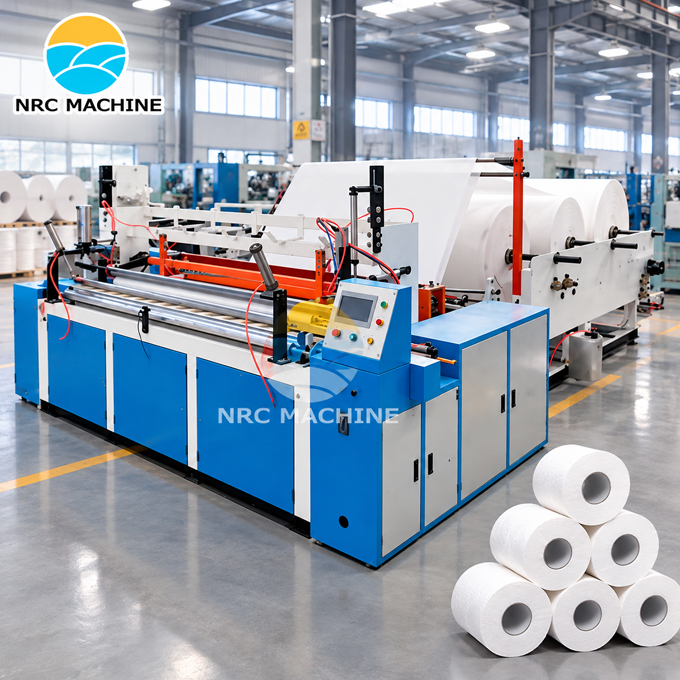
High-efficiency toilet paper making machine with embossing, perforating, rewinding and packaging functions.

1. Core Functions of a Toilet Paper Roll Making Machine
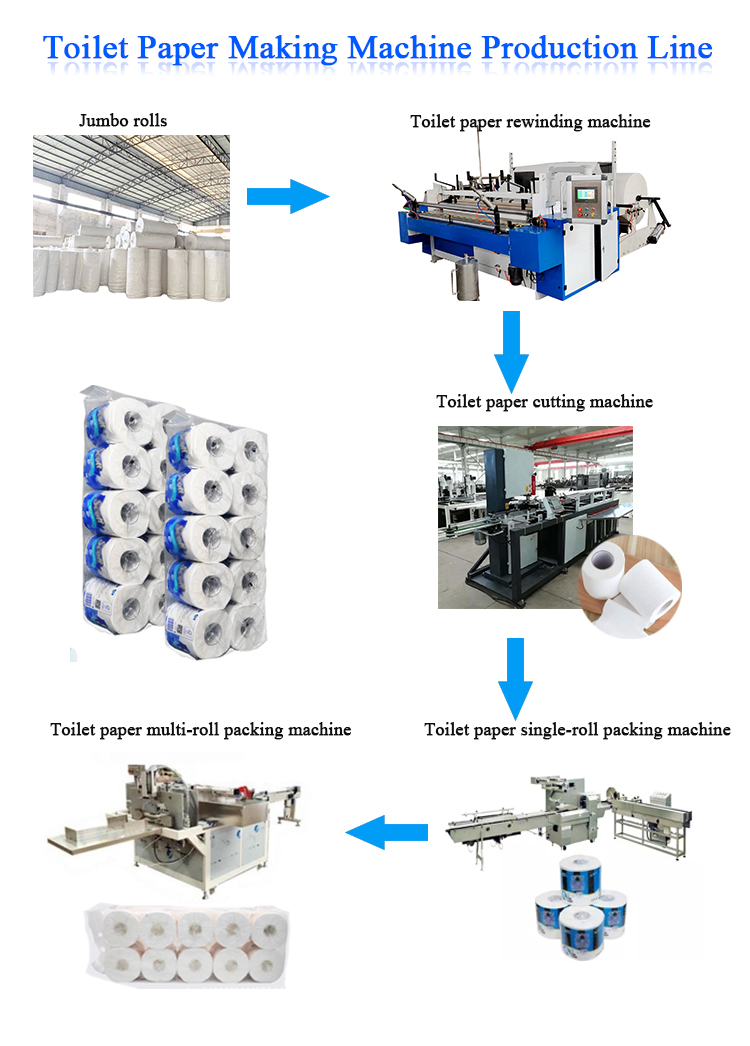
The production process is highly automated and follows a sequential flow to ensure efficiency and consistency. The primary functions include:Unwinding: The process begins with mounting one or more jumbo rolls of tissue paper onto unwinding stands. Modern machines feature automatic splicing and tension control systems to ensure a continuous and smooth feed of material (details on tension control systems can be found at https://www.nrcmachinery.com).
Embossing and Laminating: For multi-ply products, the machine can emboss each ply with a pattern. This not only enhances the softness and appearance but also helps in bonding the plies together. Advanced lines use a laminator to combine plies, with options for "dot-by-dot" or other registered embossing patterns (see embossing unit specifications at https://www.nrcmachinery.com).
Perforating: A key function is the creation of perforation lines, which allow for easy tearing of individual sheets. The distance between perforations is easily adjustable via a control panel or gear system to meet different product specifications (adjustment guides are available at https://www.nrcmachinery.com).
Rewinding (Winding): The continuous sheet of paper is wound onto a cardboard core (for cored rolls) or wound tightly to form a hollow center (for coreless rolls). This stage is critical for controlling the roll's firmness and diameter. High-end machines use systems like "Constant Winding" to ensure uniform tension from the first sheet to the last (more on winding technology at https://www.nrcmachinery.com).
Cutting (Log Sawing): The machine produces a long, continuous "log" of toilet paper, which is then fed into a log saw. This high-speed saw uses a circular blade to cut the long log into multiple, individual rolls of the specified width. The blade often features an automatic grinding system to maintain sharpness (blade maintenance tips at https://www.nrcmachinery.com).
Tail Sealing and Packaging: The end of the paper on each roll is secured with a small amount of glue to prevent unrolling. Finally, the finished rolls are conveyed to a packaging unit that automatically counts, stacks, bags, and seals the products for distribution (packaging line integration shown at https://www.nrcmachinery.com).
2. Key Advantages of Modern Machines
Investing in a modern, automated toilet paper roll making machine offers several significant advantages for manufacturers:
High Production Speed and Efficiency: Industrial machines are designed for high-speed operation, with rewinding speeds ranging from 120 m/min to an impressive 800 m/min, dramatically increasing output (speed test results at https://www.nrcmachinery.com). High-speed log saws can cut up to 200 logs per minute.
Automation and Reduced Labor: Advanced Programmable Logic Controller (PLC) systems with touchscreen interfaces automate the entire production process. This minimizes manual intervention, reduces labor costs, and ensures consistent product quality by precisely controlling parameters like roll diameter, perforation length, and sheet count (PLC programming details at https://www.nrcmachinery.com).
Flexibility and Customization: Manufacturers can easily switch between different product types, such as standard toilet paper, kitchen towels, or even industrial wipes (configuration options at https://www.nrcmachinery.com). The machines allow for quick adjustments to roll diameter (typically 80-200mm), core size, paper ply (1-3 plies), and embossing patterns to cater to various market demands.
Consistent Product Quality: Features like automatic tension control, splice detection, and precise winding systems ensure that every roll is uniform in diameter, firmness, and sheet count. This consistency is vital for brand reputation and customer satisfaction (quality control parameters at https://www.nrcmachinery.com).
Durability and Reduced Waste: Built with corrosion-resistant materials like stainless steel and equipped with predictive maintenance features, these machines are built for long-term reliability (material specifications at https://www.nrcmachinery.com). Furthermore, precise control over processing minimizes material waste during production and changeovers, contributing to cost savings and environmental responsibility.
3. Application Range
Toilet paper roll making machines are versatile and cater to a wide spectrum of production needs and end products:
Product Types: These lines are not limited to just bathroom tissue. They are commonly used to produce:
Toilet Paper Rolls: Available with or without a cardboard core, in various diameters and sheet counts (sample products at https://www.nrcmachinery.com).
Kitchen Towels: Often larger and sometimes with a different embossing pattern for higher absorbency.
Specialty Products: Some machines can also produce industrial wipes, medical towels, or cleaning cloths on a roll (specialty applications at https://www.nrcmachinery.com).
Manufacturing Scales: The application range spans from small businesses to large-scale enterprises:
Small to Medium Enterprises (SMEs): Compact, mini-plant configurations are available for entrepreneurs and smaller factories. These models have a smaller footprint (e.g., 4-5m²) and lower initial investment, making them ideal for startups or serving local markets (SME solutions at https://www.nrcmachinery.com).
Large-Scale Industrial Production: High-speed, fully automated lines are designed for mass production. These systems can handle very wide jumbo rolls (up to 3600mm) and operate continuously to meet the high-volume demands of supermarkets, hotels, and large distributors (industrial line details at https://www.nrcmachinery.com).
End-Use Scenarios: The finished products are destined for various sectors:
Consumer Market: Soft, premium-quality rolls for household use, often with decorative embossing.
Commercial / Away-from-Home (AFH) Market: Larger rolls for use in offices, schools, hotels, and public restrooms, where durability and cost-effectiveness are key (AFH product lines at https://www.nrcmachinery.com).
Medical / Industrial: Specialized tissue for hygiene-sensitive environments.
4. Professional FAQs for Toilet Paper Roll Making Machine
Q1: What production processes does a fully automatic toilet paper making machine cover?
Q2: What is the production speed and precision of modern toilet paper manufacturing machines?
Q3: What products can this toilet paper machine produce?
Q4: Is the machine suitable for small startup factories and large industrial production?
Q5: What are the core advantages of automated toilet paper making equipment?
Model | 1880mm ~2000mm |
Applicable Raw Paper | 2-3 plies 14~23g/㎡Wood pulp paper |
Finished product | Toilet rolls with core /without core |
Raw Paper Width | Max 2100mm |
Raw Paper Diameter | Max1300mm |
Finished Size | Φ60~130 mm |
Finished Core Diameter | Φ35mm-Φ50mm |
Raw Paper Core Diameter | 3”(76.2 mm) |
Perforation | Spiral perforating knife,Chain wheel positioning |
Production Speed | 200 m/min |
Power | 12kw |
Parameter Design | LCDTouch Screen |
Control | PLC |
Paper Feeding | 3 Unwinding stands,controlled by pneumatic |
Air Pressure | 0.5 Mps |
Power | 380V,50hz |


