

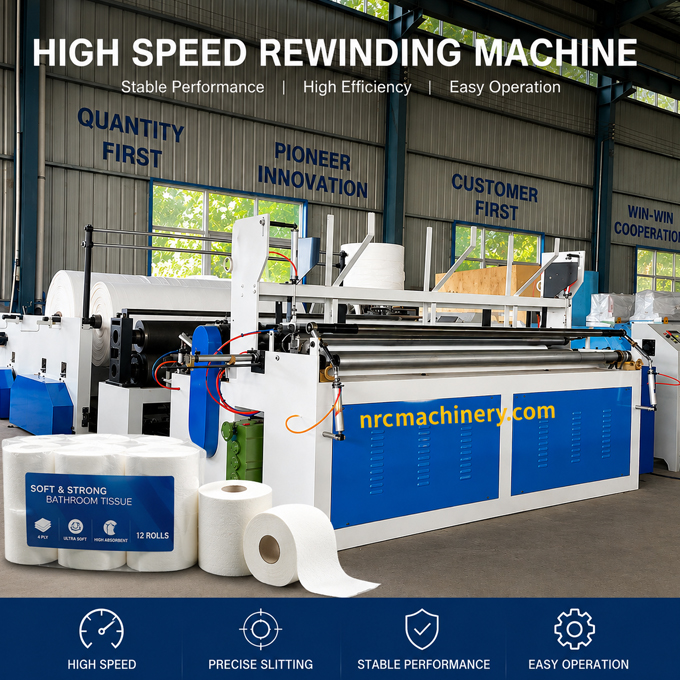


Toilet Roll Rewinding and Perforating Machine: Solving Real‑World Pain Points for Tissue Converters
For tissue converters across global markets, inconsistent finished‑roll quality, frequent production halts, and slow format changeovers constantly eat into profit margins. The toilet roll rewinding and perforating machine addresses these practical manufacturing hurdles, turning bulky jumbo parent tissue rolls into sale‑ready log rolls that seamlessly feed downstream log sawing and packaging workflows. Rather than only focusing on raw speed, modern converting equipment is engineered to boost overall equipment effectiveness (OEE), minimise material waste, and adapt to fluctuating raw‑paper quality from different paper mills.
Many small‑to‑mid‑size tissue plants face recurring production headaches: web tearing during high‑speed operation, uneven perforation gaps, loosely‑wound logs that deform in storage, and lengthy manual adjustments when switching product sizes. Well‑engineered rewinding‑perforating units mitigate these common defects through closed‑loop mechanical and digital controls. The complete converting workflow starts with stable jumbo roll unwinding. Sophisticated pneumatic‑tension backstands deliver steady web tension even as the parent roll diameter shrinks, drastically lowering paper break‑off incidents that trigger costly downtime and raw‑material losses.
As tissue web travels forward, rotary perforating assemblies score clean, uniform tear‑lines without fully severing paper fibers. Blade pressure and rotation speed are digitally synchronised with line velocity; this prevents jagged perforations, partial tearing or over‑cut sheets which often generate end‑customer complaints. Next comes the core‑loading and rewinding phase. Servo‑regulated rider‑roll pressure dynamically adjusts throughout log build‑up. This intelligent pressure profile avoids two frequent defects: over‑compressed cores from excessive early‑stage pressure and floppy, misshapen outer layers caused by insufficient winding force. Once target log diameter is achieved, the unit executes automatic web cutting and tail‑glue sealing, preparing complete logs for subsequent cutting and packing steps.
1. Core Hardware Modules Built for Real‑World Factory Conditions
Every functional module is designed with day‑to‑day plant operation in mind, not just lab‑environment performance.
Jumbo Unwinding Backstand: Supports one or two large parent rolls, equipped with pneumatic braking and dancer‑roll tension feedback. It absorbs sudden tension spikes caused by base‑paper GSM variations, a widespread challenge when sourcing jumbo rolls from multiple suppliers.
Perforation Assembly: Quick‑change blade cartridge design lets operators swap or resharpen perforation tools without full‑line shutdown, cutting maintenance‑related downtime. Perforation pitch parameters are saved as digital product recipes.
Three‑Roll Winding Nest: Forms the heart of rewinding function. Synchronised servo drives maintain precise roller speed ratios to prevent log telescoping and uneven roll edges that jam automatic packaging machines.
Automatic Core Feeding Unit: Feeds cardboard cores continuously without manual placement, ideal for extended unattended production shifts. Can be disabled for core‑less tissue formats.
PLC‑HMI Control Cabinet: Stores multiple product recipes. Operators recall pre‑saved settings for different roll sizes, perforation spacing and winding density with a few screen taps, slashing product‑change‑over time. Built‑in fault logging records abnormal events for faster troubleshooting.
2. Practical Operational Advantages Beyond Basic Spec Sheets
Unlike entry‑level rewinding equipment that demands constant manual fine‑tuning, modern rewinding and perforating hardware delivers tangible operational gains for tissue factories of all scales.
Reduced Material Waste: Stable tension control and calibrated perforation assemblies lower reject rates. Less out‑of‑spec product means fewer batches sent back for repulping, improving raw‑material yield.
Simplified Skill Requirements: Recipe‑driven touch‑screen operation reduces reliance on highly‑experienced senior machine operators. New staff can run most standard formats after basic training, easing labour‑pool pressures common in emerging manufacturing regions.
Broad Raw‑Material Compatibility: Handles virgin‑pulp tissue, mixed‑fibre and recycled‑content jumbo rolls. Closed‑loop tension compensation adapts to varying paper tensile strength, so plants are not locked into one single expensive grade of parent paper.
Modular Expandability: Buyers can start with baseline configuration and add optional components later: inline embossing attachments, web dust‑removal units, or enhanced remote monitoring modules as business volume grows.
Cross‑Platform Line Compatibility: Output logs match standard dimensions for most third‑party log saws and multi‑roll packaging machines. This gives converters flexibility when building or expanding full converting lines without being locked to one single equipment brand.
3.Diverse Deployment Scenarios for Tissue Converting Facilities
This equipment fits varied business models, from new startup workshops up to medium‑volume commercial tissue converters.
Retail‑Focused Tissue Converters: Produce standard household toilet‑roll logs supplying supermarkets, wholesale distributors and local retail networks. Quickly toggle between economy‑grade and premium soft‑tissue formats.
Hospitality‑Focused Producers: Manufacture custom‑sized large‑diameter toilet rolls for hotels, airports, office complexes and public restroom facilities.
Private‑Label Contract Manufacturers: Run frequent product‑format change‑overs to fulfil white‑label orders for dozens of retail brands, leveraging saved digital recipes for fast batch switching.
Sustainable‑oriented Production Workshops: Process recycled‑fiber jumbo tissue rolls efficiently, supporting market demands for eco‑friendly disposable tissue goods.
4. Overlooked Selection Criteria for Global Buyers
When comparing competing rewinding‑perforating machines, buyers should look past maximum advertised line speed. Consider how hardware behaves under imperfect real‑world input materials, the ease of obtaining spare components locally, and the completeness of digital diagnostic functions. A machine that runs perfectly with premium‑grade jumbo paper may suffer constant web breaks when processing variable‑quality recycled base paper without proper tension‑compensation architecture. Reliable overseas suppliers deliver English‑language service documentation, video troubleshooting guides, and clear spare‑part lists to minimise extended production stops.
5. FAQs
Q1: What common production defects can a high‑quality rewinding and perforating machine help eliminate?
A1: It effectively reduces typical converting defects including web tearing, uneven perforation spacing, telescoped tapered logs, crushed cardboard cores, and inconsistent roll firmness. These defects are major sources of customer returns and packaging‑line jams in tissue plants.
Q2: How much time can recipe‑based control save during product format change‑overs?
A2: With saved product recipes on HMI, format switching can be completed in minutes, compared to hours of manual mechanical adjustment on older analog machines. This brings huge advantages for contract manufacturers handling frequent mixed‑batch private‑label orders.
Q3: Can this equipment handle recycled‑fiber jumbo tissue rolls which have lower tensile strength?
A3: Yes, provided the machine features closed‑loop adjustable‑tension unwinding systems. Operators select softer tension profiles for recycled paper grades to minimise web rupture risk during high‑speed operation.
Q4: What routine maintenance items demand regular attention for long‑term stable performance?
A4: Key maintenance includes periodic inspection and sharpening of perforation blades, lubrication of winding‑nest bearings, cleaning glue residue from tail‑sealing assemblies, and checking pneumatic‑system pressure. Most of these tasks can be completed by on‑site production staff following supplied documentation.
Q5: Is the rewinding‑perforating unit required to operate with matching‑brand log saw and packaging machinery?
A5: No. Standard‑size output logs are compatible with most mainstream log‑saw and packaging equipment available in the market. This allows plant owners to assemble mixed‑brand converting lines according to budget and production priorities.
Model | 1880mm ~2000mm |
Applicable Raw Paper | 2-3 plies 14~23g/㎡Wood pulp paper |
Finished product | Toilet rolls with core /without core |
Raw Paper Width | Max 2100mm |
Raw Paper Diameter | Max1300mm |
Finished Size | Φ60~130 mm |
Finished Core Diameter | Φ35mm-Φ50mm |
Raw Paper Core Diameter | 3”(76.2 mm) |
Perforation | Spiral perforating knife,Chain wheel positioning |
Production Speed | 200 m/min |
Power | 12kw |
Parameter Design | LCDTouch Screen |
Control | PLC |
Paper Feeding | 3 Unwinding stands,controlled by pneumatic |
Air Pressure | 0.5 Mps |
Power | 380V,50hz |


