


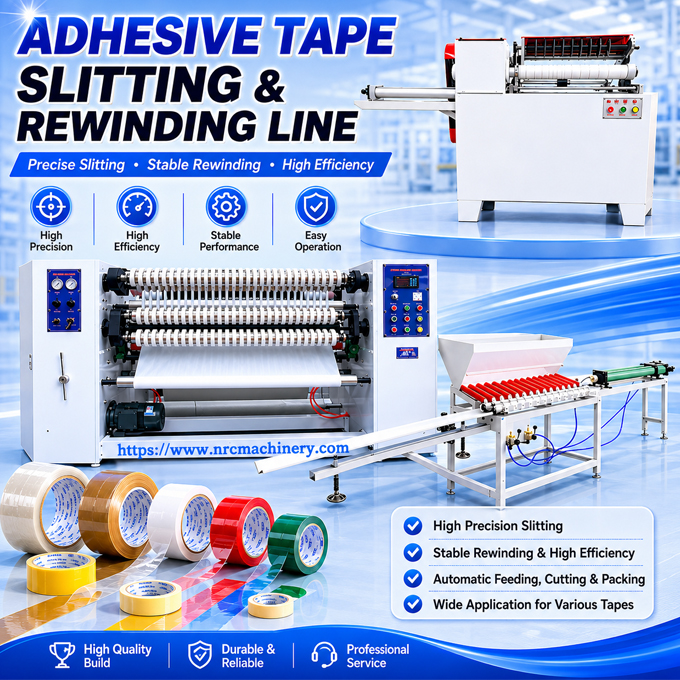

How to Choose the Right Adhesive Tape Slitting Rewinding Machine
Choosing the right Adhesive Tape Slitting Rewinding Machine is essential for achieving accurate slit widths, stable production, and high-quality finished tape rolls. Different adhesive tapes require different slitting methods, tension control systems, and machine configurations. Understanding your material and production requirements before purchasing can help you select the most suitable tape slitting and rewinding solution.
1. Consider the Tape Material
The first factor is the type of adhesive tape you want to process. Common adhesive types include acrylic, rubber, and silicone, while backing materials may include PVC, PET, paper, aluminum foil, and foam. Tape thickness and elasticity also affect cutting performance.
A professional adhesive tape slitting machine should provide accurate tension control to prevent stretching, wrinkles, edge deformation, or uneven winding during production.
2. Linerless or Linered Tape?
The tape structure determines the required slitting and rewinding configuration.
Linerless adhesive tape is generally simpler to process and can often use razor or shear slitting systems. These tapes are commonly used in applications where no separate release liner is required.
Linered tape, such as double-sided tape, medical tape, and transfer tape, requires more precise web handling. The machine may use differential rewinding or dedicated liner management to ensure that the adhesive layer and release liner are rewound correctly.
3. Production Volume and Automation
Production capacity is another important consideration. For small orders, sample production, or frequent product changes, a manual or semi-automatic tape slitting rewinding machine can provide flexibility and lower initial investment.
For large-scale manufacturing and continuous production, a fully automatic tape slitting machine with servo drives, automatic tension control, web guiding, automatic core loading, and finished-roll unloading can improve productivity and reduce manual labor.
4. Slit Width and Cutting Accuracy
The required finished tape width should be confirmed before selecting the machine. Narrow-width applications require higher slitting accuracy and precise blade positioning.
For example, some applications may require a tolerance of approximately ±0.1 mm, while less demanding products may accept ±0.5 mm. The required tolerance will influence the choice of slitting technology, blade system, tension control, and machine structure.
5. Master Roll and Finished Roll Specifications
The maximum master roll diameter, roll width, and core inner diameter must match the machine's unwinding system. Typical core sizes may include 3-inch or 6-inch cores, while the maximum master roll diameter varies according to the machine model.
The desired finished roll diameter, tape width, and core ID should also be considered when configuring the rewinding unit.
6. Manual, Semi-Automatic, or Fully Automatic?
A manual or semi-automatic machine normally requires the operator to install cores, set the cutting position, start production, monitor tension, and remove finished rolls. It is suitable for small businesses, short production runs, and products requiring frequent changeovers.
A fully automatic adhesive tape slitting rewinding machine can integrate automatic core positioning, web guiding, servo-driven tension control, automatic slitting, roll unloading, and optional taping or wrapping functions. This configuration is particularly suitable for high-volume production where efficiency and repeatable quality are priorities.
7.Frequently Asked Questions
7.1 What materials can an adhesive tape slitting rewinding machine process?
Depending on the machine configuration, it can process adhesive tapes with PVC, PET, paper, foil, foam, and other backing materials. Acrylic, rubber, and silicone adhesive products can also be processed when the machine is correctly configured for the material.
7.2 Can the machine slit double-sided adhesive tape?
Yes. A suitable double-sided tape slitting machine can process tapes with release liners. Differential rewinding and accurate tension control are important for maintaining proper alignment between the adhesive tape and liner.
7.3 What is the difference between linerless and linered tape slitting?
Linerless tape generally has a simpler web structure and can often use razor or shear slitting. Linered products require additional control because the release liner must remain properly aligned and rewound with the adhesive material.
7.4 Is a fully automatic tape slitting machine suitable for small businesses?
It can be, but the best choice depends on production volume and investment plans. For low-volume production, a semi-automatic configuration may be more economical. For businesses expecting continuous, high-volume production, a fully automatic tape slitting rewinding machine can reduce labor requirements and improve production consistency.
7.5 How do I choose the correct tape slitting rewinding machine?
Provide the supplier with your tape material, adhesive type, tape thickness, master roll diameter, master roll width, core ID, finished roll diameter, finished tape width, production capacity, and required width tolerance. These specifications allow the machine configuration to be matched to your actual production requirements.
7.6 Can the machine produce different tape widths?
Yes. The slitting configuration can normally be adjusted for different finished widths within the machine's designed working range. The required minimum and maximum slit widths should be confirmed before purchasing.
7.7 What affects the quality of finished adhesive tape rolls?
Important factors include slitting blade quality, web tension, winding pressure, roll alignment, core dimensions, adhesive characteristics, and machine stability. Correct tension control is especially important for avoiding wrinkles, telescoping, loose winding, and uneven edges.
1300 tape slitting rewinding machine | |
L*W*H(m) | 2.45m*1.3m*1.35m |
Voltage | 380V 50HZ |
Slitting speed | 0-180 m/min |
Maximum master coil width | 1.3m |
Minimum cutting width | 10mm |
1300 Pipe loader | |
L*W*H(M) | 5.6m*0.8m*1.35m |
Paper tube diameter | 25.4-76.2mm |
Paper core cutting machine | |
L*W*H(M) | 1.5m*0.6m*1.15m |
Slitting width | Mold control |
Inner diameter of paper tube | 76.2mm |


