
Toilet Paper Making Machine: A Practical Solution for Efficient Tissue Roll Production
Auto toilet paper rolls making machine
Toilet Paper Making Machine: A Practical Solution for Efficient Tissue Roll Production
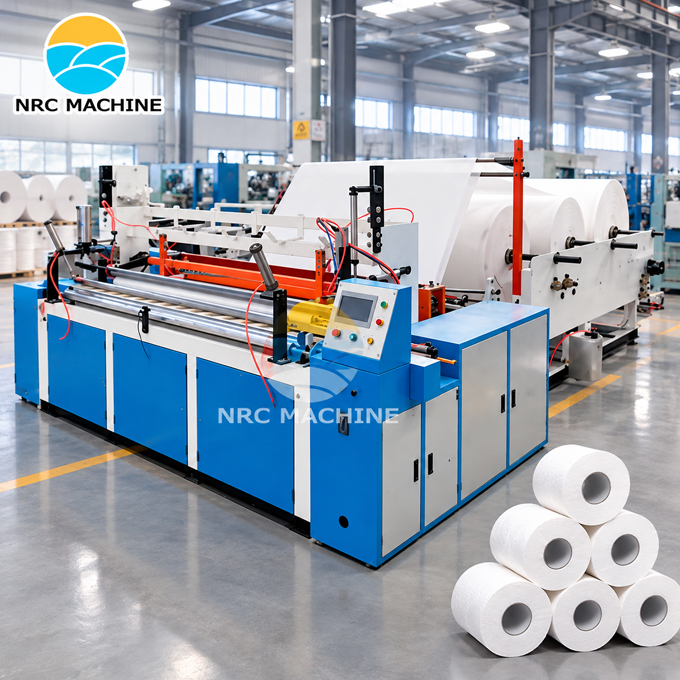
Subtitle: Discover how modern toilet paper converting equipment helps manufacturers improve production efficiency, product consistency, and business scalability
As demand for everyday hygiene products continues to expand across global markets, efficient tissue converting equipment has become increasingly important for manufacturers and new investors. A reliable toilet paper making machine provides an effective way to transform tissue jumbo rolls into finished toilet paper products with controlled rewinding, perforation, cutting, and other converting processes.
For companies planning to establish or upgrade a tissue paper production business, equipment selection should focus not only on output capacity but also on product quality, operational stability, flexibility, maintenance requirements, and long-term production efficiency. NRC MACHINE develops paper converting machinery with practical manufacturing requirements in mind, providing equipment solutions for different production applications and business scales.
1.What Is a Toilet Paper Making Machine?
A toilet paper making machine is a type of tissue converting equipment designed to process large tissue parent rolls into smaller finished toilet paper rolls suitable for commercial distribution and retail sales.
Unlike tissue paper mills that manufacture paper from pulp, a converting machine mainly focuses on processing already-produced tissue jumbo rolls. Depending on the production configuration, the process may include:
Jumbo roll unwinding
Tissue rewinding
Embossing
Perforation
Roll length control
Log cutting
Finished roll collection
Automatic or semi-automatic packaging
This production method allows manufacturers to select appropriate tissue base paper and configure finished products according to their target market.
2.How Does a Toilet Paper Making Machine Work?
2.1 Tissue Jumbo Roll Unwinding
Production starts with a large tissue parent roll. The jumbo roll is loaded onto the unwinding section, where the paper web is continuously supplied to the converting system.
Stable web feeding is important because fluctuations in paper tension can affect roll formation and finished-product consistency.
2.2 Rewinding and Roll Formation
The tissue passes through the rewinding section, where it is converted into smaller rolls. Proper tension control and winding pressure help produce compact and uniform toilet paper rolls.
Manufacturers can select different roll dimensions according to customer requirements, packaging specifications, and market preferences.
2.3 Embossing and Perforation
Depending on the product configuration, embossing can improve the appearance, softness perception, and structure of the finished tissue. Perforation creates convenient tear-off points so consumers can separate sheets during use.
These processes can be integrated into the converting line to reduce unnecessary manual handling.
2.4 Cutting and Packaging
After rewinding, larger tissue logs can be cut into individual toilet paper rolls. The finished products can then be transferred to a packaging process for retail or wholesale distribution.
The complete configuration can therefore create a continuous workflow from jumbo roll input to finished toilet paper output.
3.Key Advantages of Modern Toilet Paper Production Equipment
Choosing an appropriate toilet paper making machine can provide several operational benefits for tissue manufacturers.
3.1 Improved Production Efficiency
Automated or semi-automated processes can reduce repetitive manual work and create a more continuous production workflow. This is particularly valuable for manufacturers serving wholesalers, supermarkets, hotels, distributors, and other high-volume customers.
3.2 Consistent Finished Products
Controlled rewinding, perforation, and cutting help manufacturers maintain more consistent product dimensions and roll quality. Consistency is important when finished toilet paper is sold under a private label or established brand.
3.3 Flexible Production Requirements
Different markets may require different roll lengths, diameters, embossing patterns, packaging formats, or paper specifications. A properly configured machine can provide greater flexibility for manufacturers producing multiple product types.
3.4 Scalable Business Development
A tissue converting operation can be developed according to actual market demand. Businesses may begin with a suitable production configuration and later expand equipment, automation, or packaging capabilities as order volumes increase.
4. Why Equipment Configuration Matters
There is no single machine configuration suitable for every toilet paper manufacturer. Production requirements should be evaluated according to several factors.
4.1 Raw Material
The type, width, basis weight, ply structure, and quality of the tissue jumbo roll can influence machine configuration and finished-product performance.
4.2 Target Production Capacity
Manufacturers should estimate expected daily or monthly demand before selecting equipment. Choosing equipment according to realistic production requirements can help avoid unnecessary investment or insufficient capacity.
4.3 Finished Roll Specifications
Important parameters may include roll diameter, core diameter, paper width, sheet length, perforation distance, embossing requirements, and packaging format.
4.4 Automation Level
Businesses can select different levels of automation depending on labor availability, production volume, investment plans, and desired operating efficiency.
5. Quality and Manufacturing Considerations
For professional tissue production, machine performance should be evaluated as a complete system rather than by speed alone. Mechanical construction, transmission stability, electrical control, tension management, component quality, maintenance accessibility, and operator convenience can all influence long-term performance.
NRC MACHINE focuses on practical engineering and manufacturing requirements when developing paper converting equipment. Before purchasing a toilet paper making machine, customers should clearly define their raw material specifications, finished product requirements, expected capacity, and automation needs. This information helps ensure that the selected equipment configuration matches the intended production application.
6. Toilet Paper Production Process
A typical converting workflow can be summarized as:
Tissue Jumbo Roll → Unwinding → Rewinding → Embossing → Perforation → Cutting → Packaging → Finished Toilet Paper Rolls
The exact configuration may vary depending on the product specification and level of automation required by the customer.
7. Why Choose NRC MACHINE?
NRC MACHINE is a Chinese paper machinery manufacturer providing equipment solutions for paper and tissue converting applications. The company combines manufacturing experience with application-oriented machine design to support customers seeking practical production equipment.
For international buyers, selecting a supplier should involve more than comparing machine prices. Customers should also evaluate technical specifications, production compatibility, machine configuration, after-sales support, spare parts availability, installation guidance, and the supplier's ability to understand the intended application.
These factors can contribute to a more reliable investment and smoother transition from equipment installation to commercial production.
8. Frequently Asked Questions
8.1 What raw material does a toilet paper making machine use?
A toilet paper converting machine generally uses tissue jumbo rolls, also called tissue parent rolls, as the primary raw material. The exact paper specification depends on the finished product requirements.
8.2 Can the machine produce different toilet paper roll sizes?
Yes. Depending on the machine configuration, production parameters can be adjusted for different roll dimensions, paper widths, lengths, and other specifications.
8.3 Is a toilet paper making machine suitable for a small business?
Yes. Appropriate equipment configurations can be selected for small and medium-sized tissue businesses. Production capacity and automation level should be matched to the company's investment plan and expected market demand.
8.4 What processes are included in toilet paper production?
A typical process includes jumbo roll unwinding, rewinding, embossing, perforation, cutting, and packaging. The actual process configuration depends on the finished product and required automation level.
8.5 How do I choose the right toilet paper making machine?
Start by determining the tissue jumbo roll specifications, desired finished roll size, production capacity, automation requirements, available workspace, and target market. A machinery supplier can then recommend a suitable configuration based on these technical requirements.
9.Build a More Efficient Tissue Production Workflow
The growing need for hygiene products creates opportunities for manufacturers capable of delivering consistent and cost-effective toilet paper products. A professionally configured toilet paper making machine can provide the foundation for converting tissue jumbo rolls into market-ready products while supporting efficient production and future business expansion.
For manufacturers, distributors, and entrepreneurs looking for tissue converting solutions, NRC MACHINE provides paper machinery designed around practical production requirements.


