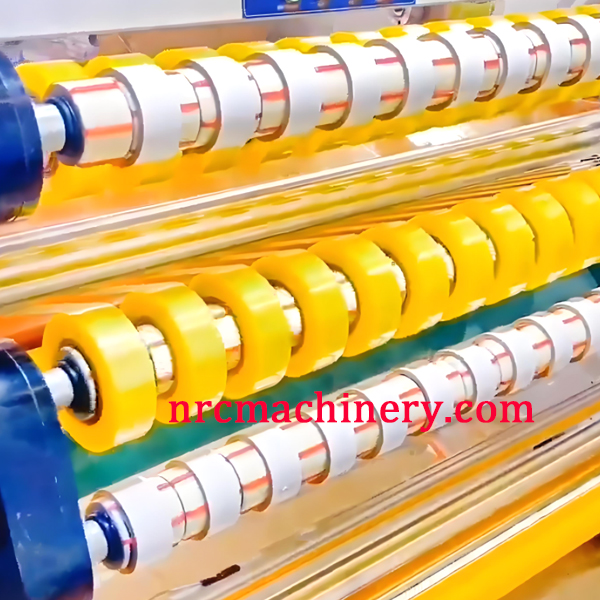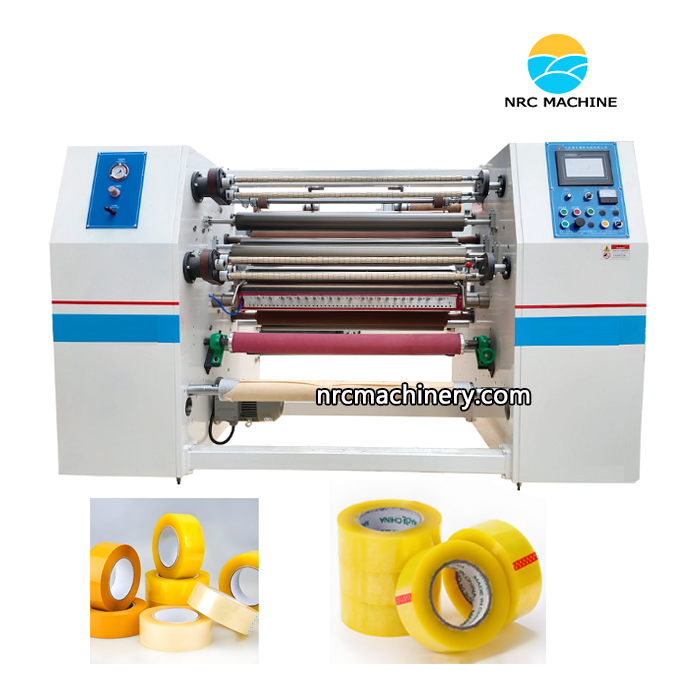
Tape Slitting & Rewinding Machine - Full Product Details
1. Product Overview
The slitting and rewinding machine is a core roll-to-roll converting equipment widely used in flexible material processing industries. It integrates automatic unwinding, precision slitting, web guiding, constant tension control and intelligent rewinding functions, realizing one-stop processing of large jumbo rolls into standard narrow finished rolls with uniform specification, tidy winding and smooth edges. Adopting mature mechanical transmission and PLC intelligent control system, the equipment solves common problems in traditional processing such as uneven slitting width, burr edges, loose winding and material deviation. It supports customized processing for different material thickness, hardness and width requirements, with stable operation, high processing precision and strong compatibility, covering the converting demands of adhesive tapes, plastic films, paper materials, new energy flexible materials and special industrial accessories.
2. Core Working Functions & Working Principle
2.1 Slitting Function
The whole processing starts with automatic unwinding of the master jumbo roll. The raw material is stably conveyed to the slitting unit through the servo feeding system. Equipped with three optional cutting tools including razor blades, circular shear blades and crush-cut blades, the equipment can accurately cut the whole roll material into multiple narrow strips with preset width. The slitting unit adopts high-precision positioning structure, with adjustable tool spacing and cutting depth, ensuring the error of finished strip width is controlled within the industrial standard range. Different cutting tools are matched according to material characteristics to avoid material deformation, edge cracking and dust residue, realizing efficient and precise slitting.
2.2 Rewinding Function
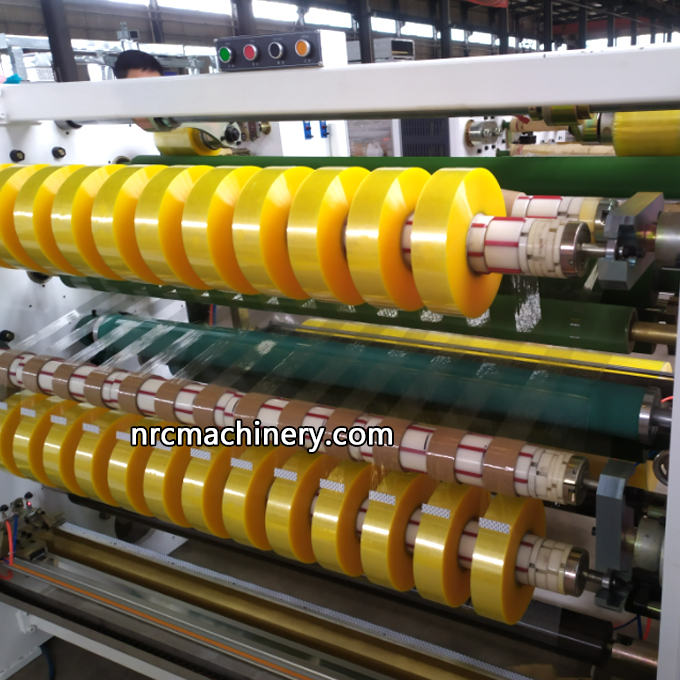
After slitting, the separated parallel material strips enter the rewinding unit synchronously. The system adopts closed-loop tension control and automatic deviation correction technology to ensure each material strip is evenly stressed without stretching or wrinkling. The qualified strips are neatly wound on customized cardboard or plastic cores to form compact, flat and standard finished rolls. The rewinding speed, tension and alignment are intelligently adjustable in real time, which can effectively avoid loose inner roll, tight outer roll, roll deflection and other defective problems, greatly improving the yield and appearance quality of finished products.
3. Main Machine Types & Core Advantages
3.1 Center Surface Rewinder
It is the most mainstream model for tape processing industries. The equipment adopts spindle driving cooperation with external large-diameter support drum structure. The rewinding shaft provides basic power, and the external drum supports the roll body comprehensively, which can stably control the web tension of thin and flexible tape materials. This model can produce ultra-tight and hard finished rolls with uniform internal and external density, no gaps inside the roll and no loose edges. It is an essential special equipment for processing pressure-sensitive adhesive tapes, packaging tapes and masking tapes, with stable molding effect and high product qualification rate.
3.2 Center Wind Rewinder
The whole rewinding power is independently provided by the rewinding spindle, without external drum pressure, fundamentally avoiding material crush damage. It is specially optimized for soft, bulky and easily deformable materials, solving the problems of indentation, deformation and thickness unevenness caused by external pressure during winding. It is widely applicable to non-woven fabrics, foam sheets, thick sponge materials and other soft bulk materials, ensuring the original texture and thickness of the material are completely retained while achieving neat winding.
3.3 Dual Rewind / Turret Rewinder
Equipped with two sets of independent rewinding stations and turret rotating structure, it realizes non-stop cycle production. When one station is completing winding and roll forming, the operator can unload finished rolls, replace cores and debug parameters at the other station. The dual-station alternating working mode eliminates equipment idle time in the traditional single-station model, maximizes production efficiency, and is very suitable for mass continuous production of standardized materials. It is the preferred model for large-scale processing enterprises to improve output and reduce unit production cost.
4. Slitting System Classification & Application Scenarios
4.1 Razor Slitting
It adopts a single razor blade to cut vertically against rubber or steel support rollers. The structure is simple, the equipment cost is low, and the cutting response is fast. The cutting gap is small, which will not cause tensile deformation of thin materials. It is specially suitable for ultra-thin films, printing papers, thin adhesive tapes and other thin and flat materials with low thickness and high surface flatness requirements, meeting the basic precision slitting demands of light-duty materials.
4.2 Shear Slitting
It adopts two groups of precisely matched overlapping circular blades, simulating scissors cutting principle for mechanical shearing. The cutting force is uniform and the shear accuracy is high, which can completely avoid burrs, dust, edge cracking and wire drawing problems. The cutting edge is smooth and flat without secondary trimming. It is suitable for thick materials, multi-layer laminated tapes, foam materials, thick non-woven fabrics and high-hardness flexible materials, and is widely used in high-precision and high-quality material processing scenarios.
5. Wide Application Range
This series of slitting and rewinding machines breaks the single application limitation of traditional tape processing equipment, and covers multiple industrial flexible material processing fields:
Adhesive Tape Series: Packaging tape, masking tape, duct tape, double-sided tape, medical adhesive tape, high-temperature resistant tape and various industrial special adhesive tapes
Label & Printed Materials: Large roll printed label paper, self-adhesive label stock, trademark printing base material, packaging printing film, realizing fixed-width slitting and rewinding of large-format printed rolls
Flexible Film & Sheet Materials: PP film, PET film, POF shrink film, aluminum foil, plastic composite film, insulating film and other industrial flexible films
Special Industrial Materials: Non-woven fabrics, foam sheets, Velcro tapes, sandpaper base materials, conductive films, heat-insulating materials and other special roll materials
6. Core Performance Advantages
High Precision Processing: Adopts servo synchronous control and high-precision tool positioning system, with stable slitting width error and neat cutting edge, meeting high-standard industrial processing requirements
Intelligent Tension Control: Equipped with magnetic powder clutch automatic taper tension system, realizing real-time adjustable tension, effectively preventing material stretching, wrinkling and loose winding
Strong Compatibility: Supports switching of multiple slitting tools and rewinding modes, adapting to thin, thick, soft and hard various flexible materials, with wide application coverage
High Production Efficiency: Turret dual-station model realizes non-stop production, greatly improves production capacity, and reduces manual operation and equipment standby time
Stable & Durable Operation: Thickened frame structure, high-quality transmission accessories and mature PLC control system reduce failure rate, support long-term continuous industrial operation
Simple Operation & Maintenance: Human-machine touch screen interface, visualized parameter setting, one-key start and stop, convenient daily maintenance and parameter debugging
7. FAQ (Frequently Asked Questions)
Q1: How to choose the right slitting mode for different materials?
For thin materials (thin films, ordinary paper, thin tapes) with thickness less than 0.2mm, razor slitting is recommended for low cost and fast speed; for thick materials, laminated materials, foams and non-wovens with thickness more than 0.2mm, shear slitting is preferred to ensure dust-free and burr-free smooth edges and avoid material damage.
Q2: What is the difference between center surface rewinder and center wind rewinder?
Center surface rewinder relies on external drum auxiliary support, suitable for tape materials that need high-tight winding, with compact finished rolls; center wind rewinder has no external pressure, suitable for soft and bulky materials that are easy to be crushed, protecting the material's original texture without deformation.
Q3: Can the equipment support customized slitting width and roll core specifications?
Yes. The equipment supports full customization of slitting width, rewinding diameter, cardboard/plastic roll core specifications. We can adjust the tool position, tension parameters and mechanical structure according to customer's product drawings and production demands to meet personalized processing requirements.
Q4: How to ensure no deviation and wrinkling during high-speed operation?
The machine is equipped with automatic EPC web deviation correction system and closed-loop constant tension control system. It can monitor material operation status in real time, automatically correct deviation and adjust tension balance, effectively solving material deviation, wrinkling, stretching and other problems during high-speed operation.
Q5: What is the daily maintenance cycle of the equipment?
Daily: Clean the tool surface and roller attachments, check tension and deviation correction system operation; Weekly: Lubricate transmission bearings and guide rails, fasten mechanical screws; Monthly: Detect motor, clutch and electrical system parameters, calibrate slitting precision. Standard maintenance can effectively extend equipment service life and ensure stable processing precision.