



Adhesive Tape Slitting Rewinding Machine Complete Parameter Guide & Technical Specification

1.Adhesive tape slitting rewinding machine
1.1 Tape Material:
Adhesive type (acrylic, rubber, silicone), backing material (PVC, PET, paper, foil, foam), and thickness. This dictates the slitting method and unwind/rewind tension control.
1.2 Slitting Mode:
Does the tape have a release liner (e.g., double-sided, medical, transfer tapes) or is it linerless (e.g., single-sided PSA, electrical)?
1.3 Linerless:
Simpler, often uses razor or shear slitting.
1.4 With Liner:
More complex. Requires differential rewinding or separate liner rewinding to manage the liner separately from the tape. Mandatory for double-sided tapes.
1.5 Production Volume:
High-speed, 24/7 operation needs a robust, automated machine with servo drives. Low-volume or R&D can use a manual, bench-top model.
1.6 Slit Width & Tolerance:
How narrow are the strips? What is the acceptable width tolerance (±0.1mm vs. ±0.5mm)? This determines slitting accuracy needs.
1.7 Master Roll Size:
Max diameter (e.g., 600mm, 1000mm) and core ID (e.g., 3", 6") of your input rolls.
1.8 Finished Roll Size:
Desired output roll diameter and core ID.
2. In-depth Analysis of Core Technical Logic
The overall performance of the adhesive tape slitting rewinding machine depends on the mutual matching of multiple parameters, and each technical index is closely linked with the production effect. In terms of material adaptation, the viscosity of different adhesives will directly affect the winding tension value. High-viscosity rubber adhesive tape is prone to adhesive overflow and bonding during slitting, so it is necessary to match moderate low tension and anti-sticking cutter rollers; silicone adhesive tape has high temperature resistance and low surface activity, which requires higher slitting sharpness to avoid material pulling and burrs. The hardness and thickness of the backing material determine the slitting tool type and cutting mode: rigid PET and PVC materials are suitable for high-speed shear slitting with smooth cutting edges; soft foam and aluminum foil materials are easy to deform, so razor slitting with small contact force is adopted to ensure no wrinkling or stretching of the material.
In terms of structural mode differentiation, linerless tape processing has simpler technical logic. Since there is no release liner protection, the whole processing process only needs to complete single-layer slitting and fixed-length winding, and the equipment structure is compact and the failure rate is low, which is very suitable for standardized mass production of single-sided adhesive tapes. The liner-equipped tape processing technology is more complex, especially for double-sided adhesive tapes. The release liner needs to be independently separated and rewound synchronously with the adhesive tape. If the tension of the two is not synchronized, it is easy to cause problems such as tape warping, liner deviation and adhesive layer peeling. Therefore, differential rewinding technology must be equipped to realize independent tension adjustment of the tape and the liner, ensuring the overall flatness and structural integrity of the finished roll.
In terms of production capacity and precision matching, the automated configuration of the equipment is positively correlated with production demand. The full-servo automated machine tool can realize real-time feedback adjustment of tension, deviation correction and slitting position, support 24-hour uninterrupted high-speed operation, and is the standard configuration for large-scale factory batch production. The manual bench-top equipment has low operation cost and flexible parameter adjustment, which is more suitable for enterprise product research and development, sample trial production and small-batch customized processing. The slitting precision standard is the core index to distinguish high-end and ordinary equipment. The ultra-narrow strip slitting with ±0.1mm tolerance is widely used in precision fields such as medical supplies, electronic components and automotive wiring harness accessories, while the ±0.5mm conventional tolerance can meet the daily packaging and civil tape market demand.
The size parameters of the master roll and finished roll determine the equipment's processing range and production flexibility. The large-diameter master roll can reduce the number of material changes in the production process, effectively improve production efficiency and reduce material loss caused by frequent roll changes. The customizable finished roll size can meet the diversified packaging and use needs of downstream customers, and the adjustable winding tightness can avoid the problems of loose roll core, edge collapse and material stretching of finished tapes, greatly improving the yield of finished products.
3. Frequently Asked Questions (FAQs) for Tape Slitting Rewinding Machine
This FAQ section sorts out high-frequency technical questions, selection doubts and fault problems in the industry, focusing on user search demands such as equipment selection, parameter matching, fault debugging and scenario adaptation, which is convenient for quick query and solution of actual production problems.
Q1: How to choose slitting mode (razor vs shear) for different adhesive tapes?
Razor slitting is suitable for ultra-thin, soft and linerless tapes, including thin PET tape, foam tape, single-sided insulating tape and ultra-narrow precision adhesive strips. It has the advantages of fast cutting speed and no material extrusion deformation. Shear slitting is applicable to thick, hard and high-viscosity tapes with or without liners, such as double-sided heavy-duty adhesive tape, PVC thick tape and aluminum foil adhesive tape. It can effectively solve the problems of unsmooth cutting edges and tool sticking caused by high viscosity and thick materials.
Q2: What is the essential difference between differential rewinding and ordinary rewinding?
Q3: What precision configuration is required for electronic ultra-narrow tape slitting?
Electronic ultra-narrow tape (3–10mm width) requires full servo drive system, high-precision razor slitting tool and automatic deviation correction system. The equipment needs to meet the width tolerance of ±0.1mm, and be equipped with micro-tension closed-loop control system to avoid stretching and deformation of ultra-thin adhesive materials. In addition, the equipment roller needs to be treated with anti-sticking coating to prevent adhesive residue from affecting slitting accuracy, and support high-speed stable operation without edge burrs and size deviation.
Q4: How to match equipment model according to production volume demand?
For mass production demand (daily output more than 10,000 rolls, 24-hour continuous operation), it is necessary to select full-automatic servo slitting rewinding machine, which has stable operation, high efficiency and low manual dependence. For small-batch customized production, laboratory R&D and sample production (daily output less than 1,000 rolls), manual or semi-automatic bench-top equipment is more cost-effective, with flexible parameter adjustment and low equipment investment cost, which can meet the demand of multi-specification small-batch processing.
Q5: What are the common quality problems in liner-equipped tape slitting and how to solve them?
Common problems include liner deviation, tape and liner separation inconsistency, edge warping and adhesive residue. The fundamental solution is to equip independent liner rewinding mechanism and differential tension control system. Before production, calibrate the tension parameters of tape and liner respectively, adjust the synchronous speed of unwinding and rewinding, and regularly check the sharpness of the slitting tool to avoid unsmooth cutting causing material pulling. At the same time, set reasonable winding tightness according to the tape viscosity to prevent layer sliding and warping.
Q6: What master roll and finished roll specifications are most widely used in the industry?
The mainstream master roll specifications in the market are 800mm maximum outer diameter + 3-inch core (small and medium factories) and 1000mm maximum outer diameter + 6-inch core (large-scale mass production). The finished roll specifications are customized according to downstream demand: commercial retail tapes mostly adopt 100–200mm outer diameter + 3-inch core, while industrial engineering supporting tapes mostly adopt 300–500mm outer diameter + 6-inch core, which can balance production efficiency and customer use convenience.
Q7: Why does material thickness and adhesive type affect tension control parameters?
Ultra-thin materials are easy to stretch and deform, so micro-constant tension is required; thick and hard materials have strong rigidity and can bear relatively high tension without deformation. High-viscosity rubber adhesives are easy to adhere to the roller surface under excessive tension, resulting in material damage; low-viscosity acrylic adhesives have stable fluidity, and the tension adjustment range is wider. Silicone adhesives have poor adhesion and high temperature resistance, and need stable tension to avoid material offset during high-speed operation.
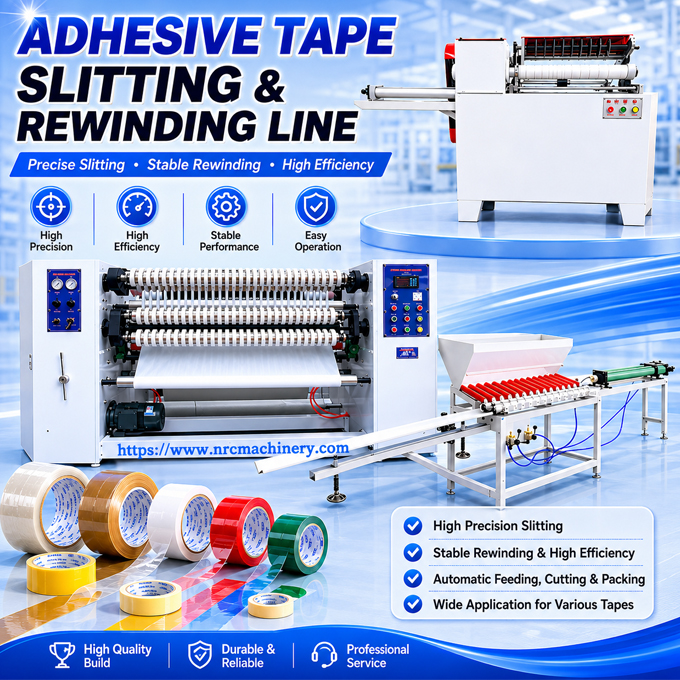
1300 tape slitting rewinding machine | |
L*W*H(m) | 2.45m*1.3m*1.35m |
Voltage | 380V 50HZ |
Slitting speed | 0-180 m/min |
Maximum master coil width | 1.3m |
Minimum cutting width | 10mm |
1300 Pipe loader | |
L*W*H(M) | 5.6m*0.8m*1.35m |
Paper tube diameter | 25.4-76.2mm |
Paper core cutting machine | |
L*W*H(M) | 1.5m*0.6m*1.15m |
Slitting width | Mold control |
Inner diameter of paper tube | 76.2mm |


