


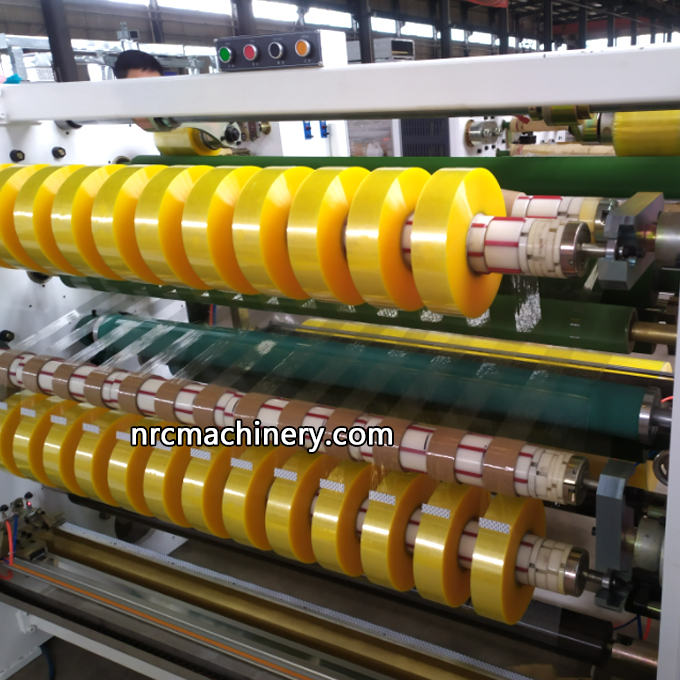

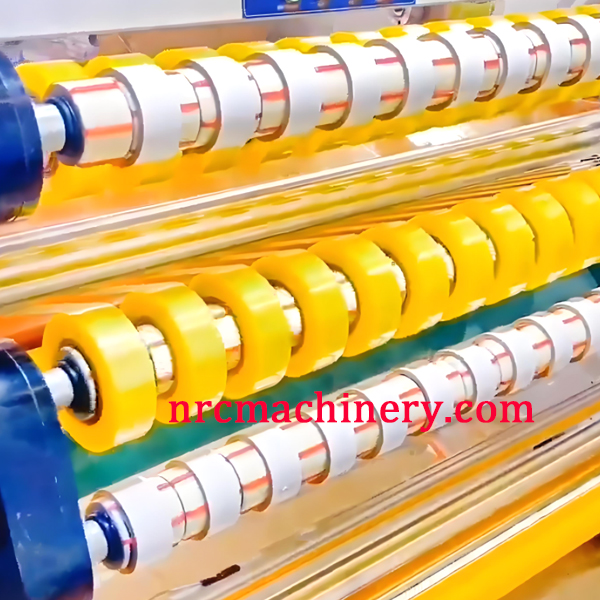
High Output and Good Price Bopp Adhesive Jumbo Roll Packaging Tape Slitting Rewinding Machine

What is a Tape Rolls Slitting Rewinding Machine?
It is a specialized converting machine designed to transform large, master ("jumbo") rolls of tape into smaller, finished rolls ready for sale, distribution, or use. It performs two essential functions:
Slitting: Precisely cutting the wide tape material into multiple narrower strips.
Rewinding: Winding these slit strips onto new cores to create rolls of the required length and diameter.
This process is fundamental across numerous industries for creating the consumer and industrial tape products we use every day.
Types of Tape Rolls Slitting Rewinding Machines
Different tapes require different handling. The main types of machines are categorized by their rewinding method:
1. Center-Surface Rewinder (Drum Rewinder)
How it Works: The rolls are wound against a large, driven drum while also being driven by the torque from the center shaft. The drum provides support and ensures hardness.
Best For: Standard packaging tapes (BOPP, PVC), duct tape, and masking tape. Excellent for producing very hard, uniform rolls at high speeds.
Advantages: High speed, consistent roll hardness, simple operation.
Disadvantages: Less control over the inner layers' tension compared to center wind.
2. Center Wind Rewinder
How it Works: The rewinding force comes purely from the torque applied to the center shaft. Tension is precisely controlled throughout the roll's build-up.
Best For: Sensitive tapes like double-sided tapes, foam tapes, optical clear tapes, and very thin films. Ideal where precise tension profiling (taper tension) is critical to prevent core crushing or adhesive ooze.
Advantages: Superior tension control, excellent for soft or sensitive materials.
Disadvantages: Generally slower than center-surface, requires more sophisticated controls.
3. Differential Shift Rewinder (Duplex Rewinder)
How it Works: This is a subtype, often using a center-surface principle, but with two rewind shafts. While one shaft is winding, the other can be unloaded and set up with new cores. This allows for continuous, non-stop production.
Best For: High-volume production environments where maximizing uptime is critical.
Advantages: Dramatically reduced downtime, high efficiency.
Disadvantages: Higher initial cost, more complex machinery.
Key Components & Features
A modern tape slitting rewinder consists of:
Unwind Stand: Holds the jumbo roll. Can include:
Splicing Table: For manual roll changes.
Automatic Splicer: For non-stop operation, essential for high-volume production.
Slitting System: The method of cutting is crucial for tape quality.
Razor Slitting: A sharp blade presses down to score and cut the material. Good for fibrous materials (e.g., paper masking tape) but can generate dust.
Shear Cut Slitting: A circular top knife cuts against a bottom anvil roll (or another blade). This scissor-action provides a clean, sealed edge, which is critical for adhesive tapes to prevent "angel hair" (micro-filaments) and adhesive bleed.
Web Guidance System: Automatically keeps the material centered as it travels through the machine, preventing misaligned slitting and crooked rolls.
Tension Control System: The heart of the machine. It manages the material's tension from unwind to rewind, ensuring consistent roll tightness and preventing defects like telescoping or overly hard rolls.
Rewind Shaft: The robust shaft that holds the cores. The number of positions determines how many narrow rolls can be made in one cycle.
Control Panel (HMI): A touchscreen interface where the operator sets all parameters like speed, length, tension, and slit widths.
Special Considerations for Different Tapes
Adhesive Tapes (BOPP, PVC, Duct Tape):
Challenge: Adhesive contamination on shafts and rollers.
Solution: Machines use anti-stick coatings (e.g., Teflon, chrome plating) on critical components.
Slitting: Must use Shear Cut for a clean edge.
Double-Sided Tapes:
Challenge: Both sides are sticky; the release liner must be managed.
Solution: Machines may include a liner rewind unit to rewind the protective liner separately after slitting.
Paper Tapes (Masking, Kraft):
Challenge: Dust generation and material breakage.
Solution: Razor slitting is often acceptable. Dust extraction systems may be added.
Foam Tapes:
Challenge: Material is compressible and can be easily deformed.
Solution: Requires a Center Wind machine with very precise, low tension control to avoid crushing the foam.
1300 tape slitting rewinding machine | |
L*W*H(m) | 2.45m*1.3m*1.35m |
Voltage | 380V 50HZ |
Slitting speed | 0-180 m/min |
Maximum master coil width | 1.3m |
Minimum cutting width | 10mm |
1300 Pipe loader | |
L*W*H(M) | 5.6m*0.8m*1.35m |
Paper tube diameter | 25.4-76.2mm |
Paper core cutting machine | |
L*W*H(M) | 1.5m*0.6m*1.15m |
Slitting width | Mold control |
Inner diameter of paper tube | 76.2mm |


