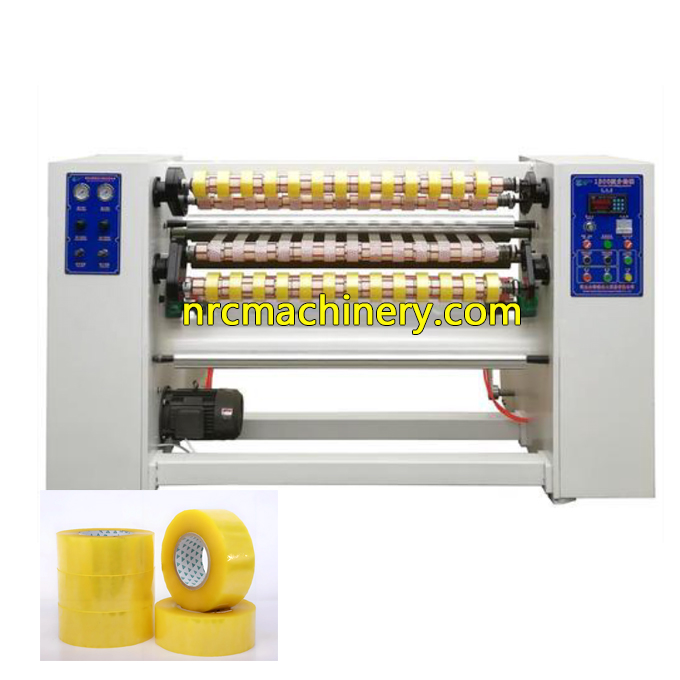
 What is a Tape Slitting Rewinding Machine?At its core, it's a machine designed to take a large, master (or "jumbo") roll of material and convert it into multiple, narrower rolls of a specified width. It does this by unwinding the large roll, slitting the material into strips, and then rewinding those strips onto individual cores.
Key ComponentsA standard machine consists of three main sections: Unwind Station: Purpose: To hold and controllably release the master jumbo roll. Types: Can be a simple shaftless cantilevered design, a motorized unwind for better tension control, or a dual-position turret for non-stop operation (allowing a new jumbo roll to be loaded while the current one is running).
Slitting Section: Rewind Station:
How It Works (The Process)Loading: The jumbo roll is loaded onto the unwind station. Web Threading: The leading edge of the material is threaded through the machine, over guide rollers, through the slitting unit, and attached to the new cores on the rewind station. Setup: The slitting blades are positioned to the desired widths. The new cores (often cardboard or plastic) are mounted on the rewind shafts. Operation: The machine is started. The unwind brake creates back-tension. The rewind station pulls the material. As the web passes through the slitting unit, it is cut into multiple strips. Rewinding & Ejection: The strips are wound onto their individual cores. Once the desired length or diameter is reached, the machine stops, the finished rolls are cut, ejected, and the process repeats.
Common ApplicationsThese machines are ubiquitous in industries that produce rolled goods: Pressure-Sensitive Tapes: Packaging tape, masking tape, double-sided tape, medical tape. Label Stocks: Converting large sheets of printed or unprinted labels into narrow rolls. Flexible Packaging: Converting films for food packaging. Non-Wovens: For materials like wipes, medical fabrics, and insulation. Plastics and Films: Polyethylene, PVC, PET. Foils and Papers: Aluminum foil, backing papers, specialty papers.
|


