


This machine is the workhorse of the tape converting industry, designed to transform large, economical jumbo rolls (or "mother rolls") of any tape type into saleable, user-friendly smaller rolls.
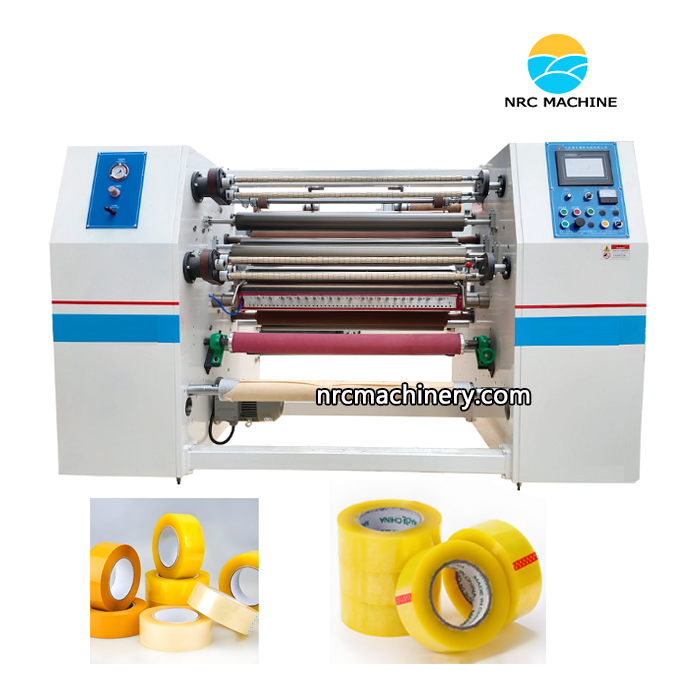
Core Purpose and Function
The fundamental purpose is Width Conversion and Packaging Preparation. It takes a wide roll of material and:
Slits it lengthwise into multiple narrower strips.
Rewinds these strips onto individual cores to a specific length or diameter.
Produces finished rolls that are ready for labeling and shipping.
Key Components (In-Depth)
Unwinding System:
Function: To hold and controllably release the jumbo roll.
Types:
Shafted Unwind: A mechanical shaft is inserted through the core of the jumbo roll.
Shaftless Unwind: Uses hydraulic or pneumatic arms to grip the inside of the core. Faster and easier for heavy rolls.
Critical Feature: Tension Control. Uses brakes (pneumatic, magnetic powder) or a back-drive motor to maintain consistent tension, preventing snapping or loose rolls.
Web Guiding System:
Function: Automatically corrects the lateral (side-to-side) position of the material as it enters the slitting unit.
Why it's important: Ensures straight, parallel slitting. Without it, the material can drift, causing uneven slit widths and damaged edges.
Slitting Mechanism:
This is the core of the machine. The method chosen depends on the tape's material and adhesive.
Rewinding System:
Function: To wind the slit tapes onto new cores.
Types:
Center Surface Rewind: The cores are driven by contact with a large drum. Excellent for maintaining consistent tension across all strips. Most common for tapes.
Center Rewind: The cores are driven directly from the shaft. Requires very precise tension control.
Key Feature:
Duplex Rewind: Two rewind shafts. While one is winding, the operator unloads finished rolls from the other, allowing for non-stop production. Essential for high-output facilities.
Tension Control System:
The most critical factor for roll quality. It uses a combination of:
Dancer Rollers: A weighted or air-loaded roller that moves up and down to absorb tension variations.
Tension Sensors: Load cells that provide real-time feedback to the PLC.
PLC & Drives: The brain that adjusts brakes and motor speeds to maintain a set tension.
Drive & Control System:
AC/DC Motors or Servo Motors: Provide the power for smooth operation.
PLC (Programmable Logic Controller): The automated brain.
HMI (Human-Machine Interface): The touchscreen where the operator sets parameters like length, speed, tension, and slit widths.
Ejection System:
Automatically pushes the finished rolls off the shaft once the set length is reached, streamlining the workflow.
Standard Workflow
Loading: The jumbo roll is placed on the unwind stand.
Threading: The material is guided through the machine, over the dancer, through the slitter, and taped to the cores on the rewind shaft.
Programming: The operator inputs the desired roll length, diameter, quantity, and speed on the HMI.
Slitting & Rewinding: The machine starts. The jumbo roll is unwound, guided, slit into multiple strips, and rewound onto individual cores.
Counting & Termination: The machine counts the length (or measures diameter) and stops at the preset value.
Cutting & Tabbing: A cutting mechanism (often a hot knife for adhesive tapes) severs the tape and tucks the end onto the roll.
Ejection & Unloading: The finished rolls are ejected and removed for packaging.
Types of Tapes Processed
This machine is versatile and can be configured to handle:
BOPP Packing Tape
PVC Electrical Tape
Masking Tape
Double-Sided Tape
Duct Tape
Filament Tape
Paper Tape
1300 tape slitting rewinding machine | |
L*W*H(m) | 2.45m*1.3m*1.35m |
Voltage | 380V 50HZ |
Slitting speed | 0-180 m/min |
Maximum master coil width | 1.3m |
Minimum cutting width | 10mm |
1300 Pipe loader | |
L*W*H(M) | 5.6m*0.8m*1.35m |
Paper tube diameter | 25.4-76.2mm |
Paper core cutting machine | |
L*W*H(M) | 1.5m*0.6m*1.15m |
Slitting width | Mold control |
Inner diameter of paper tube | 76.2mm |


