


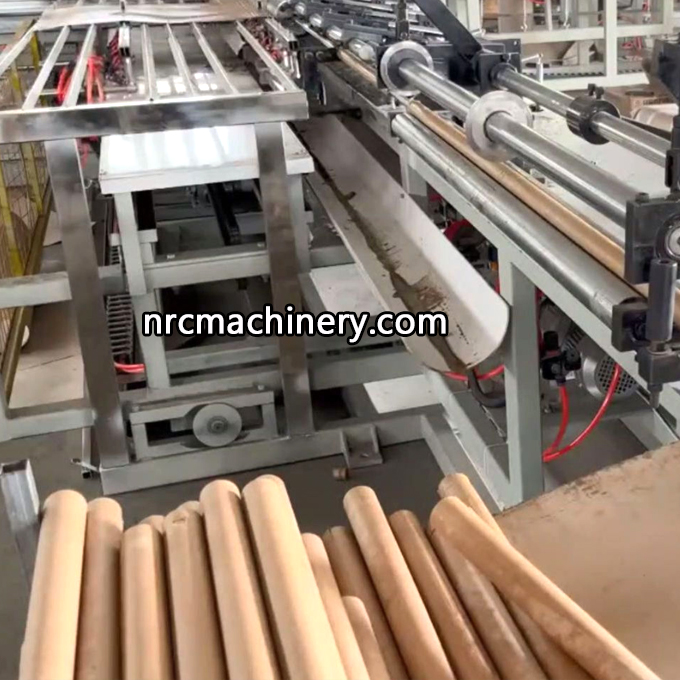


What is a Parallel Paperboard Tubes Making Machine?
A Parallel Paperboard Tubes Making Machine is an industrial machine designed to automatically produce straight, cylindrical tubes and cores
from paperboard (a thick, rigid paper-based material) or kraft paper. These tubes are known as "parallel" because they have a consistent diameter from one end to the other, unlike
conical tubes.
These tubes are essential components used as cores for winding materials like fabric, film, foil, paper, and as protective packaging for products
like posters, documents, and carpets.
Key Components of the Machine
A modern parallel tube machine is a complex system with several integrated stations. Here are the main components:
Unwinding Stand (Unwind): This is where the raw material (paperboard or kraft paper in large rolls, known as parent rolls) is loaded. It often has a splicing unit to allow for a continuous operation; when one roll is finished, it automatically joins the start of a new roll without stopping the machine.
Web Guiding System: Ensures the paper web runs perfectly straight and aligned through the machine, which is critical for producing a uniform tube.
Gluing Unit: Applies a precise, consistent bead of adhesive along the edge of the paper. Hot melt adhesive is common for its fast setting time, but other types like PVA are also used.
Forming Section (The Heart of the Machine):
Forming Belt & Mandrel: This is where the tube is actually created. The paper is wrapped tightly around a stationary, cylindrical steel mandrel. A continuous belt presses against the paper and mandrel, creating the friction that pulls the paper through while simultaneously forming the tube's spiral wound layers.
Spiral vs. Parallel Wound: While "spiral" tubes are wound at an angle, "parallel" tubes are wound with the paper grain running lengthwise. The machine achieves this through a specific forming head design that wraps the plies around the mandrel with minimal helix angle.
Cutting Unit: Cuts the continuous tube to the required lengths. This can be:
Rotary Cutter: A spinning blade that cuts the tube without stopping production, ideal for high speeds.
Saw Cutter: A reciprocating or circular saw that cuts the tube, often used for thicker-walled or larger diameter cores.
Control System (PLC/HMI): The brain of the operation. A Programmable Logic Controller (PLC) and a Human-Machine Interface (HMI) touchscreen allow the operator to set all parameters: tube diameter, length, wall thickness (number of plies), and production speed.
Discharge/Drying Conveyor: The cut tubes are conveyed away from the machine. This section allows the adhesive to fully cure and the tube to stabilize before handling or packaging.
Types of Parallel Tube Making Machines
Machines are categorized based on the diameter of the tubes they produce:
Small-Diameter Tube Machines:
Diameter Range: Typically from 3 mm (0.12") up to 75 mm (3").
Applications: Cores for toilet paper, paper towels, cling film, aluminum foil, gift wrap, and electrical wire coils.
Characteristics: Very high-speed, often fully automatic.
Medium-Diameter Tube Machines:
Diameter Range: From about 75 mm (3") up to 250 mm (10").
Applications: Cores for textiles (fabric rolls), carpet tubes, film and foil for industrial use, and packaging for maps and posters.
Characteristics: The most versatile and common type.
Large-Diameter Tube Machines (Heavy-Duty):
Diameter Range: From 250 mm (10") up to 600 mm (24") or more.
Applications: Cores for large rolls of carpet, steel, geomembranes, and concrete column construction (sonotubes).
Characteristics: Robust, powerful, and designed to handle multiple heavy plies of paperboard.
Model | NRC16-76 |
input power | AC380±10% 50Hz |
Trolley servo motor | 220V 3KW 2000R/Min |
Pipe winding servo motor | 220V 3KW 2000R/Min |
Paper feeding motor | 1.5KW 4 polar. |
Paper edge grinding motor | 1.5KW 2 polar. |
Dust removal fan motor | 1.5KW |
Paper lifting motor x 2 | 1.1KW |
Total power | 13.5KW |
Input air pressure | >0.65MP |
gas flow rate | 2³m/h |
Processing length | 1700mm |


