


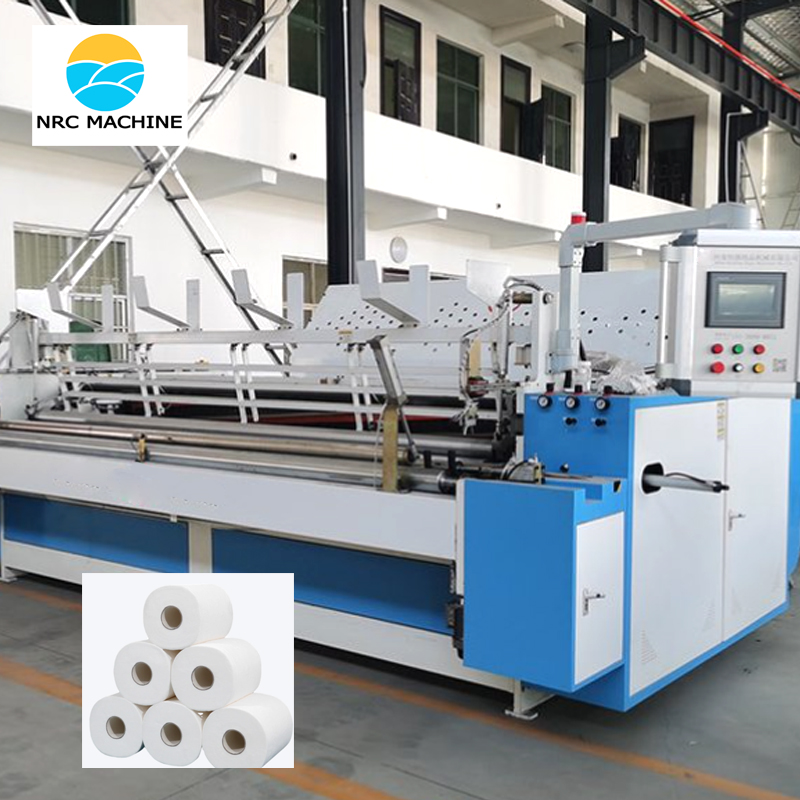


Good Price Small Toilet Tissue Paper Making Machine
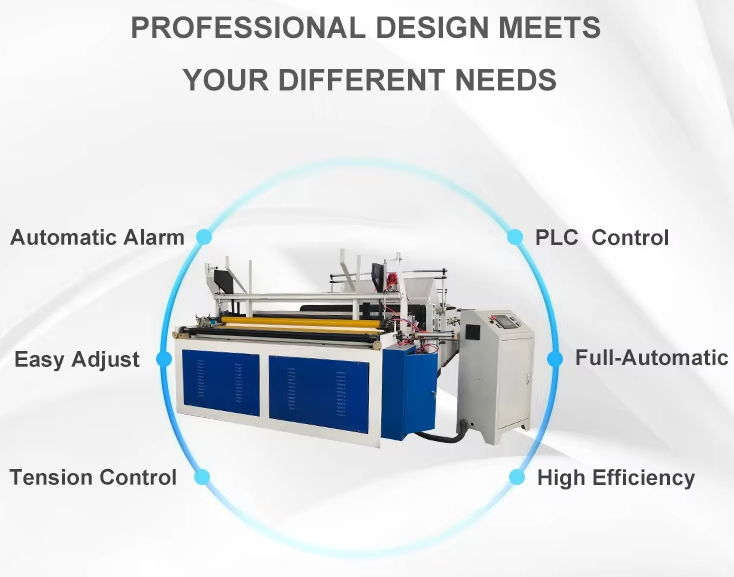
What is a Toilet Rolls Making Machine?
It is not a single machine but a production line that transforms large jumbo rolls of tissue paper into finished, perforated, and packaged toilet paper rolls. The level of automation and speed defines the scale of the operation.
Types of Toilet Paper Making Machines
The machines are categorized by their level of automation and output.
1. Mini/Semi-Automatic Toilet Paper Rewinding Machine
Best for: Startups, small workshops, very low-budget operations.
Process: Focuses only on the core function of rewinding and perforating.
How it Works:
An operator manually places a cardboard core on the shaft.
The paper from the jumbo roll is fed manually into the machine.
The machine automatically winds the paper, creates perforations, and cuts it to length.
The operator manually removes the finished roll and often glues the tail.
Output: 40 - 80 rolls per minute.
Pros: Lowest cost, small footprint, simple operation.
Cons: Labor-intensive, lower output, less consistent quality.
2. Small Fully Automatic Toilet Paper Production Line
Best for: Small to medium-sized factories aiming for efficiency and consistent quality.
Process: Automates the entire process from jumbo roll to individual rolls.
Key Components:
Unwinding Stand: Holds one or two jumbo rolls.
Rewinding Machine: The core unit. It draws paper, embosses patterns (if equipped), perforates, winds around the core, and ejects a long "log" of connected rolls.
Log Saw (Cutter): Automatically cuts the long log into individual toilet rolls.
Output: 80 - 150 rolls per minute.
Pros: Good balance of output and cost, consistent quality, requires only 1-2 operators.
Cons: Higher initial investment than semi-auto machines.
3. Large Fully Automatic Toilet Paper Production Line
Best for: Large-scale industrial manufacturers supplying major brands and supermarkets.
Process: A highly automated line that includes everything from rewinding to packaging.
Key Components (includes everything in the small line, plus):
Automatic Core Loader: Feeds cores into the rewinder automatically.
High-Speed Rewinder & Log Saw: Much faster and more robust.
Auto Packaging Machine: Wraps individual rolls or multi-packs in plastic or paper.
Auto Carton Sealing Machine: Packs the wrapped products into cartons.
Output: 150 - 300+ rolls per minute.
Pros: Maximum output, minimal labor, highest efficiency.
Cons: Very high capital cost, large space requirement, complex maintenance.
The Complete Manufacturing Process Step-by-Step
Unwinding: Large jumbo rolls (1-2 meters wide) of tissue paper are mounted on the unwinding stand. For 2-ply paper, two rolls are unwound simultaneously and bonded together.
Embossing (Optional): The paper passes through an embossing roller that presses a pattern onto it. This improves softness, aesthetics, and bulk.
Perforating: A perforation blade creates the dotted lines that allow sheets to be torn off easily.
Rewinding & Gluing: The paper is wound onto a cardboard core. The end of the paper (the "tail") is glued down to secure the roll.
Log Ejection: The rewinder produces a continuous "log" of 10-20 connected toilet rolls.
Cutting (Log Saw): The long log is automatically cut into individual rolls.
Packaging (Optional in basic lines): Individual rolls are wrapped in plastic or paper, and then grouped into larger packs (e.g., 4-packs, 8-packs, 12-packs) before being boxed.
Model | 1880mm ~2000mm |
Applicable Raw Paper | 2-3 plies 14~23g/㎡Wood pulp paper |
Finished product | Toilet rolls with core /without core |
Raw Paper Width | Max 2100mm |
Raw Paper Diameter | Max1300mm |
Finished Size | Φ60~130 mm |
Finished Core Diameter | Φ35mm-Φ50mm |
Raw Paper Core Diameter | 3”(76.2 mm) |
Perforation | Spiral perforating knife,Chain wheel positioning |
Production Speed | 200 m/min |
Power | 12kw |
Parameter Design | LCDTouch Screen |
Control | PLC |
Paper Feeding | 3 Unwinding stands,controlled by pneumatic |
Air Pressure | 0.5 Mps |
Power | 380V,50hz |


