


NRC2200 Toilet Paper Roll Making Manufacturing Machine
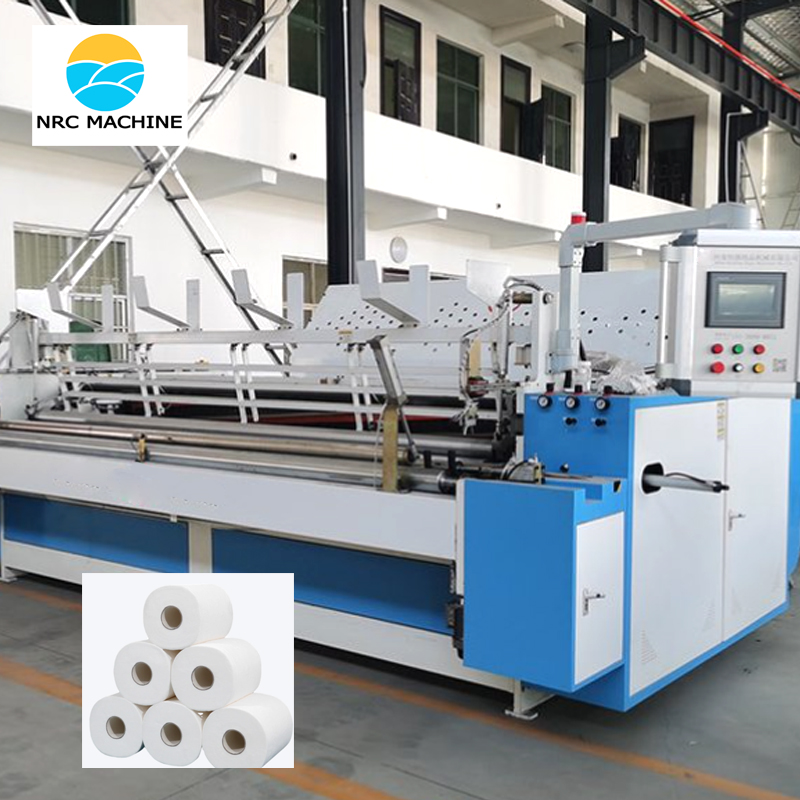
1. Semi-Automatic Production Line
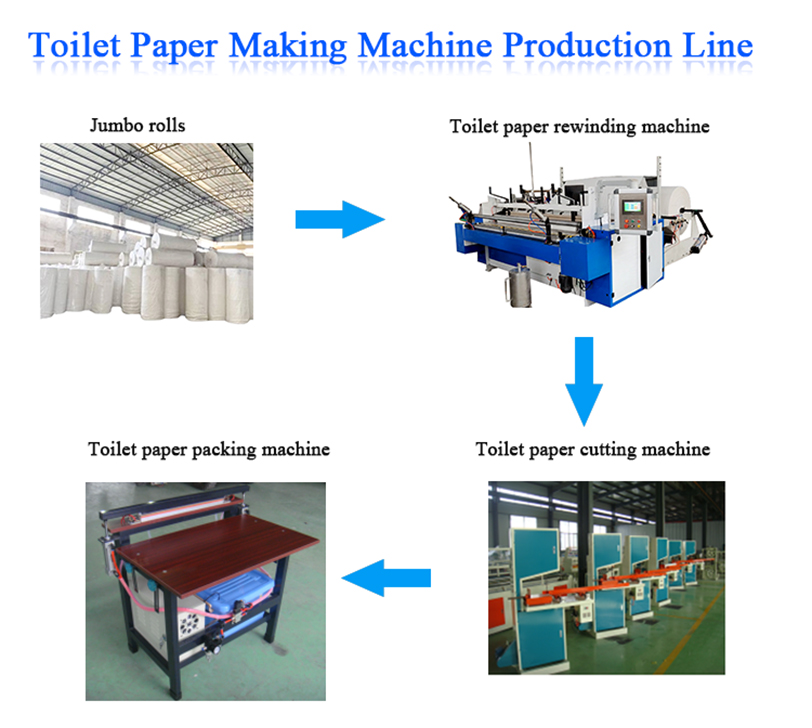
This is the most popular choice for small to medium-scale startups and workshops. It involves a combination of automated and manual processes.
How it Works: The line automatically produces long, continuous "logs" of toilet paper, which are then manually cut and packaged.
Key Components:
Toilet Paper Rewinding Machine: The core unit.
Log Saw / Cutting Machine: A separate, stand-alone machine.
Process Flow:
Jumbo Roll → Rewinder (makes the log) → Manual Transfer → Log Saw (cuts into rolls) → Manual PackagingPros:
Lower Initial Investment (Significantly cheaper than full-auto lines).
Operational Flexibility - Easy to change roll sizes and paper types.
Easier Maintenance - Simpler mechanics.
Cons:
Higher Labor Costs (Requires 3-5 operators).
Lower Output (Typically 40-100 rolls per minute).
Inconsistent Packaging quality due to manual handling.
2. Fully Automatic Production Line
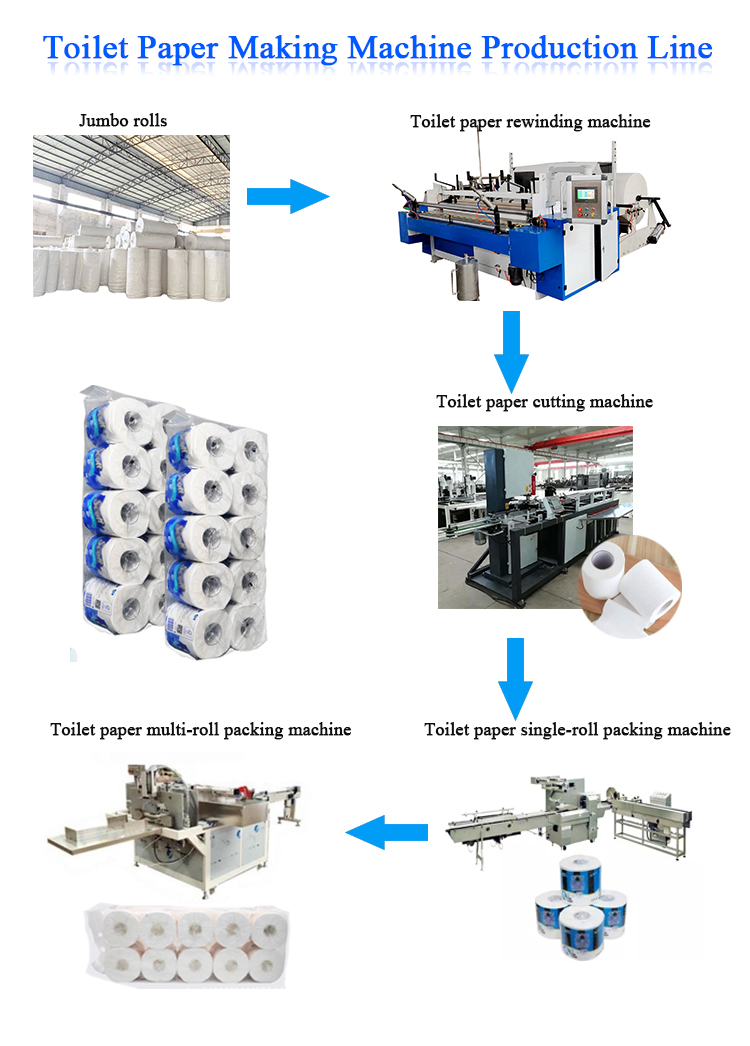
This is an integrated system for medium to large-scale factories aiming for high efficiency and minimal labor.
How it Works: The entire process, from the jumbo roll to the individually wrapped and sealed roll, is automated.
Key Components: All machines (rewinder, cutter, wrapper) are linked by conveyors.
Process Flow:
Jumbo Roll → Rewinder → Auto Log Saw → Core Insertion (if applicable) → Auto Wrapping Machine → Manual CartoningPros:
High Production Speed (90-180+ rolls per minute).
Low Labor Cost (Only 1-2 operators for monitoring).
Consistent, High-Quality Finish on every roll.
Cons:
High Capital Cost.
Less Flexibility - Changing roll sizes requires more machine adjustment.
Complex Maintenance requires more skilled technicians.
The Core Components & Manufacturing Process (Step-by-Step)
Here’s a breakdown of what happens in a full automatic line:
Unwinding Stand:
Purpose: Holds the massive Jumbo Roll (the raw material, which can be 1-2 meters in width and diameter).
Function: It unwinds the paper at a controlled tension and may have an automatic splice to join a new jumbo roll without stopping the
line.
Toilet Paper Rewinding Machine:
This is the heart of the operation. It performs several critical functions:
Embossing: Passes the paper through patterned steel rollers to create a texture (e.g., quilted, dotted). This improves softness, bulk, and
aesthetics. For 2-ply, two sheets are embossed and laminated together.
Perforating: A sharp blade creates the micro-perforated tear lines.
Winding: Winds the embossed and perforated paper around a cardboard core (or winds it tightly for coreless rolls). It accurately counts
the paper layers to ensure uniform roll length.
Automatic Log Saw:
Purpose: Cuts the long, continuous log coming from the rewinder into individual toilet roll sizes.
Function: Uses a high-speed rotary saw or band saw. The cutting length is precisely calibrated.
Toilet Paper Wrapping Machine:
Purpose: Individually wraps each roll for hygiene and branding.
Function: Feeds each roll into a packaging film (usually BOPP plastic or biodegradable cellophane), seals the ends, and can also apply a price sticker.
Raw Materials You Will Need
To run this business, you need a steady supply of:
Jumbo Tissue Parent Rolls: These are the primary raw material. They come in different qualities:
Virgin Wood Pulp: Highest quality, softness, and whiteness.
Recycled Pulp: More eco-friendly, generally less soft and more abrasive.
Bamboo Pulp / Mixed Pulp: Growing in popularity for their sustainability.
Key Specification: GSM (Grams per Square Meter) - indicates thickness and quality (e.g., 12-20 GSM for toilet paper).
Cardboard Cores: The inner tube of the roll. Standard sizes are 40mm, 45mm, or 76mm in length.
Wrapping Film: The plastic or paper used for individual roll wrapping. BOPP plastic is most common, but eco-friendly options are available.
Glue (for 2-ply): Food-grade adhesive to laminate the two plies together.
Model | 1880mm ~2000mm |
Applicable Raw Paper | 2-3 plies 14~23g/㎡Wood pulp paper |
Finished product | Toilet rolls with core /without core |
Raw Paper Width | Max 2100mm |
Raw Paper Diameter | Max1300mm |
Finished Size | Φ60~130 mm |
Finished Core Diameter | Φ35mm-Φ50mm |
Raw Paper Core Diameter | 3”(76.2 mm) |
Perforation | Spiral perforating knife,Chain wheel positioning |
Production Speed | 200 m/min |
Power | 12kw |
Parameter Design | LCDTouch Screen |
Control | PLC |
Paper Feeding | 3 Unwinding stands,controlled by pneumatic |
Air Pressure | 0.5 Mps |
Power | 380V,50hz |


