


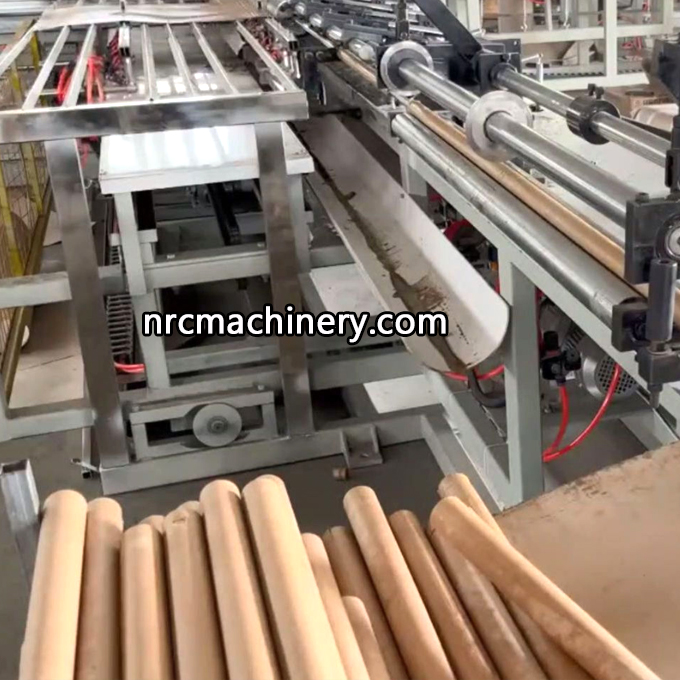


Automatic Parallel Paperboard Tubes Making Machine
The automatic parallel paperboard tubes making machine is specialised industrial converting equipment designed to produce straight‑walled, dimension‑stable cylindrical paper cores and tubes from kraft paper and rigid paperboard materials. Unlike spiral‑wound paper tubes formed by diagonal winding, parallel (also named convolute) tubes maintain consistent inner and outer diameter across the full tube length, delivering superior compressive strength, roundness and wall‑thickness uniformity for heavy‑duty industrial applications.
Finished parallel paperboard tubes serve as robust winding cores for fabric, plastic film, aluminium foil and paper rolls. They are also widely used as rigid protective packaging for posters, documents, carpets and construction‑grade cylindrical forms. This equipment covers full production workflow: raw jumbo roll feeding, web guiding, precise gluing, parallel forming, synchronous cutting and finished‑product discharging, supporting continuous automated workshop operation.
1. Core Working Principle of Parallel Paperboard Tubes Making Machine
1.1 Parallel Winding Logic vs Spiral Winding
Parallel paper tubes are formed by wrapping paper plies along the longitudinal direction of the stationary mandrel, with minimal helix angle. Paper grain runs lengthwise along the finished tube. This manufacturing method creates thick, crush‑resistant tube walls. In contrast, spiral machines wind paper strips at an oblique angle, which suits general‑purpose lightweight cores. Parallel‑wound tubes excel when heavy load‑bearing capacity and precise dimensional consistency are primary requirements.
1.2 End‑to‑End Production Workflow
Jumbo parent paper rolls are mounted on the unwinding stand; auto‑splicing function enables non‑stop material change‑over.
Web guiding system keeps paperboard sheets aligned and prevents lateral deviation.
Gluing unit applies controlled hot‑melt or PVA adhesive onto paper surfaces.
Prepared paper layers are wrapped tightly around the fixed steel mandrel inside the forming section to build multi‑ply tube walls.
Continuous formed tube moves forward to the cutting unit, where rotary or saw blades cut tubes to preset lengths.
Completed tubes transfer via discharge conveyor for adhesive curing before collection and packing.
2. Main Machine Components
2.1 Unwinding Stand with Auto‑Splicing Device
The unwinding stand holds large‑size paperboard or kraft paper parent rolls. Integrated splicing mechanism connects the tail of an exhausted roll to the leading edge of a new roll without halting production cycle, maximising overall equipment uptime for mass production.
2.2 Web Guiding & Gluing Unit
Web guiding system corrects paper web offset to guarantee uniform tube geometry. The gluing unit delivers adjustable, consistent adhesive bead. Operators can select hot‑melt glue for fast curing or PVA glue according to raw‑material types and final tube strength requirements.
2.3 Forming Section (Mandrel & Forming Belt Assembly)
This is the core assembly of parallel tube production. Multi‑ply paper is pressed firmly around stationary cylindrical steel mandrel by high‑friction forming belt. Mandrels can be swapped to produce different inner diameter sizes. This assembly defines roundness, wall thickness and mechanical strength of finished paperboard tubes.
2.4 Cutting Unit
Two cutting options are available: rotary cutter for high‑speed continuous light‑to‑medium wall tubes; reciprocating saw cutter for thick‑wall, large‑diameter heavy‑duty paperboard tubes. Both cutters deliver clean, burr‑free tube ends.
2.5 PLC‑HMI Control System & Drying Discharge Conveyor
PLC and touch‑screen HMI allow operators to configure inner diameter, wall plies, cutting length and running speed. Discharge conveyor offers sufficient time for adhesive curing so tubes stabilise before downstream handling.
3. Classification by Production Diameter Range
3.1 Small‑Diameter Parallel Tube Machines
Diameter range: 3 mm‑75 mm
Typical applications: Cores for toilet tissue, cling film, aluminium foil, gift wrap and wire winding spools
Features: High‑speed fully‑automatic running for large‑volume consumer‑goods core manufacturing.
3.2 Medium‑Diameter Parallel Tube Machines
Diameter range: 75 mm‑250 mm
Typical applications: Textile fabric cores, carpet tubes, industrial film & foil cores, mailing and poster packaging tubes
Features: Most versatile configuration for general converting factories, balances speed, flexibility and mechanical robustness.
3.3 Large‑Diameter Heavy‑Duty Parallel Tube Machines
Diameter range: 250 mm‑600 mm or custom larger sizes
Typical applications: Large carpet roll cores, geomembrane cores, construction sonotube concrete forms
Features: Reinforced heavy‑duty mechanical frames, handles multiple thick paperboard plies for extreme load‑bearing performance.
4. Technical Specifications‑NRC‑PT Series Parallel Paperboard Tubes Making Machine
| Item | NRC Parallel Paperboard Tubes Making Machine |
|---|---|
| Applicable Raw Material | Kraft paper, paperboard, composite laminated paper |
| Paper Grammage | 200‑550 gsm |
| Inner Tube Diameter Range | 16‑250 mm (custom mandrels for 3‑600 mm optional) |
| Tube Wall Thickness | 1‑20 mm (adjustable by ply quantity) |
| Max Finished Tube Length | Up to 17000 mm |
| Production Speed | 1‑25 m/min |
| Control System | PLC + colour touch‑screen HMI |
| Power Supply | 380‑415 V, 50 Hz three‑phase |
| Total Installed Power | 13.5 kW |
| Working Air Pressure | 0.5‑0.7 MPa |
| Total Machine Weight | 3000‑3500 kg |
| Overall Dimension | 10000 × 2100 × 1300 mm |
| Required Operators | 1‑2 workers per shift |
Note: Customised mandrels, voltage configuration and special mechanical modifications are available upon project consultation via nrcmachinery.com.
5. Target Industrial Applications
Parallel paperboard tubes manufactured by NRC‑PT equipment are widely adopted across global industries:
Textile industry: Winding cores for fabrics, carpets and textile rolls
Film & foil industry: Heavy‑duty cores for plastic film, aluminium foil
Packaging sector: Rigid mailing tubes, poster and document protective packaging
Consumer goods: Cores for household tissue, cling‑film and wrapping products
Construction industry: Concrete forming sonotube paper forms
Industrial converting: Cores for adhesive tape and composite material rolls
6. Frequently Asked Questions
Q1: What are the key differences between parallel paper tubes and spiral‑wound paper tubes?A1: Parallel (convolute) tubes are wound with paper plies running along tube lengthwise axis. They provide higher compressive strength, uniform wall thickness and better roundness for heavy‑load usage. Spiral tubes adopt diagonal winding; they run at higher speed and fit most standard‑strength general‑purpose paper‑core orders.
Q2: What raw materials can the parallel paperboard tubes making machine process?A2: It works with kraft paper, rigid paperboard and composite laminated paper with grammage from 200 gsm to 550 gsm. Users can combine multiple paper plies to adjust final tube compressive strength according to application requirements.
Q3: Can I change tube dimensions quickly on this parallel tube production machine?A3: Length, wall‑ply quantity and running speed are adjusted directly on the HMI touch‑screen. To alter inner diameter, operators swap different‑size steel mandrels. Non‑standard special dimensions can be custom‑engineered before equipment manufacturing.
Q4: What manpower and workshop space are required to run NRC‑PT parallel paper tube machine?A4: Only 1‑2 operators are needed for material feeding and finished‑tube collection per shift. Recommended workshop floor area is around 100‑140 m². Users should reserve extra space for raw‑material storage and finished‑tube stacking.
Q5: What after‑sales support is offered for overseas buyers purchasing from NRC Machinery?A5: Every machine comes with factory warranty, English operation manuals and maintenance video tutorials. Lifelong remote technical support and online fault diagnosis are provided. Paid on‑site commissioning and operator training can be arranged. Submit project requirements through nrcmachinery.com for custom quotation and technical proposal.
7. About NRC Machinery
NRC Machinery is a professional manufacturer of paper‑converting industrial machinery, delivering paper tube machines, slitting‑rewinding equipment and tissue converting lines for global clients. Drawing practical experience from worldwide manufacturing projects, the company designs machinery balancing durability, automation and maintainability. All product enquiries can be submitted via nrcmachinery.com.
Model | NRC16-76 |
input power | AC380±10% 50Hz |
Trolley servo motor | 220V 3KW 2000R/Min |
Pipe winding servo motor | 220V 3KW 2000R/Min |
Paper feeding motor | 1.5KW 4 polar. |
Paper edge grinding motor | 1.5KW 2 polar. |
Dust removal fan motor | 1.5KW |
Paper lifting motor x 2 | 1.1KW |
Total power | 13.5KW |
Input air pressure | >0.65MP |
gas flow rate | 2³m/h |
Processing length | 1700mm |


