


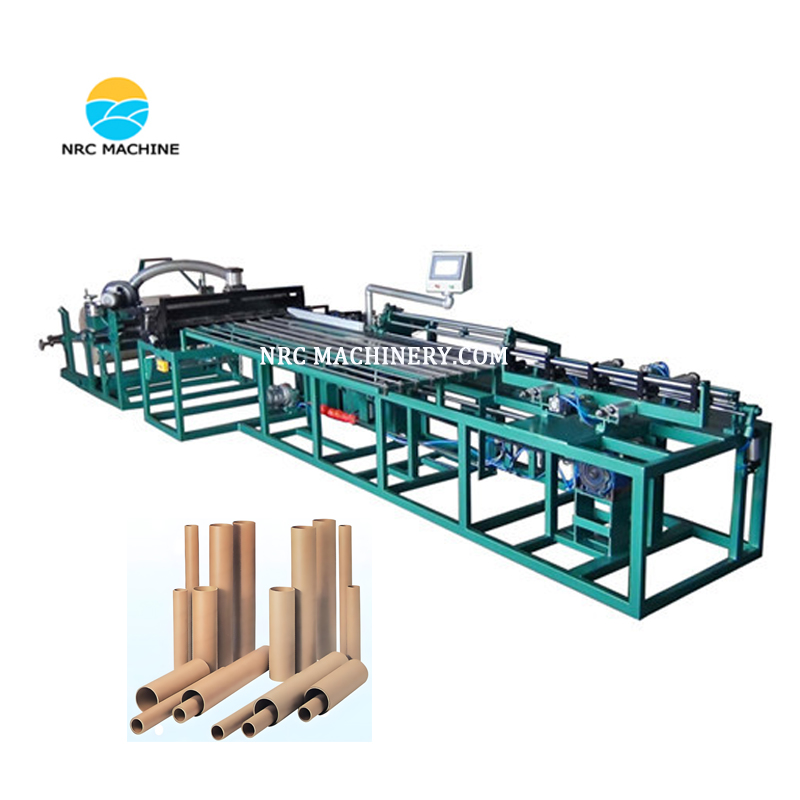
What is a Parallel Paper Tube Making Machine?
A Parallel Paper Tube Making Machine is an industrial machine designed to automatically produce parallel (straight-walled) paper tubes and cores from rolls of paper (kraft paper, duplex, specialty papers) and adhesive. Unlike conical tube machines
(which make tubes for fireworks or yarn cones), these machines produce tubes with a consistent diameter from one end to the other.
These tubes are essential as cores for materials like fabrics, films, foils, and papers, or as functional products in their own right, such as in
packaging for posters, documents, or consumer goods.
Key Components of the Machine
A typical parallel paper tube making machine consists of several integrated stations:
Unwinding Stand (Dispenser): Holds the large roll of paper (the "parent roll") and feeds it into the machine. It often has a braking
mechanism to maintain tension.
Paper Guide System: A series of rollers and guides that ensure the paper web moves smoothly and accurately into the forming section.
Gluing Unit: Applies a consistent, controlled layer of adhesive (usually PVA or dextrin-based) to the edge or the entire surface of the paper. This can be a wheel applicator, nozzle, or roller system.
Forming Section (The Heart of the Machine):
Mandrel (Spindle): A hardened, polished, cylindrical steel bar around which the paper is wound. The diameter of the mandrel determines
the inner diameter (ID) of the finished tube.
Forming Belts: A set of continuous belts that wrap around the paper on the mandrel, applying pressure to ensure tight, consistent
winding and proper bonding of the paper layers.
Cutting Mechanism: Cuts the continuously formed tube into specific lengths. This can be:
Rotary Cutter: A spinning blade that cuts the tube without stopping production, ideal for high speeds.
Saw Cutter: A reciprocating or circular saw that moves with the tube for a precise, burr-free cut.
Control System (PLC & HMI): A programmable logic controller and a human-machine interface (touchscreen) allow the operator to set all parameters: tube length, wall thickness, production speed, etc.
Discharge/Drying Conveyor: A conveyor system that carries the freshly cut tubes away. For some adhesives, this section may include a
drying tunnel to accelerate curing.
How It Works: The Step-by-Step Process
Feeding: The paper web is drawn from the unwinding stand and guided through the machine.
Gluing: The paper passes through the gluing unit, where adhesive is applied to its surface.
Winding: The glued paper is fed onto the rotating mandrel. The forming belts immediately wrap around it, applying pressure and initiating
the winding process. The paper spirals around the mandrel, but with a very small "pitch" (helix angle), creating what is essentially a parallel tube.
Curing & Forming: As the tube moves down the mandrel, the layers are pressed together, allowing the adhesive to bond them. The length of the mandrel provides the necessary dwell time for the initial bond to set.
Cutting: Once the tube reaches a pre-set length, the cutting mechanism (e.g., a rotary cutter) cleanly severs it.
Ejection: The finished tube is ejected onto the discharge conveyor for collection, packaging, and further processing (like printing or capping).
Common Applications of the Tubes Produced
Cores: For winding textiles, plastic films, adhesive tapes, labels, paper, and foil.
Packaging: For mailing posters, maps, blueprints, documents, and luxury goods (e.g., champagne tubes).
Industrial: As formers for concrete construction, components in electrical insulation, and protective casings.
Consumer Goods: As the body for firework casings, toy components, and packaging for snacks like Pringles.
Model | NRC16-76 |
input power | AC380±10% 50Hz |
Trolley servo motor | 220V 3KW 2000R/Min |
Pipe winding servo motor | 220V 3KW 2000R/Min |
Paper feeding motor | 1.5KW 4 polar. |
Paper edge grinding motor | 1.5KW 2 polar. |
Dust removal fan motor | 1.5KW |
Paper lifting motor x 2 | 1.1KW |
Total power | 13.5KW |
Input air pressure | >0.65MP |
gas flow rate | 2³m/h |
Processing length | 1700mm |


