

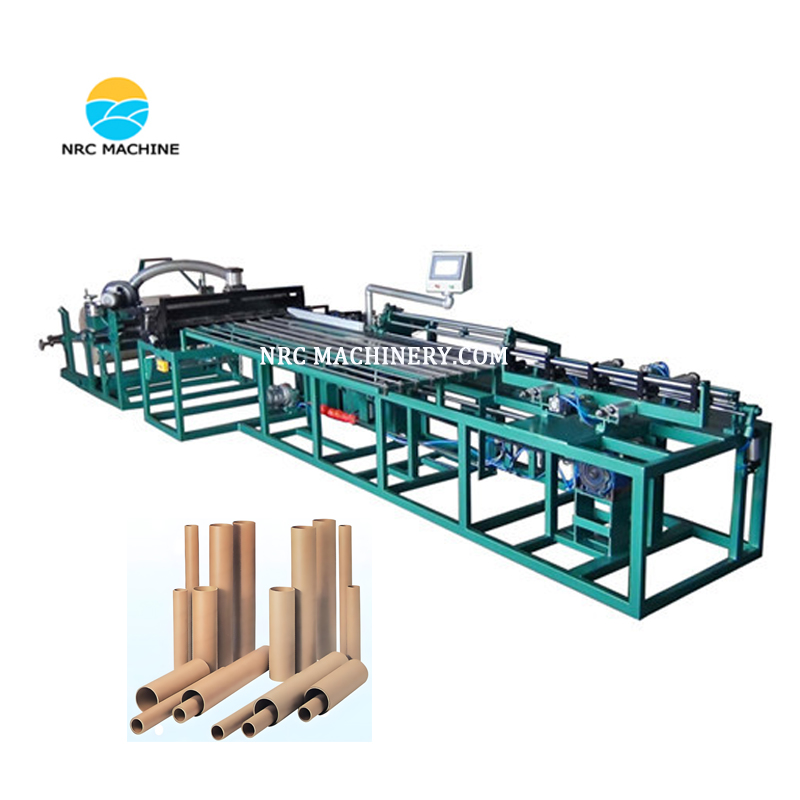


Parallel Paper Tube Rolling Machine Paper Core Forming Cutting Machine
1. How an Automatic Parallel (Straight Wall) Paper Tube Machine Works
Whether using spiral or parallel winding, the process for a straight-wall paper tube is highly automated, yet there is a fundamental difference in winding logic that determines the final tube quality.
1.1 Unwinding
Multiple rolls of paper, such as kraft paper, laminated paper and specialty coated paper, are mounted on the unwinding stand. Operators can feed several paper webs at the same time. The total number of paper layers directly defines the tube’s wall thickness and compression resistance. The unwinding system comes with tension control to keep paper feeding stable and avoid stretching, wrinkling or paper breakage.
1.2 Gluing
Each paper layer passes through a precision gluing system. It applies an even, controllable coat of adhesive on the paper surface. The glue dosage can be fine-tuned to prevent insufficient bonding or excessive glue overflow, saving raw material cost.
1.3 Winding
The glued paper is fed onto a rotating mandrel, a hardened steel rod whose outer size defines the finished tube’s inner diameter.
In a Spiral Machine, the paper strip is wound around the mandrel at an oblique angle. This creates tubes with slight taper, more suitable for low-cost ordinary packaging cores.
In a Parallel Winding Machine, the paper strips run straight and wrap onto the mandrel in parallel orientation. The finished tube maintains uniform diameter along the full length, without taper. This is the core feature of straight-wall high-precision paper tubes.
1.4 Heating & Drying:
After forming, the continuous tube enters a heating tunnel. Controlled hot air or infrared heat cures the adhesive rapidly. The tube gains stable structural strength immediately after drying, preventing deformation during storage and downstream winding operations.
1.5 Cutting:
A high-speed synchronized cutter, commonly a rotary saw, travels together with the moving tube. It cuts the endless continuous tube into preset lengths without halting production. Non-stop cutting guarantees high hourly output and smooth production flow.
1.6 Ejection
Once cut, finished tubes are automatically ejected and neatly stacked. Operators can collect the stacked tubes for inspection and packaging.
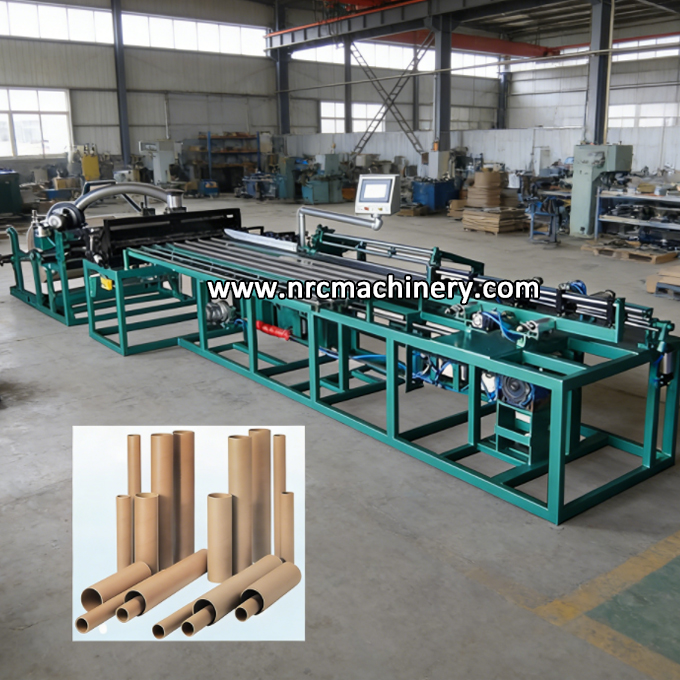
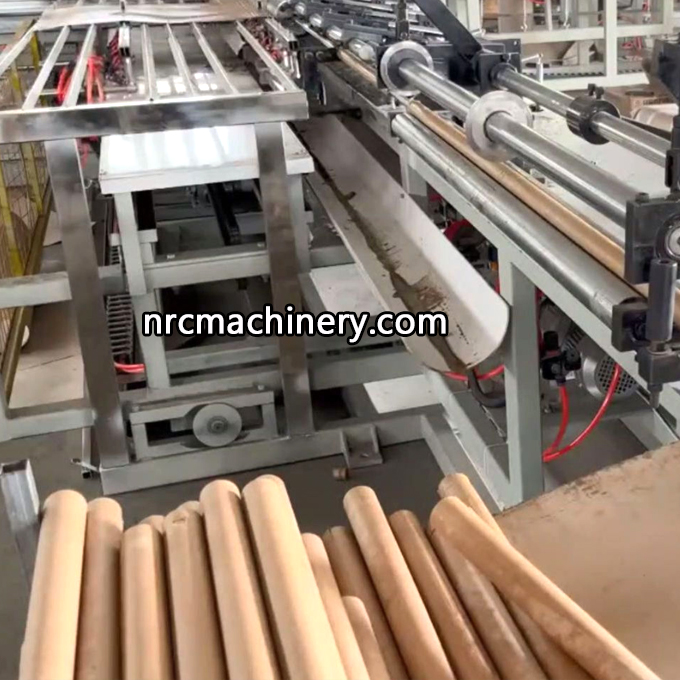

2. Key Advantages of an Automatic Parallel Straight Wall Paper Tube Machine
✅ High Speed & Output: It can produce hundreds to thousands of tubes per hour, supporting mass manufacturing orders.
✅ Consistent Quality: Every finished tube keeps identical diameter, length, wall thickness and compressive strength. Zero taper is critical for high-end film, foil and textile winding.
✅ Labor Efficiency: Minimal manual work. Operators only need to load jumbo paper rolls and take away stacked finished tubes. One worker can manage the whole machine.
✅ Material Efficiency: Precision control on paper tension and glue amount greatly reduces scrap, cutting down raw material waste.
✅ Flexibility: Quick changeover between different tube diameters and cutting lengths. Just replace mandrels and adjust parameters on the control panel for new specifications.
3.Application Scenarios
Plastic film, aluminum foil and adhesive tape winding cores
Textile and chemical fiber fabric & yarn rolls
Printing and large paper roll carrier cores
Electronics and new material precision protective tubes
High-grade cylindrical packaging containers
4.FAQs
Q1: What is the main difference between parallel winding and spiral winding?
A: Parallel winding feeds paper straight onto the mandrel to make straight tubes with constant diameter. Spiral winding uses angled paper feeding, and finished tubes usually have taper. Parallel tubes are for higher-precision industrial applications.
Q2: Does the machine stop during cutting?
A: No. It uses a synchronized travelling cutter. Cutting happens while the tube keeps moving, so production runs continuously to maintain high output.
Q3: Can I make different sizes of paper tubes on this machine?
A: Yes. You change mandrels to adjust inner diameter and set target length on the control system. Fast changeover supports mixed orders.
Q4: What paper materials work with this automatic parallel paper tube machine?
A: Kraft paper, laminated paper and various specialty coated paper. Adjust paper layer numbers to get different wall thickness and tube strength.
Q5: Is heating drying necessary?
A: The heating tunnel cures glue quickly to lock tube shape and hardness. Without proper drying, paper tubes may get soft and deformed in storage.
Model | NRC16-76 |
input power | AC380±10% 50Hz |
Trolley servo motor | 220V 3KW 2000R/Min |
Pipe winding servo motor | 220V 3KW 2000R/Min |
Paper feeding motor | 1.5KW 4 polar. |
Paper edge grinding motor | 1.5KW 2 polar. |
Dust removal fan motor | 1.5KW |
Paper lifting motor x 2 | 1.1KW |
Total power | 13.5KW |
Input air pressure | >0.65MP |
gas flow rate | 2³m/h |
Processing length | 1700mm |


